Bathroom safety guide: every change in one place
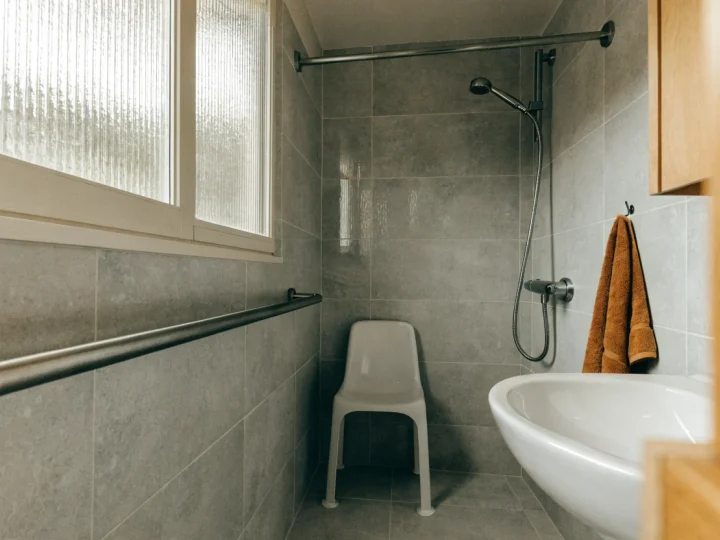
Every bathroom safety change in one place, from free habits and night lights to grab bars, seats, toilet aids and renovations, with a printable checklist.
This article is general information, not medical advice. For advice about your own situation, talk to a doctor, occupational therapist, physiotherapist or other qualified professional. In an emergency, call 911.
Quick answer
A safer bathroom is a set of small changes, not one big one. Several are free: leave a light on at night, keep the floor clear, test the water before you get in, and never lean on a towel rack or soap dish [2] [3]. Then come a non-slip surface in the tub, hot water at the tap no hotter than 49°C (120°F), a seat to wash from, help at the toilet and grab bars anchored to the wall [1] [3] [4]. This page walks through the room from the door to the drain and links to our detailed guide on each change.
Every change at a glance
The table runs from the cheapest changes to the biggest. The cost bands are rough. We don’t list prices, because they vary by product, store and region.
| Change | What it does | Cost band | Our guide |
|---|---|---|---|
| Clear the floor, secure the bath mat, test the water | Cuts trip and slip hazards and the risk of burns. The Public Health Agency of Canada asks whether you test the water before you get in, and whether bath mats beside the tub have a rubberized backing [3] | Free | Home safety checklist |
| Water heater and mixing valve set | Hot water at the tap no hotter than 49°C (120°F) [4] | Free to set; a plumber may charge to add a mixing valve | Home safety checklist |
| Night light | Lights the bathroom at night, or the path to it [2] [3] | Small purchase | Night lights and falls at night |
| Non-slip mat, strips or coating | A surface that grips in the tub or shower [1] [2] | Small purchase; coatings cost more | Non-slip options for tubs and showers |
| Handheld shower head | Lets you wash sitting down, with the spray where you want it [3] | Small purchase | Shower chairs |
| Raised toilet seat or safety frame | Makes the toilet taller, or adds arms to push up from [3] | Small to larger purchase | Raised toilet seat vs safety frame |
| Shower chair or stool | Takes the standing out of washing [3] | Larger purchase | Shower chairs |
| Tub transfer bench | Lets you sit and slide over the tub wall instead of stepping over it | Larger purchase | Tub transfer bench vs shower chair |
| Clamp-on tub rail or floor-to-ceiling pole | A hand-hold without drilling the wall | Small to larger purchase | Grab bars on fiberglass tubs and walls without studs |
| Grab bars | A fixed bar to hold while you step, sit and stand, anchored into the studs [1] [3] | Installed | Grab bar height and placement |
| Grab bars in a rental | Same bars. In Ontario, the standard lease says a tenant needs the landlord’s permission for changes other than decorative items [15] | Installed | Can tenants install grab bars? |
| Comfort-height toilet | A new, taller toilet that stays with the house | Installed | Raised toilet seat vs safety frame |
| Walk-in tub or walk-in shower | Replaces the tub so there’s no wall to climb over | Renovation | Walk-in tub cost in Canada |
Where to buy bathroom safety products
Pharmacies, home health stores, hardware stores and online stores sell all of these products in Canada and the US. The table lists one or two products for each part of the bathroom. All but the handheld shower head also appear in our detailed guides. The figures are the makers’ own, linked in the sources. We haven’t tested them.
| Option | Where it goes | Type | What the maker says | Sold in | Where to buy |
|---|---|---|---|---|---|
| GE Enbrighten UltraBrite Motion Activated LED Night Light 12201 [5] | Doorway and path | Plug-in motion-sensor night light | 40 lumens. Turns on in low light when it senses motion up to 25 ft away; off after 90 seconds. Keeps the second outlet free. UL listed | Canada and US | See it at Amazon: GE Enbrighten UltraBrite Motion Activated LED Night Light 12201 (opens in a new tab) |
| Gorilla Grip Bath Mat, 35 x 16 in [6] | Tub or shower floor | Suction-cup mat | Suction cups and drainage holes. Machine washable. For smooth, non-textured, non-tiled surfaces only; not for newly refinished tubs | Canada and US | See it at Amazon: Gorilla Grip Bath Mat, 35 x 16 in (opens in a new tab) |
| 3M Safety-Walk Tub and Shower Tape, clear, 2 in x 15 ft [7] | Tub or shower floor | Adhesive strips | A roll you cut to length. For showers and bathtubs. Not over grout | Canada and US | See it at Amazon: 3M Safety-Walk Tub and Shower Tape, clear, 2 in x 15 ft (opens in a new tab) |
| Carex E-Z Lock Raised Toilet Seat with Armrests FGB311C0 [8] | Toilet | Raised toilet seat with arms | Adds 5 in. Locks to the bowl. Padded armrests 17¼ in apart. Weight limit 300 lb | Canada and US | See it at Amazon: Carex E-Z Lock Raised Toilet Seat with Armrests FGB311C0 (opens in a new tab) |
| Drive Medical Toilet Safety Frame with Padded Arms RTL12000 [9] | Toilet | Toilet safety frame | Bolts under the toilet seat, with legs to the floor. Padded arms 19 or 23½ in apart; height adjusts in 1 in steps. Weight limit 300 lb | Canada and US | See it at Amazon: Drive Medical Toilet Safety Frame with Padded Arms RTL12000 (opens in a new tab) |
| Moen Home Care 24 in Concealed Screw Grab Bar 8724 [10] | Tub or shower wall and edge | Straight grab bar, 24 in | Stainless steel, 1.25 in diameter. Supports up to 500 lb. Complies with ADA specifications | Canada and US | See it at Amazon: Moen Home Care 24 in Concealed Screw Grab Bar 8724 (opens in a new tab) |
| Drive Medical Clamp-On Tub Rail 12036 [11] | Tub or shower wall and edge | Clamp-on tub rail | Clamps onto tub walls 3 to 7 in wide; no tools. Weight limit 300 lb. Tighten carefully on fiberglass tubs | Canada and US | See it at Amazon: Drive Medical Clamp-On Tub Rail 12036 (opens in a new tab) |
| Moen Home Care Shower Seat DN7025 [12] | Washing | Shower seat, no back | Seat 20 by 15 in; height 14 to 21 in. Non-slip seat surface. Supports up to 250 lb | Canada and US | See it at Amazon: Moen Home Care Shower Seat DN7025 (opens in a new tab) |
| Eagle Health Sliding Transfer Bench 77662 [13] | Washing | Sliding tub transfer bench | Seat slides across and swivels, locking every quarter turn. Seat height 18¾ to 23 in. Seat belt. Weight limit 400 lb | Canada and US | See it at Amazon: Eagle Health Sliding Transfer Bench 77662 (opens in a new tab) |
| Moen Engage Magnetix Handheld Shower 26100EP [14] | Washing | Handheld shower head | 60 in hose. Six spray settings. Flow of up to 1.75 gallons (6.65 L) a minute. Magnetic dock | Canada and US | See it at Amazon: Moen Engage Magnetix Handheld Shower 26100EP (opens in a new tab) |
Weight limits assume the product is set up and used as the maker instructs. Grab bars also depend on the wall and anchors behind them.
More options at Amazon: shower chairs (opens in a new tab), tub transfer benches (opens in a new tab), raised toilet seats (opens in a new tab), handheld shower heads (opens in a new tab), non-slip bath mats (opens in a new tab) and motion-sensor night lights (opens in a new tab). For grab bars, our grab bar guide lists bars by length, with the makers’ load ratings.
Why the bathroom
Most of the injuries in that CDC study, 81%, were falls [1]. The share that happened while getting on, off or using the toilet rose with age, from about 19% at ages 65 to 74 to about 37% at 85 and older [1]. The study’s authors suggest non-slip strips in the tub or shower, grab bars inside and outside it, and a grab bar next to the toilet [1]. They say knowing which activities are risky, combined with these simple changes, “could benefit all household residents” [1]. They also say more research is needed to know how well grab bars and other changes prevent bathroom injuries [1].
A walk through the bathroom
Start at the door and work toward the drain. Each stop has a free change, a product, and a link to the guide that goes deeper.
The doorway and the light
Light is the first change, and it can be free. The National Institute on Aging says to leave a light on in the bathroom at night or use a night light that turns on by itself in the dark [2]. It also suggests motion-activated lights that plug into outlets along the way [2]. The Public Health Agency of Canada’s home safety guide asks, “Do you have a night light in the bathroom?” [3]
A plug-in light like the GE Enbrighten 12201 (opens in a new tab) comes on when it senses movement and turns off after 90 seconds [5]. Our guide to night lights and falls at night compares the types and has a checklist for the whole route from the bed.
The floor
Two floors matter: the bathroom floor and the floor of the tub or shower. For the first, the Public Health Agency of Canada says bath mats beside the tub should have a rubberized or non-skid backing [3]. For the second, the National Institute on Aging says to put “nonskid mats, strips, or carpet on all surfaces that may get wet” [2].
Which product suits depends on the tub’s surface. A suction-cup mat like the Gorilla Grip 35 x 16 in mat (opens in a new tab) needs a smooth, non-textured surface [6]. Adhesive strips like 3M’s clear tub and shower tape (opens in a new tab) go on smooth surfaces too, and 3M says not to apply them over grout [7]. There are also anti-slip liquids applied to the tub itself [3]. Our guide to non-slip mats, strips and coatings explains which one fits which tub.
One more free change: the Public Health Agency of Canada warns that some tile and bath cleaning products make surfaces more slippery [3].
The toilet
With age, more bathroom injuries happen at the toilet [1]. The Public Health Agency of Canada’s guide says raised toilet seats “can make getting on and off the toilet easier,” and describes seats that raise the toilet by 10 to 15 cm (about 4 to 6 in) [3]. It asks whether, if you have trouble getting on and off the toilet, you have a raised seat and a well-anchored grab bar [3].
A raised seat like the Carex E-Z Lock seat (opens in a new tab) adds 5 in, locks to the bowl and has padded armrests [8]. A frame like the Drive Medical RTL12000 (opens in a new tab) gives you padded arms to hold as you sit and stand, with legs down to the floor [9]. A comfort-height toilet is the renovation version: a taller toilet that stays with the house. Our guide to raised toilet seats, safety frames and comfort-height toilets compares all three, with what to measure.
Getting in and out of the tub or shower
Getting out is one of the riskiest moments. The CDC found that the most hazardous activities were bathing, showering, or getting out of the tub or shower, and that about half of bathroom injuries were “precipitated by bathing or showering, slipping, or getting out of the tub or shower” [1]. The National Institute on Aging says to mount grab bars near the toilet and on both the inside and the outside of the tub and shower [2].
A grab bar is the fixed hand-hold. The Public Health Agency of Canada says grab bars “must be anchored firmly into the studs in the wall,” and adds, “Towel racks or soap dishes should never be used for support!” [3] A straight bar like the Moen Home Care 8724 (opens in a new tab) is 24 in long and rated for 500 lb [10]. Our grab bar height and placement guide shows where the Canadian and US rules put bars beside the toilet and in the tub, with measured drawings.
Two situations need their own guide:
- A fiberglass or acrylic tub-shower. Alaska’s Department of Health notes that a fiberglass surround has an air gap behind it, and warns against mounting grab bars over it, because bars must be secured firmly to studs [16]. Our guide to grab bars on fiberglass tubs and walls without studs covers kits, anchors and backing. It also covers options that skip the wall, like the Drive Medical clamp-on tub rail (opens in a new tab), which clamps onto tub walls 3 to 7 in wide and is rated for 300 lb [11].
- A rental. Ontario’s guide to the standard lease says a tenant can put up decorative items, such as pictures, but needs the landlord’s permission for other changes to the unit [15]. Our guide to grab bars for tenants explains the rules, who pays, and how to ask.
If lifting a leg over the tub wall is the hard part, a tub transfer bench changes the move. You sit on the end outside the tub and slide across. Our guide to tub transfer benches and shower chairs explains the difference and how to measure for one. Some benches have a seat that moves. On the Eagle Health sliding bench (opens in a new tab), the seat slides along the bench and swivels, and the maker rates it for 400 lb [13].
The renovation answer is a walk-in tub or a walk-in shower, so there is no wall to climb over. Our guide to walk-in tub costs in Canada lists prices from a maker’s Canadian site and the tax credits that may apply.
Washing
The Public Health Agency of Canada’s guide puts it simply: “Bath seats allow you to take a shower sitting down. If you have trouble standing, or if you find it difficult to lower yourself into the tub, a bath seat will help you” [3]. A seat with no back, like the Moen Home Care DN7025 (opens in a new tab), adjusts from 14 to 21 in high and supports up to 250 lb [12]. If standing up is the hard part, a chair with a back to lean on and arms to push up from may suit better. Our shower chairs guide covers stools, chairs with backs and arms, heavy-duty chairs and fold-down seats, and how to measure the tub.
The same guide says hand-held shower heads “can make showering easier, especially if you’re using a bath seat,” and calls them inexpensive, widely available and relatively easy to install [3]. A handheld like the Moen Engage Magnetix (opens in a new tab) has a 60 in hose and a magnetic dock [14]. The guide also notes that if you replace the taps, lever-type faucet handles are easier to use [3].
Water temperature
Sitting to wash means more time under the spray, so the temperature matters. The Public Health Agency of Canada says to set the water heater to 60°C (140°F) to prevent the growth of bacteria such as Legionella, and to prevent scalding by installing mixing valves on faucets, showers and tubs, set to 49°C (120°F) [4]. Its home safety checklist asks whether you test the water temperature before you get into the tub or shower [3]. A plumber can check the temperature at the tap and add a mixing valve.
The door lock and calling for help
Two things are easy to forget. First, the lock: the Public Health Agency of Canada says, “Door locks in bathrooms must have an emergency release,” and that locks and latches should have large, easy-to-use knobs or levers [3]. Second, a way to call for help. The National Institute on Aging suggests an emergency response system, where you push a button on a necklace or bracelet, or carrying a well-charged cordless or mobile phone with you around the house [2]. Our guide to medical alert systems in Canada explains how they work and features to compare.
Bathroom walkthrough checklist
From simpleaging.com. This checklist is general information, not medical advice.
Walk through the bathroom with this list, starting at the door. Most items come from the CDC, the National Institute on Aging and the Public Health Agency of Canada [1] [2] [3] [4].
The doorway and the light
- A night light, or a light left on, lights the bathroom at night [2] [3].
- The path from the bed to the bathroom is lit and clear [2] [3].
The floor
- The bathroom floor is clear, and the bath mat beside the tub has a non-skid backing or is secured [3].
- There’s a non-slip mat, strips or coating on the floor of the tub or shower [1] [2] [3].
- Nobody uses a bath or tile cleaner that leaves the surface slippery [3].
The toilet
- Getting on and off the toilet is easy. If it isn’t, there’s a raised seat, a safety frame or a taller toilet, and a well-anchored grab bar [1] [3].
The tub or shower
- There are grab bars inside and outside the tub or shower, anchored into the studs or into anchors rated for the wall [1] [2] [3].
- Nobody uses the towel rack or the soap dish for support [3].
- If stepping over the tub wall is hard, there’s a transfer bench or a plan for a walk-in shower or tub.
- If standing to wash is hard, there’s a shower chair or stool, and a handheld shower head [3].
The water
- Water at the tap is no hotter than 49°C (120°F) [3] [4].
- The person tests the water before getting in [3].
The door and help
Costs and funding for bathroom changes
The free changes come first. Night lights, mats and strips are small purchases. Seats, benches, toilet aids and grab bars cost more, and grab bars may also need someone to install them. A walk-in tub or shower is a renovation. We don’t list prices because they vary by product, store and region.
Some of the bigger changes may qualify for help:
- Canada. Our guide to the Home Accessibility Tax Credit explains which renovations qualify, and our tax credit calculator estimates what a project may be worth. Our guide to the medical expense tax credit covers bathroom aids with a prescription. Our medical expense tax credit calculator estimates that credit for 2025 or 2026. See Funding in Canada for provincial programs.
- United States. Our guide to US funding for home safety explains what Medicare, Medicaid, the VA, USDA and tax rules may cover. If you itemize, the IRS lets you deduct medical costs above 7.5% of your adjusted gross income. Grab bars and other bathroom changes made for a disability can count as medical costs [17]. Our IRS medical expense deduction calculator estimates what you might deduct and whether it would lower your tax. See Funding in the US for the rest.
Each detailed guide linked above has its own costs and funding section for that product.
Questions to ask
An occupational therapist, physiotherapist or doctor
- Which of these changes would make the biggest difference for me, or for my parent, and in what order?
- Can you watch how the person gets into the tub and on and off the toilet, and say what would help?
- Is a shower chair enough, or is a transfer bench or a walk-in shower a better fit?
- Where should the grab bars go, and how high, for this person?
- Is there a home visit program, or a funding program that needs an assessment?
A supplier, installer or plumber
- What is the maker’s weight limit, and will it fit our tub, toilet or wall?
- What is behind the wall where the grab bars would go, and what anchors will you use?
- Can you check the water temperature at the tap and add a mixing valve?
- What does the warranty cover, and can I return a product that doesn’t fit?
Safety notes and when to talk to a professional
Grab bars must be anchored. The Public Health Agency of Canada says grab bars must be anchored firmly into the studs in the wall [3]. Alaska’s Department of Health adds that a bar is only as strong as its anchors and the wall it’s mounted on [16]. Our fiberglass walls guide explains the options when there’s no stud where you need one.
Avoid suction-cup bars. Alaska’s Department of Health says suction grab bars “release randomly creating a fall danger to the user” [16]. That’s why none are linked on this site.
Fit comes first. A chair, bench or raised seat that rocks or slides is a hazard. Measure the tub or toilet first, follow the maker’s instructions, and test the product dry before the first use. Our guides to shower chairs, transfer benches and raised toilet seats each have a measuring checklist.
Hot water. The Public Health Agency of Canada says mixing valves should be set so hot water comes out at no more than 49°C (120°F) [4].
Chemicals. Anti-slip coatings and etching treatments are chemicals. Read the maker’s safety data sheet, and ask someone else to apply them if that would be hard for you. Our non-slip guide has the details.
When to talk to a professional. If someone has fallen, feels unsteady or worries about falling, talk to a doctor. A doctor can look for causes and may suggest seeing a physiotherapist or occupational therapist. The National Institute on Aging notes that, after a fall, a doctor might suggest that an occupational therapist, physical therapist or nurse visit the home to assess its safety and advise on changes [2]. Our guide to preparing a home before a parent comes home from hospital covers the first weeks home.