This article is general information, not medical advice. For advice about your own situation, talk to a doctor, occupational therapist, physiotherapist or other qualified professional. In an emergency, call 911.
Quick answer
American Standard’s Canadian website lists its walk-in tubs from C$6,648 to C$12,601 [1][9]. Installation adds to that: Safe Step’s Canadian price guide puts it at $8,000 to $12,000 on average [10]. The price depends on the tub’s size and features, such as water or air jets, and on the work needed to put it in [10]. Finance Canada names walk-in bathtubs as an example of an expense for the Home Accessibility Tax Credit, which is worth up to C$2,800 for 2026 [15][16]. Some provinces have their own credits or grants.
Walk-in tub prices at a glance
The tub
Installation
American Standard, list prices on its Canadian site
C$6,648 to C$12,601, depending on size, series and jets [1][9]
Safe Step’s guide doesn’t name a currency, and its US site gives the same price ranges for the tub [10][11]. Prices change, so ask for written quotes that list each cost.
Where to buy a walk-in tub in Canada
Some companies, such as Safe Step, sell their own tubs and install them, after a free in-home assessment [10]. Others, such as American Standard, list their tubs with prices on their websites, along with a “Where to buy” page [1]. The table lists four walk-in tubs from American Standard’s Canadian site, with figures from its product pages and spec sheets. We haven’t tested them.
Walk-in tubs on American Standard's Canadian site, by list price Sorted by list price, lowest to highest. This order is not a ranking.
Option
List price
Type
Water and weight, full
Sold in
Where to buy
American Standard Value Series 32 x 52 in, C3252OD.709 [1][2]
List prices and specs are the maker's. A list price covers the tub and the parts its page lists, such as the faucet and handheld shower. Installation adds to the cost.
The tub. Safe Step says the price of the tub depends on the door design, the size and the hydrotherapy features. It puts basic tubs at $3,000 to $6,000. Premium tubs, with features such as hydrotherapy jets and heated backrests, are $8,000 to $12,000, and premium tubs with a shower are $10,000 to $15,000 [10]. On American Standard’s Canadian site, a Value Series soaking tub lists at C$6,648. A Premium Series soaking tub lists at C$8,303, and a Premium Series tub with water jets and a heater at C$9,954 [1][3][5].
Installation. Safe Step lists the bathroom’s layout, plumbing and electrical work, structural support, removing the old tub or shower, and code requirements. Installers may update the plumbing and wiring for jets, lights and heated seats, and reinforce the floor. The width of your doorways and the way in for the new tub matter too [10].
Fitting the space. American Standard says its 32 x 52 in tub comes with an extender kit, so it fits the space of a standard 60 in bathtub [2].
Hot water. The tubs in the table hold 45 to 80 gallons (170 to 303 L) [2][4][6][8]. American Standard says the heater on its jetted tubs keeps the water warm while the jets run, but won’t heat cold water to bathing temperature [2]. Ask whether your water heater can fill the tub with warm water.
The floor. Full of water, the tubs in the table weigh 528 to 828 lb (238 to 376 kg). American Standard says to reinforce the subfloor under all the tub’s supports [2][8].
Walk-in tubs and other options at a glance
Walk-in tub
Walk-in shower
Tub transfer bench
What it looks like
How you get in
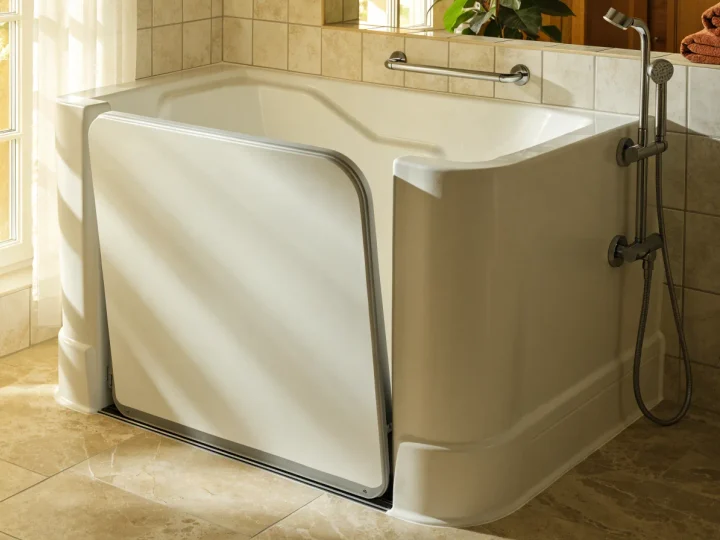
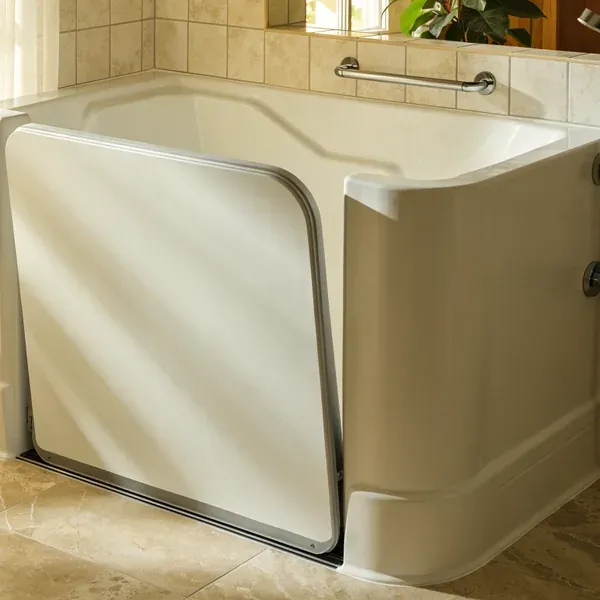
Step through a door with a low threshold, then sit on a built-in seat [2]
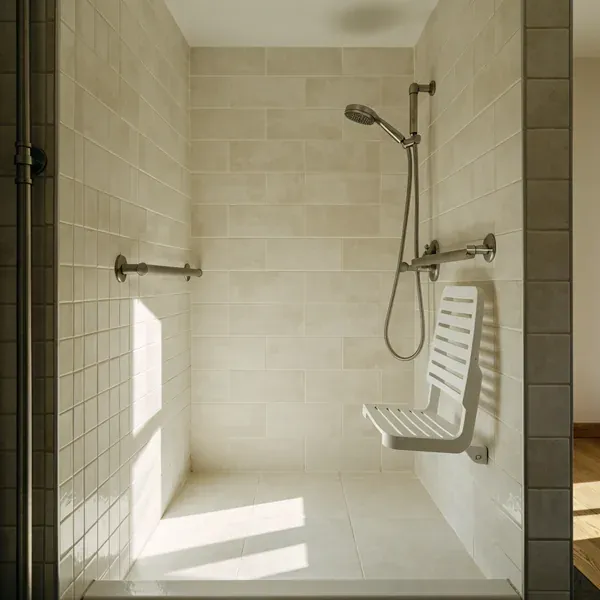
Step in over a low threshold, or roll in on a wheel-in model
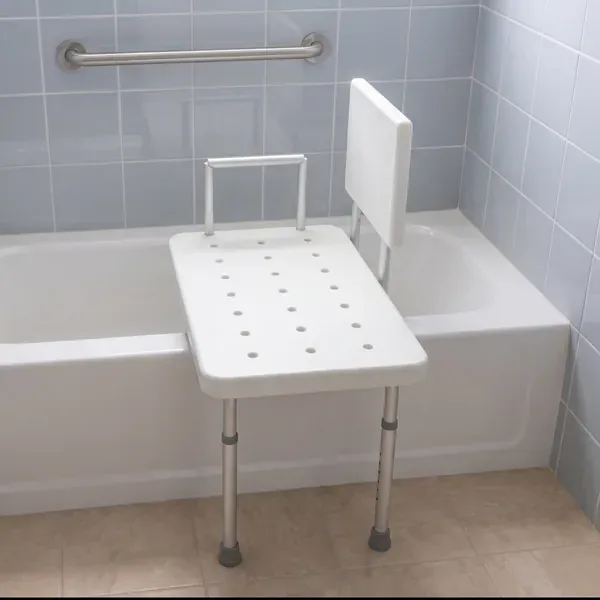
Sit on the bench outside the tub, then slide across and lift your legs over the side
Bathing
Sit in deep water. You close the door before filling and don’t open it until the tub has drained [12]
A shower, standing or on a seat
A shower sitting down, often with a handheld shower
BC’s maximum rebate
C$1,750 to convert a tub to a walk-in tub or a tub cutout [21]
C$9,100 to convert a tub to a walk-in or wheel-in shower [21]
Tax credits don’t lower the price you pay the seller. You get them later, when your tax return is assessed. Grants and loans are different: several programs below don’t pay for work done before they approve it.
If you use more than one source of help, ask each how the others affect it. For example, the CRA says government grants don’t reduce the Home Accessibility Tax Credit [14].
Federal
Home Accessibility Tax Credit
This federal credit is for someone 65 or older, or eligible for the disability tax credit, or a family member who claims for them. It covers lasting renovations that become part of the home and help the person get in, move around or function there, or lower their risk of harm. The home must be owned by the person or the family member who claims, and lived in by them. You can claim up to C$20,000 a year [14]. Finance Canada names walk-in bathtubs as an example of an eligible expense [15].
The credit is 14% for 2026, so up to C$2,800 [16]. Some price guides still show 15% and up to C$3,000, the rate from before 2025 [10][16].
For 2025, the CRA says an expense can be claimed both as a medical expense and for this credit [14]. A new law changes that from 2026: an expense you claim as a medical expense can’t also count for this credit [17][18]. Our tax credit calculator estimates what a project may be worth, and our Home Accessibility Tax Credit guide explains who qualifies.
Medical expense tax credit
The CRA lets you claim renovation expenses that give a person with a severe and prolonged mobility impairment access to their home, or greater mobility or functioning within it. The costs must be reasonable. They also must not normally be expected to raise the home’s value, and must be costs that people without such an impairment wouldn’t normally have [19]. A hot tub installed at home isn’t eligible, even if a medical practitioner prescribes it [19]. Ask the CRA whether a walk-in tub qualifies in your case.
For 2025, you can claim the part of your medical expenses above C$2,834 or 3% of your net income, whichever is less. Bathroom aids that help a person get in or out of a bathtub or shower are also listed, with a prescription [19]. Our medical expense tax credit guide has the 2026 figures and compares the two credits. Our medical expense tax credit calculator estimates the amount you can claim and the federal credit for 2025 or 2026.
Veterans Affairs Canada: Veterans Independence Program
The program can contribute to changes to a veteran’s home. Its policy lists safety changes such as grab bars, and a bath spigot or thermostatic mixing valve to prevent scalding [37]. Its 2026 rate table lists C$7,883.78 for home adaptations to a principal residence [38]. Veterans Affairs must approve the work first, normally based on two detailed cost estimates [37]. It’s for veterans who need help at home and qualify through a disability benefit, the War Veterans Allowance or certain other VAC programs [39].
Provincial
Listed from west to east. Each program has its own rules about who qualifies.
British Columbia: home renovation tax credit for seniors and persons with disabilities
BC’s credit lists “Bathtubs – walk-in” among eligible renovations. It’s 10% of up to C$10,000 of expenses a year, so up to C$1,000, and it’s refundable. It’s for BC residents who are 65 or older or have a disability, and family members who live with them [20].
British Columbia: BC Rebate for Accessible Home Adaptations
BC Housing’s rebate program, BC RAHA, lists up to C$1,750 to convert a tub to a walk-in tub or a tub cutout, and up to C$9,100 to convert a tub to a walk-in or wheel-in shower. It doesn’t fund soaker or jetted tubs for pain relief. The lifetime limit is C$20,000 per household [21]. Homeowners need household income below C$146,270 and assets below C$100,000, not counting the home. Work done before approval isn’t eligible, except some emergency changes needed to leave hospital [22].
Alberta: Residential Access Modification Program (RAMP)
RAMP gives grants of up to C$12,000 each benefit year and up to C$24,000 within 10 years. It’s for low-income Albertans who use a wheelchair, or who are 65 or older and use a four-wheeled walker on an ongoing basis. People with certain progressive conditions, such as Parkinson’s disease or ALS, may also qualify. The income limit is C$36,900 for a single adult and C$46,500 for a couple without children [23]. Its guidelines cover bathtub cut-out inserts up to C$1,000. They also cover replacing the tub and fixtures when that costs less than a lift and other tub changes would [24].
Saskatchewan: Adaptation for Independence
This program offers a forgivable loan of up to C$23,000 to make a home accessible for a household member with a disability. Household income limits run from C$58,100 (one bedroom) to C$103,500 (four or more bedrooms), and assets must be C$300,000 or less. A qualified health practitioner must identify the changes, and work done before written approval doesn’t qualify [25]. The program’s policy manual lists installing a walk-in shower or walk-in bathtub among eligible changes [26].
Manitoba: Safe and Healthy Home for Seniors
This program gives up to C$5,000 (C$6,500 in rural and remote areas) for basic home adaptations. It’s for seniors 65 and older, and family members who have seniors living with them, with a combined household income of C$60,000 or less. March of Dimes Canada runs it [27]. Ask whether a walk-in tub qualifies.
Ontario: Home and Vehicle Modification Program
This program lists rearranging bathrooms to permit safe use among eligible home changes, and you apply through March of Dimes Canada [28]. It pays up to C$15,000 for home changes over a lifetime [29]. It’s for Ontario residents, including seniors, with a disability that restricts mobility, within an income limit. You must use other public or private funding first, and households with income over C$38,000 may have to pay part of the cost [28].
Quebec: Programme d'adaptation de domicile (PAD)
The Société d’habitation du Québec’s program helps people with a disability adapt their home, including safe access to the bathroom. The money goes to the owner of the home. Option 1 includes an occupational therapist’s assessment and pays up to C$50,000 for the first eligible person in a household [30]. Option 2 pays up to C$12,000 for indoor work chosen from a set list. The list includes a curbless shower and grab bars, but not a walk-in tub [31].
Quebec: independent living tax credit for seniors
Revenu Québec’s refundable credit is for Quebec residents 70 or older. It’s 20% of what you pay to buy, lease or install eligible equipment, after the first C$250. The list includes “a walk-in bathtub or shower.” You can’t also use the same expense for another credit, such as the medical expense credit [32].
New Brunswick: Seniors' Home Renovation Tax Credit
New Brunswick’s credit lists “walk-in bathtubs” among eligible expenses. It’s 10% of up to C$10,000 a year, so up to C$1,000, and it’s refundable. It’s for residents 65 or older and family members who live with them [33].
New Brunswick: Homeowner Repair Program
New Brunswick offers forgivable loans to low-income homeowners. They go up to C$15,000 for accessibility changes for someone with a disability, and up to C$7,000 for changes that help seniors who have trouble with daily activities at home [34]. Ask whether a walk-in tub qualifies.
Nova Scotia: Housing Repair and Accessibility Program
This program lists accessible bathrooms among the changes it can help with. Its accessible housing stream can fund up to C$18,000: a C$10,000 grant and an C$8,000 forgivable loan. A repayable loan of up to C$20,000 may be added for larger projects. It’s for low- and moderate-income homeowners who have owned and lived in the home for at least a year, with investment assets of C$25,000 or less. The home must be worth no more than C$360,000 in Halifax Regional Municipality and East Hants, or C$280,000 elsewhere. Work done before approval isn’t eligible [35].
Newfoundland and Labrador: Home Modification Program
This program offers a forgivable loan of up to C$15,000 for accessibility changes, for homeowners with income of C$51,500 or less (C$65,000 in Labrador). The loan doesn’t have to be repaid if you stay in the home for five years. Major work, such as changes to a bathroom, needs a letter from an occupational therapist [36].
Other provinces and territories may have programs too. See Funding in Canada.
Questions to ask
The seller or installer
What does the price include: the tub, removing the old one, plumbing, electrical work, floor reinforcement, permits and cleanup?
How long does the tub take to fill, and to drain?
Can my water heater fill it with warm water? Does my floor need reinforcing?
Will the tub fit through my doorways?
What is the warranty on the door seal, the shell and the other parts? American Standard’s pages list each one [1].
Can I have a written quote that lists each cost?
An occupational therapist or physiotherapist
Can the person step over the threshold, sit on the seat and stand up again safely?
Would a walk-in shower, a transfer bench or grab bars work as well?
Can you write the assessment or letter that a program needs?
The CRA or a program
Does a walk-in tub count for this credit or program in my case?
Do I need approval before the work starts?
Can I use more than one program for the same cost?
Safety notes and when to talk to a professional
You wait inside while it fills and drains. Ella’s instructions say to close the door once you’re in, while still standing, and not to open it until the tub is completely drained [12]. American Standard says its Quick Drain pumps the water out fast, so the door can be opened safely [2]. Ask how long filling and draining take, and plan to keep warm.
Prevent scalds. The Public Health Agency of Canada advises setting the water heater to 60°C to stop bacteria growing, and installing mixing valves on taps, showers and tubs, set to 49°C, to prevent scalding [13].
Get in and out safely. The American Standard tubs in the table have a built-in grab bar and a 17 in (432 mm) chair-height seat [1][3][5][7]. See What adds to the price for the floor and the water heater.
When to talk to a professional. If someone has fallen, feels unsteady or worries about falling, talk to a doctor. An occupational therapist can check whether a walk-in tub suits the person, or whether a shower or a bench would work better. Several programs above ask for an assessment from an occupational therapist or another health professional [25][30][36].