Stair lift cost in the US (2026) and who may help pay
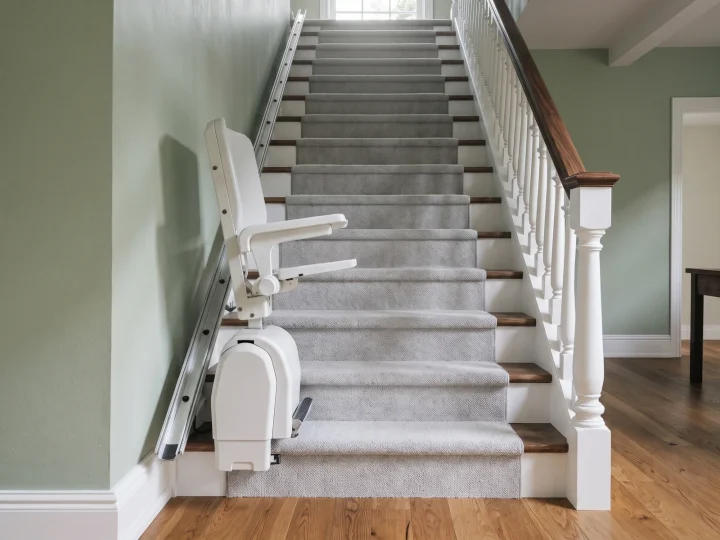
What stair lifts cost in the US from makers' own prices, what changes the price, and what Medicare, Medicaid, the VA, USDA and the IRS may cover.
This article is general information, not medical advice. For advice about your own situation, talk to a doctor, occupational therapist, physiotherapist or other qualified professional. In an emergency, call 911.
Quick answer
Stair lift makers publish US prices. Stannah’s start at $4,700 for a straight lift, $6,300 for an outdoor lift and $10,800 for a curved one, with installation included [1]. Bruno says base straight lifts usually start around $4,000, and curved lifts with a turn around $13,000 [2]. Savaria’s guide puts straight lifts at $3,300 to $5,000 and curved ones at $10,000 to $25,000 [3]. Original Medicare doesn’t pay: its equipment list denies stairway elevators [4]. Help may come from a state Medicaid waiver, the VA, a USDA rural repair grant, your Area Agency on Aging or the IRS medical expense deduction. Ask a program before you buy.
Can you get a stair lift for free?
There’s no national program that gives a stair lift to everyone who needs one, and Original Medicare doesn’t cover them [4]. Some people get help from programs with their own rules:
- a state Medicaid waiver, if your state’s waiver covers stair lifts
- the VA, for veterans
- USDA grants, for low-income rural homeowners 62 or older
- local funds through an Area Agency on Aging
The funding sections below say who qualifies and what to ask.
Stair lift prices in the US at a glance
All prices on this page are in US dollars.
| Straight stair lift | Curved stair lift | Outdoor stair lift | |
|---|---|---|---|
| What it looks like | 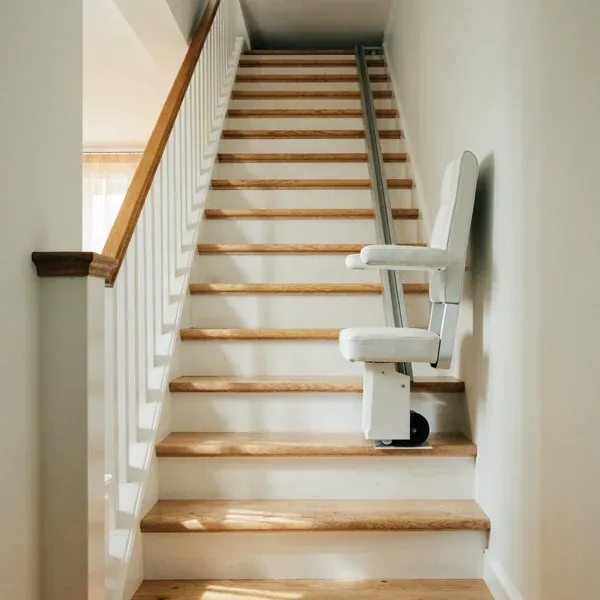 |
 |
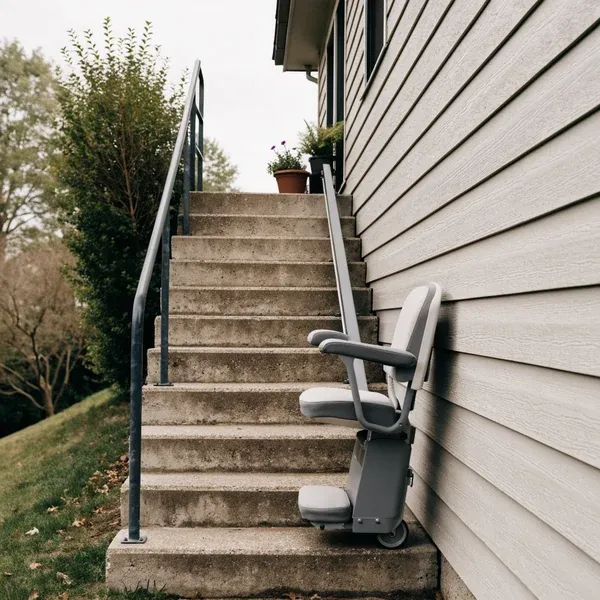 |
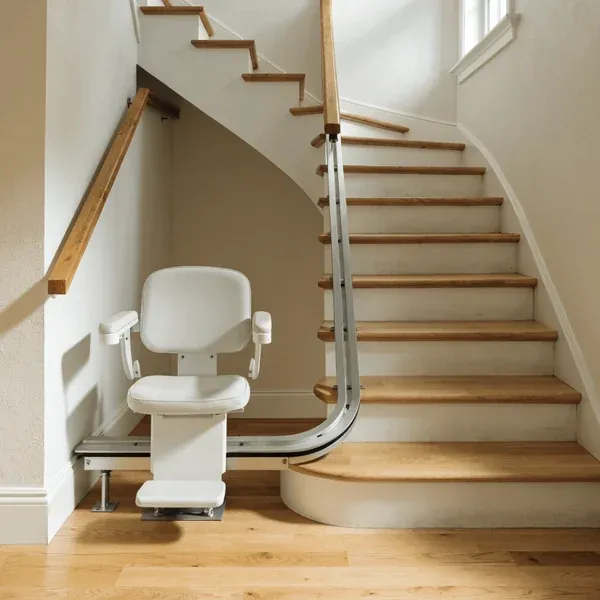
| Fits | One straight flight with no turns or landings | Stairs with turns, landings or a spiral [1] | Steps outside the house |
| Stannah’s starting price | From $4,700 | From $10,800 | From $6,300 [1] |
| Bruno’s price guide | Base models from about $4,000; premium models from about $6,000 | From about $13,000 with a turn; from $10,000 for the simplest [2] | Not listed |
| Savaria’s price guide | $3,300 to $5,000 | $10,000 to $25,000 [3] | Not listed |
| Makers’ weight limits in our tables | 280 to 600 lb | 265 to 400 lb | 250 to 400 lb |
Stannah says its quote includes installation, the warranty and the options you agree on, and that its prices are subject to change [1]. Bruno says power options, custom work and installation add to the cost, and that some states require a permit [2]. Savaria says its figures are average prices, and that they vary with where you live, labor costs, inspections and upgrades [3]. Compare written quotes from more than one seller.
Where to buy a stair lift in the US
Stair lifts are sold with installation. A seller visits to measure your stairs, then gives you a quote [1] [13] [2]. Stannah sells directly and through distributors [1]. Acorn makes, installs and services its own lifts [13]. Bruno, Harmar and Savaria sell through local dealers [2] [23] [19].
The tables list current models whose makers publish the weight limit on their US pages. The figures are the makers’. We haven’t tested these lifts, and the makers don’t publish a price for each model.
| Option | Maker's weight limit | Maker's warranty | Details | Sold in | Where to buy |
|---|---|---|---|---|---|
| Acorn 130 [10] [9] [12] | 280 lb; 350 lb on the HD version | Lifetime on the motor and gearbox for the first owner, with a yearly Acorn service | Battery backup, seat belt, folding footrest, remote control and a diagnostic display. Fixes to the stairs, not the wall. A hinged rail for the foot of the stairs is an option. Sold directly by Acorn | Canada and US | See it at Acorn Stairlifts: Acorn 130 (opens in a new tab) |
| Bruno Elan [14] | 300 lb | Limited lifetime | Made in the US. Seat turns 90°. Obstruction sensors. Wireless remotes. Options include a folding rail, power swivel and power footrest | Canada and US | See it at Bruno: Bruno Elan (opens in a new tab) |
| Stannah Siena [8] [1] [7] | 350 lb on straight stairs | Lifetime on the motor gearbox, 2 years on parts and 1 year on labor, if bought directly from Stannah | Powered footrest, extra-wide seat and longer armrests. Remote control, footrest sensors, seat belt, battery power and key lock come standard. Needs stairs at least 28 to 30 in wide | Canada and US | See it at Stannah: Stannah Siena (opens in a new tab) |
| Savaria K2 Plus [17] | 400 lb with the Plus seat; 350 lb with the L seat | 36 months on parts, through your dealer | Seat swivels and locks at the top. Sensors on the footrest and carriage. Battery charges along the rail. A flip-up rail for a doorway is an option, but it lowers the limit to 300 lb | Canada and US | See it at Savaria: Savaria K2 Plus (opens in a new tab) |
| Harmar Pinnacle SL600HD [20] [23] | 600 lb | 3 years on parts, 10 years on the gear rack and 1 year on the battery; labor not covered | Wider seat and larger backrest. Seat swivels 85° at the top. Sensors in the footrest and chassis, and a retractable seat belt. Up to 40 ft of travel, and up to 60 up-and-down trips on battery in a power cut | Canada and US | See it at Harmar: Harmar Pinnacle SL600HD (opens in a new tab) |
Weight limits are the makers' figures, for the seat named. Some options lower them. Warranties differ in what they cover, so ask for the full terms.
| Option | Maker's weight limit | Maker's warranty | Details | Sold in | Where to buy |
|---|---|---|---|---|---|
| Acorn 180 [11] [12] | 265 lb | Lifetime on the motor and gearbox for the first owner, with a yearly Acorn service | Rail built from ready-made sections. Battery backup, seat belt, folding footrest, remote control and a diagnostic display. Sold directly by Acorn | Canada and US | See it at Acorn Stairlifts: Acorn 180 (opens in a new tab) |
| Savaria Stairfriend 23 [18] | 300 lb; 350 lb option | 36 months on parts, through your dealer | Twin rail made in a few weeks and installed in one day. Seat swivels and locks. Sensors on the footrest and carriage, and a speed governor. The chair can park around a corner (option) | Canada and US | See it at Savaria: Savaria Stairfriend 23 (opens in a new tab) |
| Harmar Helix [21] | 350 lb | 2 years on parts and 1 year on the battery; limited lifetime on the drive system and structure | Rail custom made for your stairs. Swivel seat, seat belt, sensors on the footrest and chassis, an overspeed brake, and remotes to call or send the seat. A key switch is an option | Canada and US | See it at Harmar: Harmar Helix (opens in a new tab) |
| Stannah Siena [8] [1] [7] | 352 lb on stairs that turn | Lifetime on the motor gearbox, 2 years on parts and 1 year on labor, if bought directly from Stannah | Rail custom-measured for your stairs, with a double rail. Powered footrest, extra-wide seat and longer armrests | Canada and US | See it at Stannah: Stannah Siena (opens in a new tab) |
| Bruno Elite Curved (indoor) [15] | 400 lb | Limited lifetime | Rail custom designed for your stairs. Made in the US. Wireless remote and obstruction sensor. Options include a power swivel, power footrest and larger seat | Canada and US | See it at Bruno: Bruno Elite Curved (indoor) (opens in a new tab) |
Curved rails are made for one staircase. Weight limits are the makers' figures.
| Option | Maker's weight limit | Maker's warranty | Details | Sold in | Where to buy |
|---|---|---|---|---|---|
| Harmar Summit SL350OD [22] | 350 lb on a rail up to 15 ft 9 in; 250 lb on longer rails, up to 25 ft | 2 years on parts | Built for 0°F to 125°F. Weatherproof cover, marine-grade vinyl seat, and a cut-off switch on the swivel seat. A key lock is an option | Canada and US | See it at Harmar: Harmar Summit SL350OD (opens in a new tab) |
| Bruno Elite Straight Outdoor [16] | 400 lb | 5-year limited | Designed for 0°F to 125°F. Obstruction sensors. Made in the US | Canada and US | See it at Bruno: Bruno Elite Straight Outdoor (opens in a new tab) |
Temperature ranges are the makers' figures. Compare them with your winters and summers.
Questions to ask when you get stair lift quotes
From simpleaging.com. This checklist is general information, not medical advice.
Take this list to each home visit. Get the answers in writing, with the quote.
Before anyone visits
- Ask an occupational therapist or physical therapist whether a stair lift suits the person, and which features they need.
- If a program may help pay, ask what it needs before you buy, such as a prescription, a care plan or its approval [27].
The quote
- It’s in writing and based on a visit to measure your stairs.
- It names the model, the rail length and every option, and says whether installation, permits and sales tax are included [1] [2].
- It gives the maker’s weight limit for the seat and options you’re buying. Some options lower it [17].
- It says how long you’ll wait for installation.
Warranty and service
- How long the warranty lasts, and whether it covers labor or only parts [23] [17].
- Whether it depends on a yearly service, and what that costs [12].
- How often the batteries need replacing, and what they cost [23].
- Whether the warranty is the maker’s or the dealer’s [7].
Later on
How a stair lift works
A stair lift is a motor-driven chair that rides along a rail fixed to the steps [3] [10]. You move it with a control on the armrest [3]. Remote controls call it to the top or the bottom [1] [17]. At the top, the seat swivels so you get off facing the landing, not the stairs [3]. The makers in our tables say their lifts run on batteries, so they keep working for several trips in a power cut [1] [2] [20].
In the US, the safety standard for stair lifts is ASME A18.1. It covers their design, installation, inspection, maintenance and repair, for lifts that carry a person with limited mobility, typically in homes [24]. Bruno says some states require a permit [2]. Harmar says stairs steeper than 45° may need local approval [20]. Ask the installer whether your state or city needs a permit or an inspection, and whether the quote includes it.
Savaria says a stair lift isn’t an ideal choice for someone who uses a wheelchair or soon will, because they must move onto the seat at both ends [3]. Its guide puts inclined platform lifts, which carry a wheelchair, at $20,000 to $30,000 over straight stairs [3].
What changes the price
The shape and length of your stairs
Stannah says the type of staircase is the main driver of cost. Straight stairs use a standard rail cut to length, while stairs that turn need a custom curved rail. A longer flight costs more; most are 12 to 15 steps [1]. Stannah says its stair lifts average about $8,000 [1]. Bruno says the simplest curved lifts start at $10,000, and most custom ones with a bend around $13,000 [2].
Doorways and parking
The rail runs past the top and bottom steps. If a doorway is there, a rail that folds, hinges or retracts can keep it clear [3] [10] [1]. Stannah says a retracting rail and a powered swivel seat are the options that most often add to its prices. An extra length of rail, so the chair can park around a corner, also adds to the cost [1].
Seat and footrest options
Extras include a power swivel seat, a power footrest, a larger seat and a five-point harness [14] [15] [18]. Stannah says a typical straight lift costs about $5,700, and that many buyers choose options that put theirs at $5,700 to $6,200 [1].
Weight limit
The makers’ limits in our tables run from 250 to 600 lb. Heavy-duty versions, like Acorn’s HD model or Harmar’s SL600HD, carry more weight [9] [20]. Some options and longer rails lower the limit. On the Savaria K2 Plus (opens in a new tab), the flip-up rail drops it to 300 lb [17]. On the Harmar SL350OD (opens in a new tab), rails over 15 ft 9 in drop it to 250 lb [22].
Installation
Dealers set their own installation prices, and the price may be included in the quote. Bruno says a straight lift generally takes 2 to 4 hours to install and a curved one 4 to 8 hours. It says most dealers keep straight indoor lifts in stock and can install them on short notice [2].
Warranty and upkeep
Warranties differ a lot:
- Stannah covers the motor gearbox for life on new lifts bought directly from it, with 2 years on parts and 1 year on labor. It says to ask distributors about their own warranty [1] [7].
- Acorn covers the motor and gearbox for as long as the first owner has the lift, if an Acorn engineer services it every year [12].
- Bruno gives a limited lifetime warranty on its indoor lifts and 5 years on its outdoor one [14] [16].
- Harmar covers parts for 2 or 3 years, depending on the model, and batteries for 1 year. Its warranty doesn’t cover labor, and dealers may charge for labor and travel [20] [21] [23].
- Savaria gives 36 months on parts, through the dealer [17].
Plan for upkeep too. Harmar’s manual says the lift should be inspected every year and its batteries replaced every 1 to 2 years on average [23]. Acorn recommends a service every 12 months [12].
New, reconditioned or rented
Reconditioned. Stannah says a reconditioned lift typically costs about 80% of a new one. On its prices for a typical straight lift, that’s about $4,560 to $4,960 (our calculation). Straight rails, chairs and carriages are refurbished, but a curved lift needs a new rail, so the saving is smaller [1]. Its reconditioned lifts (opens in a new tab) get new batteries and a 10-year warranty on the motor gearbox, with 1 year on parts [6] and 1 year on labor [1].
Rented. Stannah says renting could cost the least if you need a lift for only 3 to 6 months [1]. Its US rental (opens in a new tab) starts with one payment that covers the first 6 months (3 months in Pennsylvania), installation, service and removal. After that, you can rent month to month, buy the lift for the remaining balance, or have it removed for free. Monthly payments after the first 6 months don’t count toward buying it, and the first payment isn’t refundable [5]. Stannah rents directly on the East and West Coasts [5]. Bruno says local dealers typically offer rentals [2]. Our guide to renting or buying a reconditioned stair lift explains how to compare them. Its prices are Canadian.
Removal and moving
If you buy a lift, you may be charged to have it removed later [5]. Stannah charges a removal fee, and says a lift will likely need to be replaced or adjusted to fit the stairs in a new home. It has a buyback policy; ask your local Stannah office [38]. Bruno says a straight lift is more likely to fit another home, if the rail is long enough. It says a curved lift would be extremely rare to reuse on another staircase [2].
Who may help pay for a stair lift
Each program has its own rules. A deduction doesn’t lower the price you pay the seller; it may lower your tax later. Our US funding guide covers these programs for other home changes too.
Questions to ask
An occupational therapist, physical therapist or doctor
- Is a stair lift the right choice here, or would something else suit better, like a second handrail or a bedroom on the main floor? Our guide to preparing a home after a hospital stay has a room-by-room checklist.
- Can the person get on and off the seat safely at the top and the bottom?
- Which features matter: a power swivel, the seat height, a harness?
- Is a wheelchair likely soon? Savaria says a stair lift isn’t ideal then [3].
- Can you write the prescription, letter or care plan a program needs?
A program or your health plan
- Does it cover a stair lift? A curved one?
- What do you need before I buy: a prescription, an assessment, a quote or your approval?
- Do I have to use your suppliers or contractors?
- Is it a grant or a loan, and do I repay it if I sell the home?
The seller or installer
- Is this model built to ASME A18.1? Harmar and Acorn list it for theirs [20] [11].
- Does my state or city need a permit or inspection, and is it in the quote?
- What should we do if the lift stops partway up?
- Who services it, how soon can they come, and is there a call-out fee?
Safety notes and when to talk to a professional
Sit properly and buckle up. Harmar’s manual says to always sit in the center of the seat with the seat belt fastened, never to ride standing up, and not to carry pets or children on your lap. Keep your hands and feet inside the chair while it moves [23].
Keep the rail clear. Clear anything off the rail before you ride. The lift is for carrying people within its weight limit, not things. Children shouldn’t operate it or play around it [23].
Leave repairs to a technician. Don’t service the lift yourself or turn off its safety switches. Harmar’s manual asks owners to keep a log of all service and maintenance, as the ASME A18.1 standard requires [23].
Plan for a breakdown. Harmar’s manual describes a manual tool another person can use to move a stopped lift to a landing [23]. Ask the installer what to do if the lift stops partway, and keep a phone within reach.
Mind the weight limit. The makers’ limits in our tables run from 250 to 600 lb. The limit should be above the rider’s weight, for the seat, rail and options you choose.
Be careful buying privately. Stannah says a lift bought from a private seller may have worn batteries, motors or safety sensors, may be near the end of its life, and may come without a warranty [6].
Others still use the stairs. Our home safety checklist and our guide to making stairs safer cover handrails, lighting and non-slip stair treads (opens in a new tab).
When to talk to a professional. If someone has fallen, feels unsteady or worries about falling, talk to a doctor. A doctor can look for causes and may refer the person to a physical therapist or occupational therapist. An occupational therapist can watch how a person manages the stairs and gets on and off a seat, and say whether a stair lift or another change suits them.
Buying in Canada? See our Canadian stair lift cost guide for Canadian prices and the provincial programs.