Stair lift cost in Canada (2026) and funding that may apply
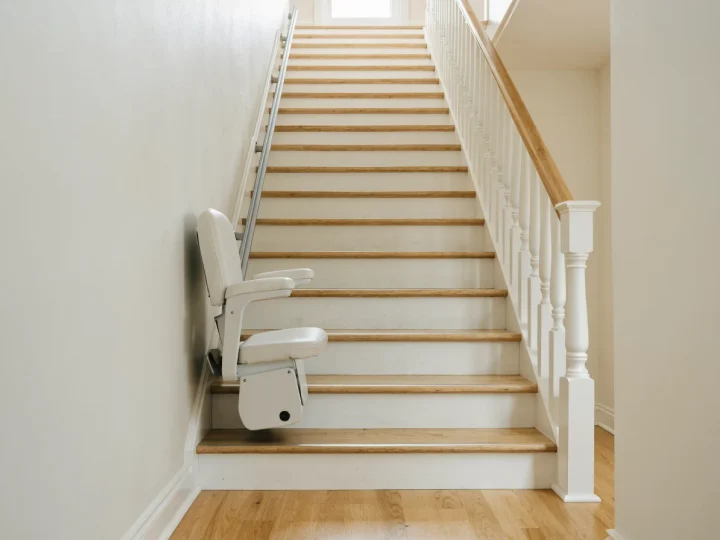
What stair lifts cost in Canada, what changes the price, eight models with the makers' specs, and the tax credits and grants that may help you pay.
This article is general information, not medical advice. For advice about your own situation, talk to a doctor, occupational therapist, physiotherapist or other qualified professional. In an emergency, call 911.
Quick answer
A stair lift is a seat that rides up and down a rail fixed to your stairs. Stannah lists starting prices on its Canadian website, with installation included. They are C$4,700 for a straight stair lift, C$6,300 for an outdoor one and C$10,800 for a curved one [1] [2]. Your price depends on the shape and length of your stairs, the options you choose, and the warranty and service. Tax credits and provincial programs may cover part of the cost. Several programs need to approve the work before it starts.
Stair lift types and prices at a glance
| Straight stair lift | Curved stair lift | Outdoor stair lift | |
|---|---|---|---|
| What it looks like | 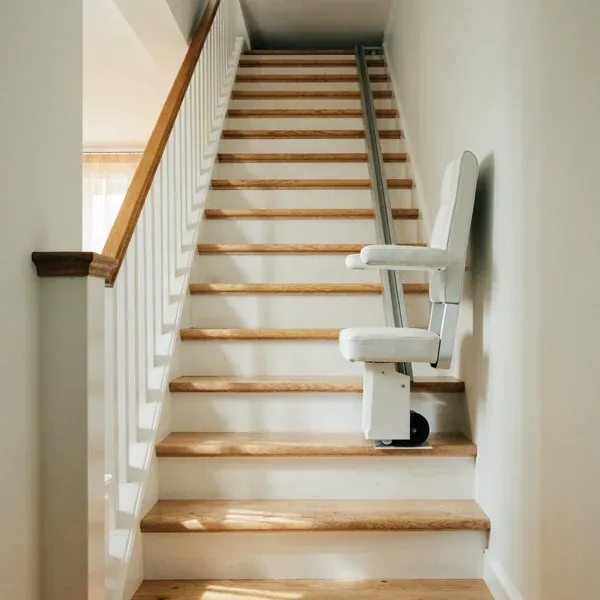 |
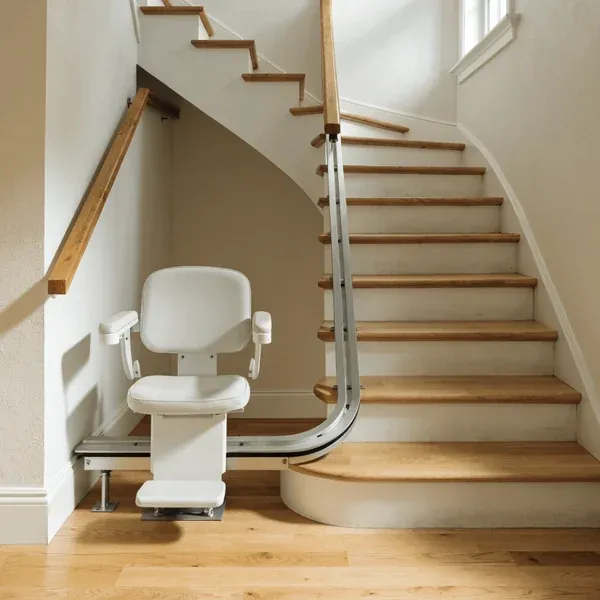 |
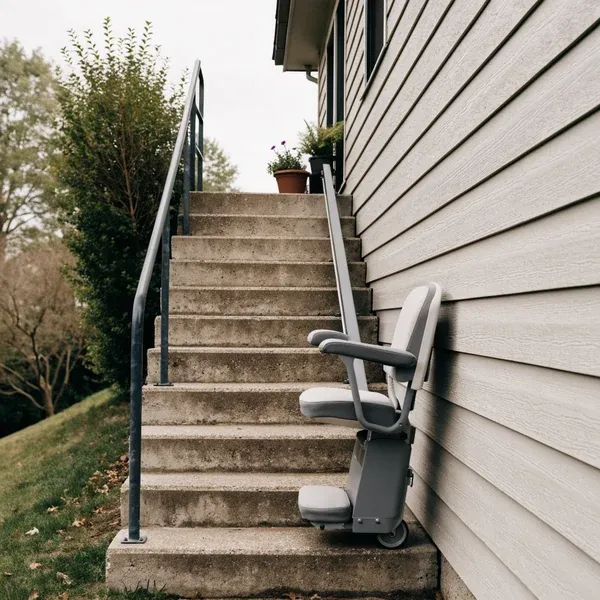 |
| Fits | One straight flight with no turns or landings | Stairs with turns, landings or a spiral [2] | Steps outside, such as up to a front door or down to a garage [3] |
| The rail | Cut to the length of your stairs [2] | Made to measure for one staircase [1] | Built to stand up to the weather [3] |
| Stannah’s starting price in Canada | From C$4,700 | From C$10,800 | From C$6,300 [1] |
| Savaria’s price guide, in US dollars | US$3,300 to US$5,000 | US$10,000 to US$25,000 | Not listed [4] |
| Makers’ weight limits in our tables | 300 to 400 lb | 266 to 400 lb | 300 to 400 lb |
Stannah says its prices include advice, measuring and installation, and that they are subject to change [2] [1]. Savaria says its guide shows average prices in US dollars. It says prices vary with where you live, labour costs, inspections, upgrades and local codes [4]. Savaria and Bruno say dealers set their own prices for installation [5] [6]. Compare written quotes.
Buying in the US? Our US stair lift cost guide has US prices and the programs that may help pay there.
Where to buy a stair lift in Canada
The makers below sell their stair lifts with installation. The seller visits to measure your stairs, then gives you a quote [1] [7] [5]. Acorn sells directly [8]. Stannah sells directly and through distributors [1]. Savaria and Bruno sell through dealers [5] [6].
The tables list current models whose makers publish their specs and sell them in Canada. The figures come from the makers’ own pages, linked in the sources. We haven’t tested these lifts. In Quebec, check that the model is on the province’s list for homes; see rules and standards below.
| Option | Maker's weight limit | Maker's warranty | Details | Sold in | Where to buy |
|---|---|---|---|---|---|
| Acorn 130 [9] | 300 lb; 350 lb on the HD model | 12 months; extended cover plans available | Battery backup, seat belt, folding footrest and remote control. A hinged rail for a doorway at the foot of the stairs is an option. Fixes to the stairs, not the wall | Canada and US | See it at Acorn Stairlifts: Acorn 130 (opens in a new tab) |
| Bruno Elan [10] | 300 lb | Limited lifetime | Seat turns 90° at the top. Sensors stop the lift if something is in the way. Wireless remotes. Options include a folding rail, power swivel and power footrest | Canada and US | See it at Bruno: Bruno Elan (opens in a new tab) |
| Savaria K2 Plus [11] | 400 lb with the Plus seat; 350 lb with the L seat | 36 months on parts | Seat swivels and locks at the top. Sensors on the footrest and carriage, and a seat belt. Battery charges along the rail. A flip-up rail for a doorway is an option, but it lowers the limit to 300 lb | Canada and US | See it at Savaria: Savaria K2 Plus (opens in a new tab) |
Weight limits are the makers' figures. Warranties differ in what they cover, so ask for the full terms. A feature not listed here may still be offered; ask the seller.
| Option | Maker's weight limit | Maker's warranty | Details | Sold in | Where to buy |
|---|---|---|---|---|---|
| Acorn 180 [8] | 266 lb (120 kg) | 12 months; extended cover plans available | Rail built from ready-made sections, which Acorn says can be installed in days. Battery backup, seat belt, folding footrest and remote control. A powered hinge for a doorway at the foot of the stairs is an option | Canada and US | See it at Acorn Stairlifts: Acorn 180 (opens in a new tab) |
| Savaria Stairfriend 23 [12] | 300 lb; 350 lb option | 36 months on parts | Twin rail made in a few weeks; installed in one day. Seat swivels and locks. Sensors on the footrest and carriage, seat belt and key switch. Battery charges at the top and bottom. The chair can park around a corner (option) | Canada and US | See it at Savaria: Savaria Stairfriend 23 (opens in a new tab) |
| Bruno Elite Curved (indoor) [13] | 400 lb | Limited lifetime | Rail custom made for your stairs. Seat turns 90°. Obstruction sensor and wireless remote. Options include power swivel, power footrest and a park position | Canada and US | See it at Bruno: Bruno Elite Curved (indoor) (opens in a new tab) |
Curved rails are made for one staircase. Weight limits are the makers' figures.
| Option | Maker's weight limit | Maker's warranty | Details | Sold in | Where to buy |
|---|---|---|---|---|---|
| Stannah Outdoor 320 [3] | 300 lb | Lifetime on the motor and gearbox if bought from Stannah; ask distributors | Works from 14°F to 105°F (about −10°C to 41°C). Swivel seat, key lock, waterproof cover and call controls at the top and bottom | Canada and US | See it at Stannah: Stannah Outdoor 320 (opens in a new tab) |
| Bruno Elite Straight Outdoor [14] | 400 lb | 5-year limited | Designed for 0°F to 125°F (about −18°C to 52°C). Weather-resistant seat and cover, covered gear rack and obstruction sensors | Canada and US | See it at Bruno: Bruno Elite Straight Outdoor (opens in a new tab) |
Temperatures are the makers' figures. Compare them with your winters.
Questions to ask when you get stair lift quotes
From simpleaging.com. This checklist is general information, not medical advice.
Take this list to each home visit. Get the answers in writing, with the quote.
Before anyone visits
- Ask an occupational therapist or physiotherapist whether a stair lift suits the person, and which features they need.
- Check what any funding program needs first. Several don’t pay for work done before they approve it, and some need an assessment or two quotes [15] [16] [17].
The quote
- It’s in writing and based on a visit to measure your stairs. Alberta’s RAMP program, for one, asks for quotes based on a site visit [17].
- It names the model, the rail length and every option, with materials and labour shown separately [17].
- It says whether delivery, installation, permits and taxes are included.
- It gives the maker’s weight limit for the seat and options you’re buying. Some options lower it [11].
- It says how long you’ll wait for installation.
Warranty and service
- How long the warranty lasts, and whether it covers labour or only parts [18].
- Whether batteries are covered [18].
- Whether the warranty needs regular service by an authorized dealer [18].
- How often the lift should be serviced, and what a visit or a yearly plan costs [19] [20].
- Whether the warranty passes to a new owner [18] [6].
Later on
How a stair lift works
A stair lift is a motor-driven chair that rides along a rail fixed to the steps, not the wall [6] [24]. You move it with a control on the armrest, and remote controls let you call it to the top or the bottom [4] [11]. At the top, the seat swivels so you can get off facing the landing, not the stairs [4] [2].
The makers in our tables say their lifts run on batteries, so they keep working in a power cut [7] [1]. Savaria and Bruno say that means several trips [4] [6].
Types
- Straight lifts fit one flight with no turns or landings.
- Curved lifts have a rail made for stairs with turns, landings or a spiral [2].
- Outdoor lifts are built to handle the weather [3] [14]. Savaria says all outdoor lifts need extra maintenance, especially near salt air or snow, and should be covered when not in use. It says no stair lift suits extreme snow or ice [4]. Check the temperature range. The Stannah Outdoor 320 (opens in a new tab) works from 14°F (about −10°C), and the Bruno Elite outdoor lift (opens in a new tab) is designed for 0°F (about −18°C) and up [3] [14].
- Platform lifts have a platform for a wheelchair. An inclined platform lift follows the angle of the stairs. A vertical one, often called a porch lift, goes straight up and down. Savaria says a stair lift isn’t ideal for someone who uses a wheelchair or soon will, because they must move onto the seat at both ends. Its US price guide puts platform lifts over straight stairs at US$20,000 to US$30,000 [4].
What changes the price
The shape and length of your stairs
Stannah says its prices depend on the length and shape of your stairs and the options you choose [2]. Straight lifts generally cost less than custom curved ones. Each curved lift is measured and built for one staircase [1].
If your stairs have a landing partway up, ask about other ways to cover them. Acorn says a transfer platform or two straight stair lifts could cost less than a curved lift [7]. Alberta’s RAMP program notes that two straight lifts may lower the cost, if the person can move from one lift to the other [17]. An occupational therapist can say whether that move would be safe.
Doorways and landings
The rail sticks out past the top and bottom steps. If a doorway is there, a rail that hinges, folds up or slides out of the way can keep it clear [4] [24]. A curved rail can also “park” the chair around the corner at a landing [12]. Stannah says a retracting rail for a door at the bottom, and a powered swivel seat, are the options that most often add to its prices [1].
Seat and footrest options
The models in our tables offer extras such as a power swivel seat, a power folding footrest, a larger seat or a five-point harness [10] [13] [12]. Stannah lists its options as costing extra [1]. Some models offer a perch seat, which is higher, like a bar stool, for people who find it hard to bend the knees or hips [4]. Stannah says a typical straight lift costs about C$5,700, and that many buyers choose options that bring it to C$5,700 to C$6,200 [1].
Weight limit
Every lift has a maker’s weight limit. Some models come in heavier-duty versions, like Acorn’s HD model or Savaria’s Plus seat [9] [11]. Options can lower the limit. On the Savaria K2 Plus (opens in a new tab), the flip-up rail drops it to 300 lb [11].
Installation
Stannah says its prices include measuring and installation [2]. Savaria sells only through dealers, who price the installation. It says this varies a lot by project and region [5]. Bruno says a straight lift usually takes 2 to 4 hours to install and a curved one 4 to 8 hours [6].
Warranty and service
Warranties differ a lot:
- Acorn gives 12 months, with extended cover plans after that [7].
- Savaria gives 36 months on parts for its own lifts and 24 months for Handicare lifts. Its warranty covers parts, not the labour to replace them, and leaves out batteries. It is void without regular maintenance by an authorized dealer [18].
- Bruno gives a limited lifetime warranty on indoor lifts and 5 years on outdoor ones. It covers the main parts for the first owner, if a Bruno dealer installed the lift [6].
- Stannah covers the motor and gearbox for life on new lifts bought directly from it. It says to ask distributors about their own warranty [25].
Servicing is another cost to plan for. Acorn recommends a service every 12 months [19]. Savaria’s owner’s manual lists checks every 6 months, done by trained technicians [20]. Savaria says batteries should last a number of years and can be checked at the yearly service [4].
New, reconditioned or rented
A reconditioned lift is a used lift that has been checked and repaired. Stannah says these typically cost about 80% of the price of a new one, and that renting could cost the least if you need a lift for only 3 to 6 months [1] [22]. Our guide to renting or buying a reconditioned stair lift compares the costs, warranties and rental terms.
Removal and moving
Taking a lift out costs money too. Stannah charges a removal fee. It says your lift will likely need to be replaced or adjusted to fit the stairs in a new home. It may buy back a Stannah lift that is less than three years old and in good condition [21]. Bruno says straight lifts are more likely than curved ones to be reused in another home. Removing a lift leaves small screw holes in bare wood, concrete or metal steps [6].
Safety features to compare
The makers in our tables list these features. Not every model has all of them, so check the spec sheet:
- Seat belt. Savaria’s manual says to always wear it [20].
- Swivel seat that locks. The seat turns at the top so you get off facing the landing. On Savaria’s K2 lifts, a switch stops the lift from running unless the seat is locked in the riding position [20]. A powered swivel is an option on some models [4] [1].
- Sensors. These stop the lift if the footrest or carriage touches something on the stairs [11] [1] [10].
- Battery backup. The lift keeps running in a power cut [4] [1].
- Key switch. It stops others from using the lift without your say-so [12] [1].
- Speed control. An overspeed governor keeps the lift from going too fast on the way down [12].
- Remote or landing controls. These call the lift to where you are [11] [3].
- Emergency stop button. It’s an option on some models [11].
Rules and standards for installing a stair lift
The Canadian standard for stair lifts is CSA B355, “Platform lifts and stair lifts for barrier-free access.” It sets minimum rules for designing, building, installing and using them, including in private homes [26]. Savaria’s owner’s manual says a lift must always be maintained to the standard it was built and installed to, which in Canada is CSA B355 [20].
Rules for homes depend on the province:
- Ontario. The Technical Standards and Safety Authority (TSSA) regulates stair chair lifts. Lifts in a private house used only by the people who live there and their guests are exempt, unless the owner asks in writing to be covered [27].
- Quebec. The Régie du bâtiment du Québec (RBQ) publishes a list of lift models that can be installed in a home. Each model must be approved by an engineer and registered with the RBQ. The contractor must check that the lift and its installation meet CSA B355-19, then declare the work [28]. Of the models in our tables, the September 2026 list includes the Acorn 130 and 180 and Savaria’s K2 Plus and Stairfriend 23. Some are approved only without certain options, such as a remote control [23].
- Other provinces. Ask the installer whether your province or city needs a permit or an inspection, and whether the quote includes it.
Costs and funding for stair lifts in Canada
For prices, see the table at the top and what changes the price. Tax credits don’t lower the price you pay the seller. You get them later, when your tax return is assessed. Grants and loans are different: several programs below don’t pay for work done before they approve it.
If you use more than one source of help, ask each how the others affect it. For example, a medical expense claim can include only the part you weren’t paid back for [29]. Government grants don’t reduce the Home Accessibility Tax Credit [30].
Federal
Provincial
Listed from west to east. Each program has its own rules about who qualifies.
Other provinces and territories may have programs too. See Funding in Canada.
Questions to ask
An occupational therapist or physiotherapist
- Is a stair lift the right choice here, or would something else suit better, like a second handrail or a bedroom on the main floor? Our guide to preparing a home after a hospital stay has a room-by-room checklist.
- Can the person get on and off the seat safely at the top and the bottom?
- Which features matter: a power swivel, a perch seat, the seat height, a harness?
- Is a wheelchair likely soon? Savaria says a stair lift isn’t ideal then [4].
- Can you do the assessment or write the recommendation that a funding program needs?
A funding program or the Canada Revenue Agency
- Does a stair lift qualify? Does a curved one?
- Do we need approval, an assessment or two quotes before the work starts?
- What are the income and asset limits?
- Is it a grant, a rebate or a forgivable loan, and what are the conditions?
- For 2026, should we claim the lift as a medical expense or for the Home Accessibility Tax Credit?
The seller or installer
- Does this model meet CSA B355?
- In Quebec, is this model, with these options, on the RBQ’s list?
- What should we do if the lift stops partway up the stairs?
- Who services it, how soon can they come, and is there a call-out fee?
Safety notes and when to talk to a professional
Wear the seat belt, and wait before you swivel. Savaria’s owner’s manual says to always wear the seat belt, and not to swivel the seat until the lift has stopped [20].
Keep the stairs clear. The same manual says to check that nothing is in the way before you ride, and to watch for people using the stairs at the same time. It says the lift is for carrying a person, not things, and must not be used to get out during a fire. Children under 16 shouldn’t use it without an adult watching [20].
Test it, and leave repairs to a technician. Savaria says to test the keys and the emergency stop button, if there is one, every month. Only trained technicians should repair or service the lift [20].
Plan for a breakdown. Quebec’s list notes, for one model, that if it breaks down, the rider must be able to get off alone or call a caregiver or 911 for help [23]. Ask the installer what to do if the lift stops partway, and keep a phone within reach.
Mind the weight limit. The makers’ limits in our tables run from 266 to 400 lb. The limit should be above the rider’s weight, for the seat and options you choose.
Be careful buying privately. Stannah says a lift bought from a private seller usually comes without an assessment, installation or support. A used curved rail is unlikely to fit your stairs [22].
Others still use the stairs. Our home safety checklist covers handrails, lighting and non-slip stair treads (opens in a new tab).
When to talk to a professional. If someone has fallen, feels unsteady or worries about falling, talk to a doctor. A doctor can look for causes and may suggest seeing a physiotherapist or occupational therapist. An occupational therapist can watch how a person manages the stairs and gets on and off a seat. They can say whether a stair lift or another change suits that person.