How to make stairs safer: railings, lighting and treads
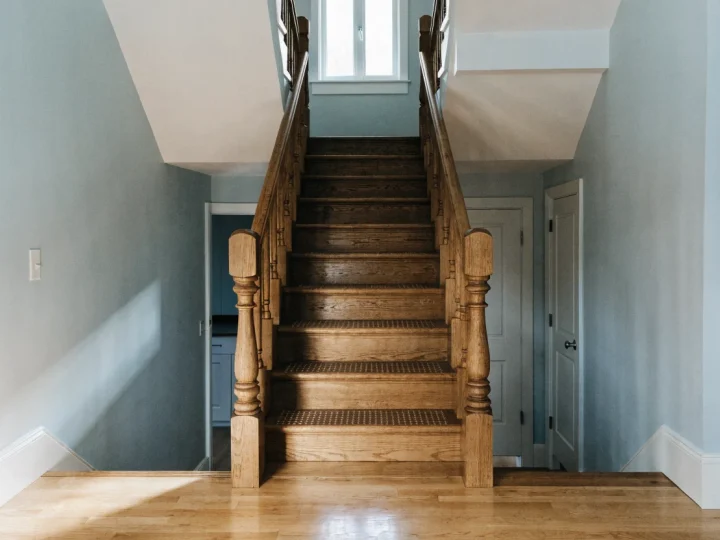
What safety guides and the building code say about stair handrails, lighting and treads, with a stair-by-stair checklist and products to compare.
This article is general information, not medical advice. For advice about your own situation, talk to a doctor, occupational therapist, physiotherapist or other qualified professional. In an emergency, call 911.
Quick answer
Three things make the most difference on stairs: firm handrails, good light and steps that don’t slip. The CDC, the US National Institute on Aging and the Public Health Agency of Canada all suggest handrails on both sides of the stairs, light switches at the top and the bottom, and a non-slip surface on the steps [1] [2] [3]. Canada’s building code asks for less in a house: a handrail on one side [4].
The three fixes at a glance
| Handrails | Lighting | Treads | |
|---|---|---|---|
| What it looks like | 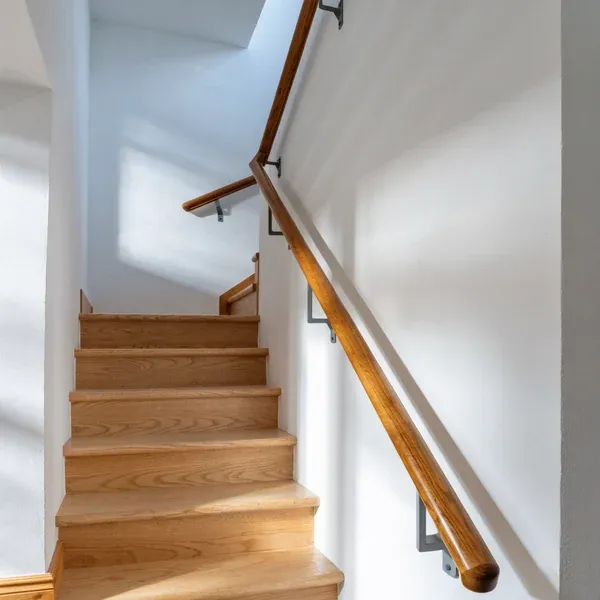 |
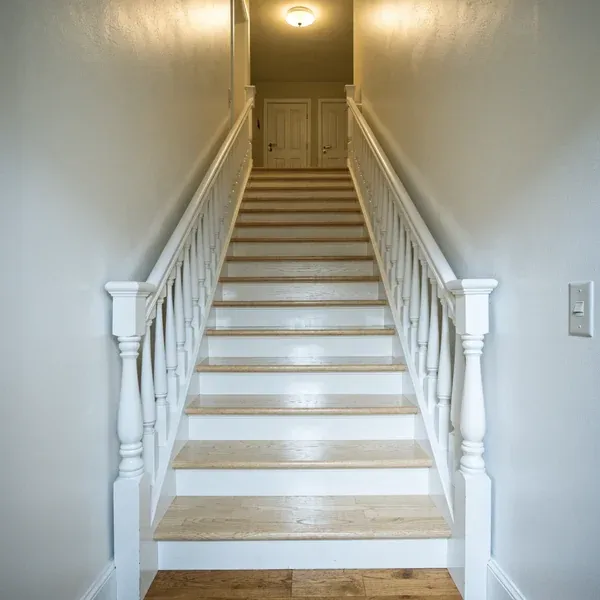 |
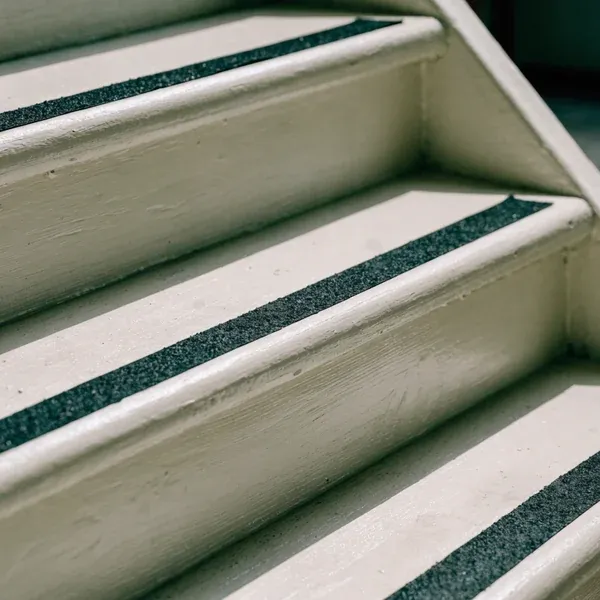 |
| What safety guides suggest | On both sides, as long as the stairs, and secure [1] [2] [3] | A light with switches at the top and bottom [1] [2] [3] | A non-skid surface. Carpet firmly attached to every step, or non-slip treads [1] [3] |
| What Canada’s code asks of a house | At least one side, 865 to 1,070 mm (about 34 to 42 in) high [4] | Every stairway lit; 3-way switches at the head and foot for 4 or more risers [4] | A finish of hardwood, vertical grain softwood, resilient flooring or similar on interior stairs [4] |
| Who usually does it | A carpenter or handy person, into solid framing | An electrician, for new switches or fixtures [1] | You can apply strips or treads yourself |
Where to buy stair safety products
Hardware stores and online stores sell these in Canada and the US. The table lists products whose maker publishes specs for them. The figures come from the makers’ pages, linked in the sources. We haven’t tested the products ourselves. Handrails need to be measured and fitted to your stairs, so they aren’t in the table; see what to check on a handrail below.
| Option | Type | What the maker says | Sold in | Where to buy |
|---|---|---|---|---|
| 3M Safety-Walk Indoor/Outdoor Tread 7639NA (610B-T2X9), 2 in by 9 in, 6 strips [6] | Anti-slip strips | General purpose 600 series, which 3M lists for steps, stairs and platforms. Abrasive grit on a plastic film with a pressure-sensitive adhesive. 3M says the series is certified by the National Floor Safety Institute as "high traction" | Canada and US | See it at Amazon: 3M Safety-Walk Indoor/Outdoor Tread 7639NA (610B-T2X9), 2 in by 9 in, 6 strips (opens in a new tab) |
| GE Enbrighten UltraBrite Motion Activated LED Night Light 12201 [7] | Plug-in motion light | Turns on in low light when it senses motion up to 25 ft away; off after 90 seconds. 40 lumens. Jasco lists stairways among the places to use it | Canada and US | See it at Amazon: GE Enbrighten UltraBrite Motion Activated LED Night Light 12201 (opens in a new tab) |
| Energizer Battery Operated Motion Activated LED Path Light 38183 [8] | Battery motion light | For spots with no outlet. Senses motion up to 15 ft away. 3 AAA batteries; magnet mount with a metal bracket; indoor or outdoor | Canada and US | See it at Amazon: Energizer Battery Operated Motion Activated LED Path Light 38183 (opens in a new tab) |
Figures are the makers'. Follow each maker's surface and installation instructions.
More options at Amazon: non-slip stair treads (opens in a new tab) and stair handrail kits (opens in a new tab). For more lights, see our guide to night lights and falls at night.
Stair safety check
From simpleaging.com. This checklist is general information, not medical advice.
Walk each staircase, inside and out, with this list. The items come from the CDC, the National Institute on Aging and the Public Health Agency of Canada [1] [2] [3].
Handrails
- There are handrails on both sides of the stairs [1] [2] [3].
- They run the full length of the stairs [1].
- They’re secure, not loose or broken [1] [2].
Light
- There’s a light, with a switch at the top and the bottom of the stairs [1] [3].
- No stairway bulb has burned out [1].
- Motion lights or night lights help light the stairs at night [2].
Steps
- No step is broken, loose or uneven [1].
- The steps have a non-skid surface [3].
- Carpet is firmly attached to every step. If not, it’s fixed, or it’s removed and non-slip treads are put on [1].
- The edge of each step is easy to see. The Public Health Agency of Canada suggests a strip of contrasting colour on the edge of each step, or on the top and bottom steps [3].
- Outdoor steps have non-slip material, and railings [2] [3].
Habits
- Nothing is left on the stairs: no papers, shoes or books [1] [2].
- There are no scatter mats at the top of the stairs [3].
- Everyone holds the handrail going up or down, even when carrying something, and nothing carried blocks the view of the steps [2].
- Nobody rushes on the stairs, and reading glasses come off first [3].
What safety guides say, and what the code asks
The CDC’s home checklist asks two questions about handrails: are they loose or broken, and is there a handrail on only one side of the stairs? Its advice is to fix loose handrails or put in new ones, and to “make sure handrails are on both sides of the stairs, and are as long as the stairs” [1]. The National Institute on Aging and the Public Health Agency of Canada say the same [2] [3].
Building codes set a lower floor. In Canada’s 2025 National Building Code, stairs inside a house need a handrail on one side [4]. The code also lets houses skip handrails on interior stairs with no more than 2 risers and exterior stairs with no more than 3 [4]. Provinces and territories decide whether and when to adopt the national code. A home that meets the code can still have stairs that are hard for some people to use.
What to check on a handrail
These figures come from Canada’s code for houses, and from the ADA Standards, which cover businesses and public buildings in the US, not private homes. They’re a useful guide when you fit a handrail at home:
- Height. Canada’s code: 865 to 1,070 mm (about 34 to 42 in) for a required handrail, measured from a line along the front edges of the steps [4]. ADA: 34 to 38 in [5].
- Space from the wall. Canada’s code: at least 50 mm (about 2 in), or 60 mm from a rough wall [4]. ADA: at least 1½ in [5].
- Something to grip. Canada’s code asks for handrails that can be grasped along their whole length, with nothing on them to break a handhold [4]. A round ADA handrail is 1¼ to 2 in across [5].
- Length. In a house, the code wants the handrail continuous from the bottom riser to the top riser of each flight [4].
- Strength. The code asks handrails to withstand a 0.9 kN load (about 200 pounds of force) at any point, and in a house it accepts fasteners into wood studs or blocking no more than 1.2 m apart [4].
Light at the top and the bottom
The code requires every stairway to be lit. In a house, stairs with 4 or more risers need 3-way switches at the head and foot of the stairs [4]. If you have to walk up or down in the dark to reach a switch, the CDC suggests having an electrician add a light and switches at both ends, and notes that you can get light switches that glow [1]. Plug-in or battery motion lights can help at night too [2].
Steps that don’t slip
The CDC suggests either making sure carpet is firmly attached to every step, or removing it and attaching non-slip rubber treads [1]. The National Institute on Aging mentions no-slip strips, “which you can buy at any hardware store,” for tile and wooden floors [2]. 3M’s bulletin for its Safety-Walk strips says the surface must be clean, dry and smooth when you apply them, and that broken or damaged surfaces should be repaired first [6].
Costs and funding for stair safety changes
Prices depend on the product, the stairs and local labour, so we don’t list them. Ask for a written quote that includes installation.
Canada
United States
Questions to ask
A carpenter or contractor
- Can you fit a handrail on the other side of the stairs, the full length of the flight?
- What will it be fastened to: studs, blocking or a newel post?
- What height and wall clearance will it have?
- Can you fix the loose or uneven steps first?
An electrician
- Can we add switches at the top and the bottom of the stairs, or a light that covers every step?
- Can the switches glow in the dark [1]?
An occupational therapist or physiotherapist
- Is this person safe on these stairs, or would a stair lift or a bedroom on the main floor make more sense?
- Would a second handrail, a different height or a thicker grip help?
Safety notes and when to talk to a professional
Handrails have to hold. The code describes handrails as there to provide guidance and support and to arrest falls, so their attachment matters [4]. Have them fastened into solid framing, and check now and then that they’re still tight [1] [2].
Keep both hands free when you can. The National Institute on Aging says to hold the handrails when you go up or down, even when carrying something, and not to let what you carry block your view of the steps [2].
Don’t rush. The Public Health Agency of Canada says, “Rushing is a major cause of falls” [3].
When to talk to a professional. If someone has fallen, feels unsteady or worries about falling, talk to a doctor. A doctor can look for causes and may suggest seeing a physiotherapist or occupational therapist. An occupational therapist can watch how a person manages the stairs and suggest changes that fit them. If stairs are becoming too hard, our guide to stair lift costs in Canada explains the options, and our home safety checklist covers the rest of the home.