Lift chairs: types and features to compare
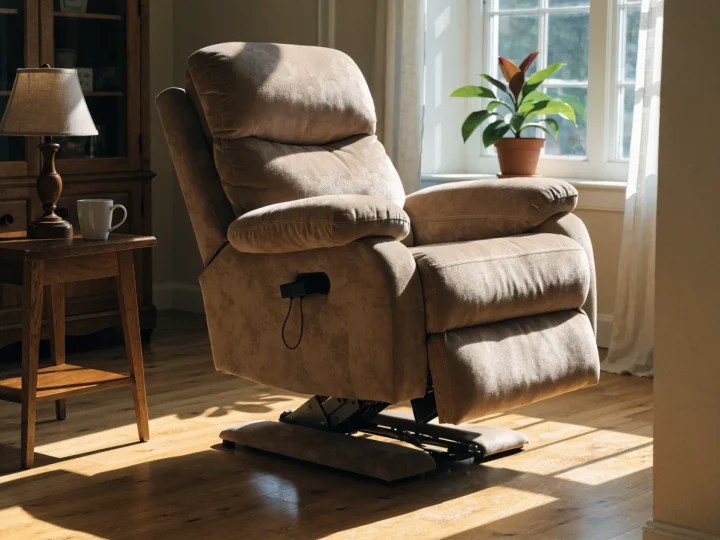
How lift chairs work, the two-position, three-position and infinite-position types, getting the fit right, costs, and what Medicare and Canadian programs pay.
This article is general information, not medical advice. For advice about your own situation, talk to a doctor, occupational therapist, physiotherapist or other qualified professional. In an emergency, call 911.
Quick answer
A lift chair is a recliner with a motor that tilts the whole seat up and forward, so a person can stand without pushing up with their arms. A hand control runs it. Chairs differ mainly in how far they recline. Two-position chairs recline partway and three-position chairs recline fully, with the back and footrest moving together. Infinite-position chairs have separate motors, so the back and footrest move on their own [18] [19] [20]. Prices on the makers’ sites run from about US$320 to about C$6,100. Medicare may pay toward the lift mechanism, but not the chair itself, and only under strict rules [1] [3] [2]. Ontario’s Assistive Devices Program doesn’t cover recliner chairs [5].
Check the fit before you buy
A lift chair only helps if it fits. Makers publish a seat width, seat depth, seat-to-floor height and a suggested user height for each size, and many sell the same chair in several sizes [12] [14]. Medicare’s own rules note that almost everyone who can walk can get out of an ordinary chair if the seat height is right and the chair has arms [2]. So before buying, ask an occupational therapist or physiotherapist whether a lift chair is the answer, and which size.
The types at a glance
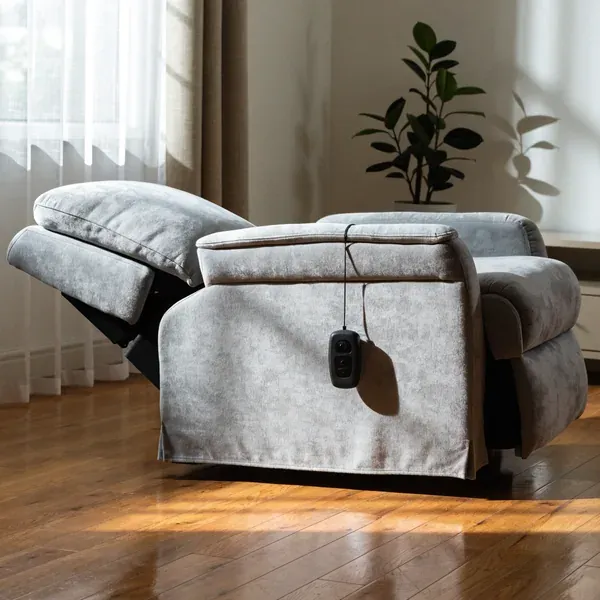
| Two-position | Three-position | Infinite-position | |
|---|---|---|---|
| What it looks like | 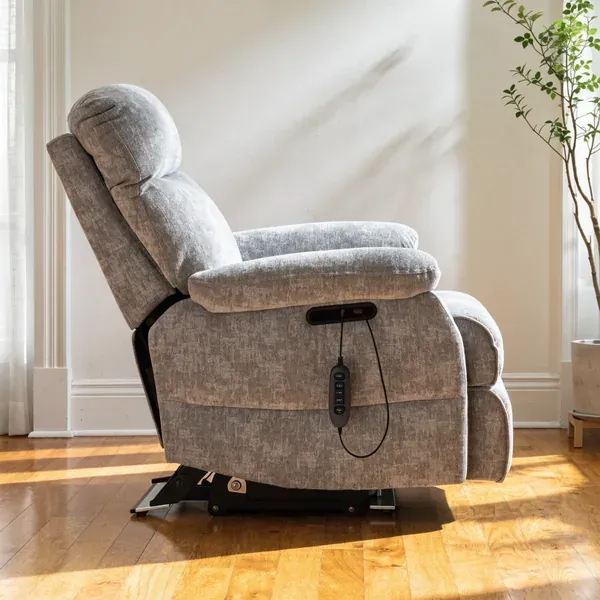 |
 |
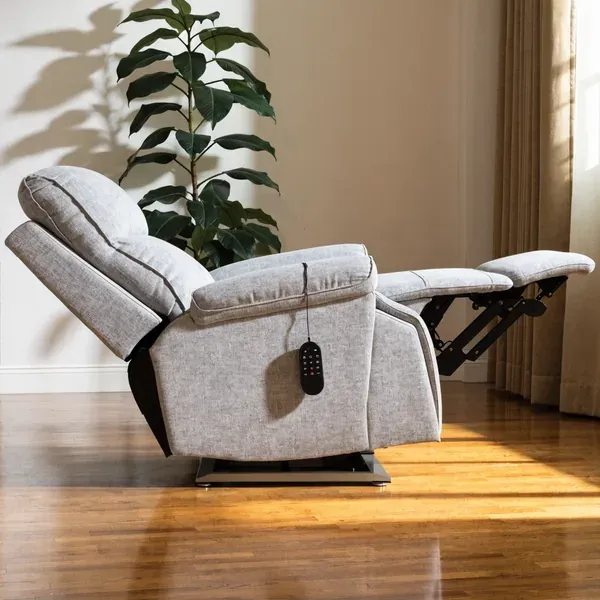 |
| How it moves | The back and footrest move together | The back reclines as the footrest rises, and can stop anywhere along the way [20] | Separate motors move the back and the footrest on their own [8] [20] |
| How far it reclines | Partway [18] | Fully, further back than a standard recliner [19] [20] | Mega Motion says all of its models lie flat; MCombo’s 7890 reclines to 165° [20] [14]. Some also have a zero gravity position, with the legs raised above the heart [20] |
| Common uses | Sitting, reading, TV | Napping | Sleeping in the chair; raising the legs |
| Examples below | None in the table | Mega Motion MM-3601 and MM-7001, MCombo 7040 | MCombo 7890, Mega Motion MM-3603, Pride VivaLift Ultra |
Makers don’t all use these names the same way. Aosom calls the HOMCOM chair below “infinite position”, yet its footrest rises as the back reclines, so the two don’t move separately [16]. Mega Motion’s MM-7001 has two lift motors, but they work together, and Mega Motion says it isn’t an infinite-position chair [9]. So ask whether the back and footrest move separately.
Where to buy lift chairs
Home health stores, furniture stores and medical supply dealers sell lift chairs, and some makers sell online. The table lists chairs whose makers publish their figures, sorted by the maker’s weight limit. Chairs from Mega Motion and Pride are sold through dealers, so those links go to the makers’ pages. We haven’t tested the products.
| Option | Maker's weight limit | Type | Fit and details | Sold in | Where to buy |
|---|---|---|---|---|---|
| HOMCOM Power Lift Recliner 713-042 [16] | 265 lb | Back and footrest move together | Grey version: seat 18½ in wide and 18¾ in from the floor. No heat or massage. Listings for other colors give different lift and recline angles, so check the one you buy | Canada and US | See it at Amazon: HOMCOM Power Lift Recliner 713-042 (opens in a new tab) |
| Mega Motion Trio Invigorate MM-3601 [7] [10] | 325 lb | Three-position, one motor | For heights 5 ft 2 in to 5 ft 10 in. Seat 22 in wide, 19½ in from the floor; needs 18 in from the wall. Heat and massage; battery backup. Two-year warranty; limited lifetime warranty on the steel lift frame | US only | See it at Mega Motion: Mega Motion Trio Invigorate MM-3601 (opens in a new tab) |
| MCombo Power Lift Recliner 7040 series [15] | 350 lb | Three-position | Six sizes, for heights from 4 ft 6 in to 6 ft 2 in, three of them with wide seats. Heat and massage; USB ports; cup holders. Two-year warranty | Canada and US | See it at Amazon: MCombo Power Lift Recliner 7040 series (opens in a new tab) |
| MCombo Dual Motor Lift Recliner 7890 series [14] | 350 lb | Infinite-position, two motors | Six sizes; seat widths 21.3 to 26.4 in. Reclines to 165°. A home button brings it back upright from a full recline in 16 seconds. Heat and massage. Two-year warranty | Canada and US | See it at Amazon: MCombo Dual Motor Lift Recliner 7890 series (opens in a new tab) |
| Mega Motion iNFI Attain MM-3603 [8] [10] | 375 lb | Infinite-position, two motors | For heights 5 ft 6 in to 6 ft 2 in. Seat 21 in wide, 19 in from the floor; needs 16 in from the wall. Lies flat; battery backup. Two-year warranty; limited lifetime warranty on the steel lift frame | US only | See it at Mega Motion: Mega Motion iNFI Attain MM-3603 (opens in a new tab) |
| Pride VivaLift! Ultra PLR-4955 [12] | 400 lb | Infinite-position | Three sizes. Small: for heights up to 5 ft 4 in, seat 20 in wide and 18 in from the floor; needs 15 in from the wall. Seven-year prorated warranty | Canada and US | See it at Pride Mobility: Pride VivaLift! Ultra PLR-4955 (opens in a new tab) |
| Mega Motion Trio Tenacity MM-7001 [9] [17] [10] | 500 lb | Three-position, two lift motors that work together | For heights 5 ft 8 in to 6 ft 6 in. Seat 26 in wide, 21 in from the floor; needs 18½ in from the wall. Sold with or without heat and massage. Battery backup. Two-year warranty; limited lifetime warranty on the steel lift frame | US only | See it at Mega Motion: Mega Motion Trio Tenacity MM-7001 (opens in a new tab) |
Weight limits, sizes and heights are the makers' figures. Most of these chairs come in more than one size; the seat figures are for one size. Ask whether delivery includes bringing the chair inside and setting it up.
How a lift chair works
A lift chair looks like a recliner, but a steel lift frame under the seat does the work. Press and hold the up button on the hand control and the motor tilts the whole chair forward and up, until you’re almost standing. Press down and it lowers you into the seat, then on into a recline [7] [11]. Makers rate each chair for a maximum user weight. Warranties often treat the lift frame and the electrical parts separately. Mega Motion gives a lifetime warranty on the steel lift mechanism and two years on the motor, hand control and control boxes [10].
Positions. Pride describes its two-position chairs as partial recline and its three-position chairs as full recline [18] [19]. In a three-position chair the back reclines as the footrest rises, and you can stop anywhere along the way [20]. In an infinite-position chair, separate motors let you set the back and footrest on their own [8] [20].
Power. The chair plugs into a wall outlet. Many chairs have a battery backup for power cuts, and Mega Motion’s chairs include one [7] [8]. Its manual says the batteries aren’t included, and that the backup is meant to bring a reclined chair back to sitting once during an outage [11]. Ask what battery it takes and how to tell when it needs replacing.
Room to recline. A lift chair needs space behind it. Mega Motion’s brochures list 16 to 18½ inches from the wall for the chairs above, and Pride lists 15 inches for the Ultra [7] [8] [17] [12]. Mega Motion’s manual gives 30 inches from the nearest obstruction for setting up a chair, and says this varies by model [11]. So check the figure for the chair you buy. Fully reclined, a chair can be more than 6 feet long: Mega Motion’s MM-3603 measures 73½ inches [8].
Getting in and out of the chair
Moving from standing to sitting, or from sitting to standing, is called a transfer. A lift chair helps with both. You sit down onto a seat that’s already raised, and the chair lowers you. To get up, it raises you until you’re almost standing [7] [11]. Mega Motion’s manual says its chairs give lift assistance to people who have difficulty rising from a seated position [11].
-
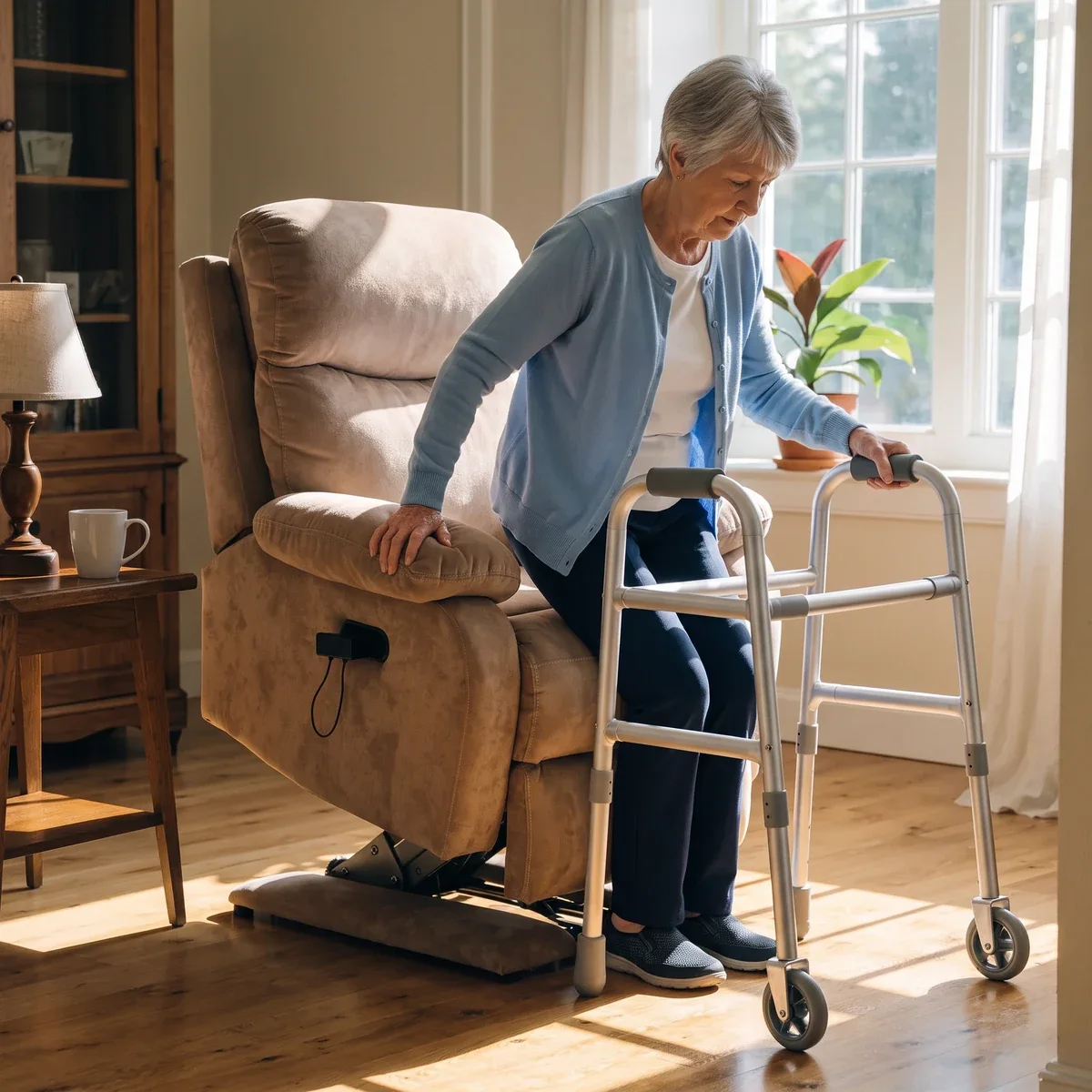 Raise the chair to a height that suits you, then back into it.
-
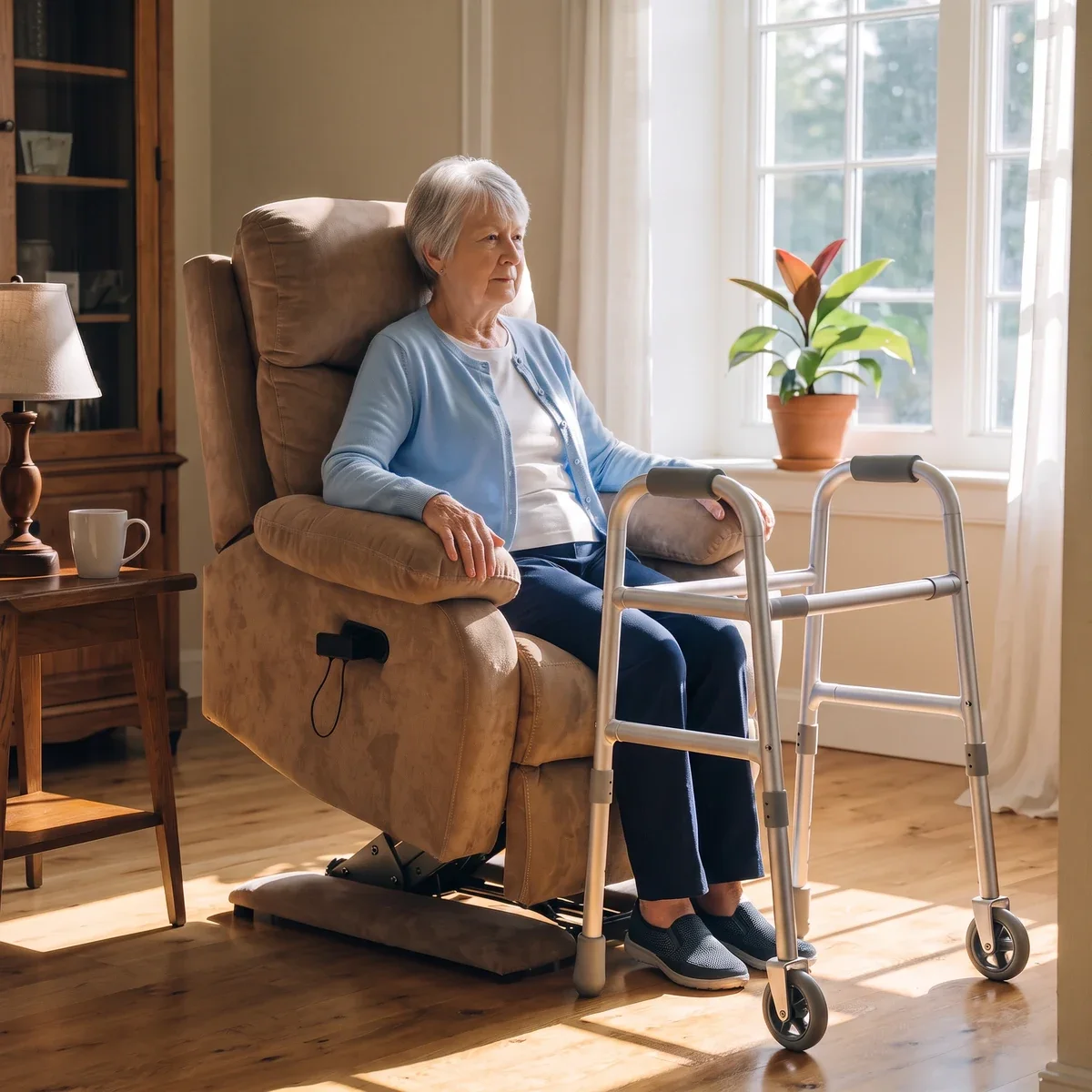 Sit in the center of the seat. Don’t drop into the chair.
-
 Press down. The chair lowers you to a comfortable sitting position.
-
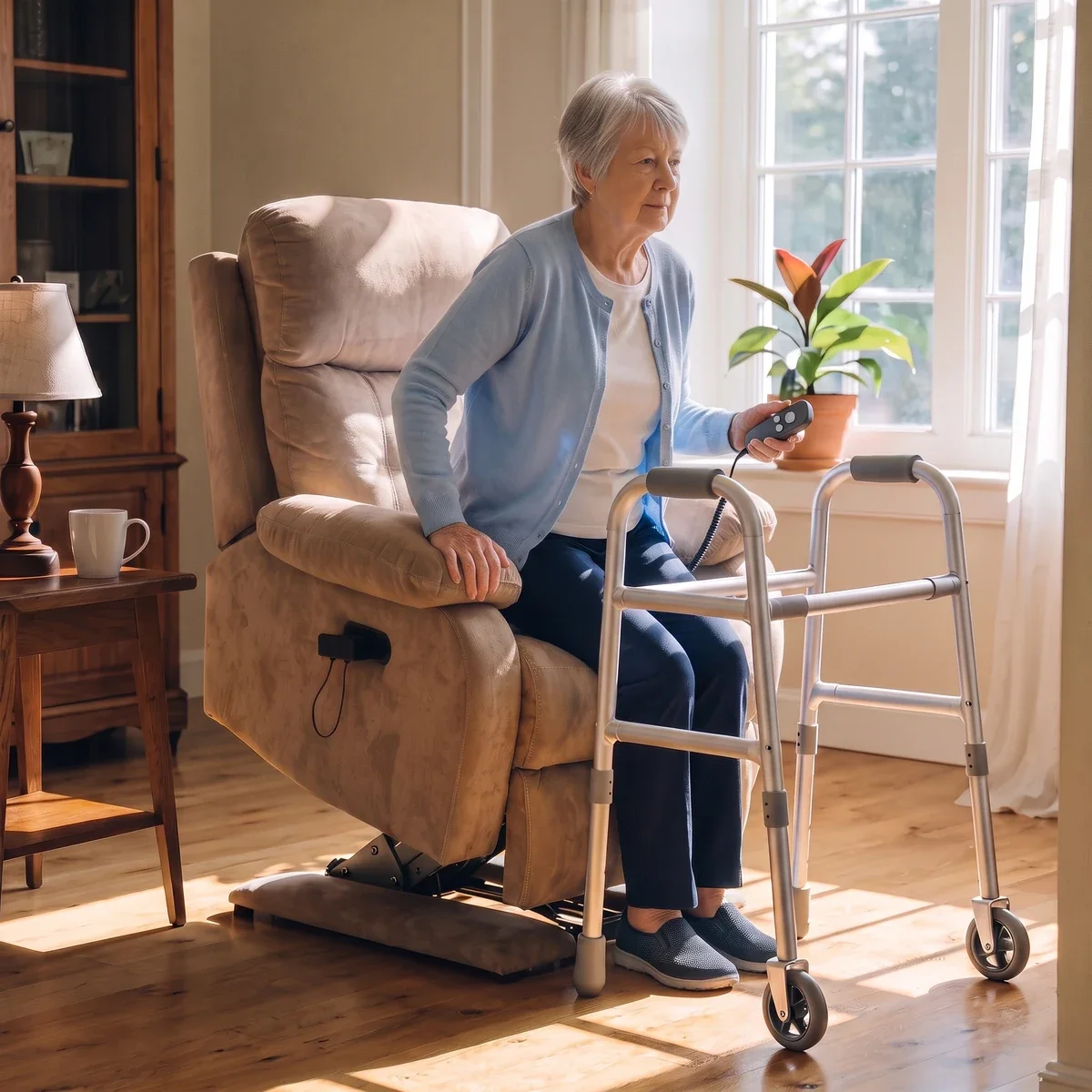 To get up, hold the up button. Let go when the chair is high enough for you to stand comfortably.
-
 Stand up only when you’re steady on your feet and can bear your weight. Then take hold of your walker, if you use one.
These steps follow Mega Motion’s owner’s manual. It also says not to put all your weight on the armrests, and suggests a mobility aid or a helper for extra stability [11].
Moving to or from a wheelchair or scooter. The manual says these transfers take a good sense of balance, and to have a trained helper there while you learn. Before you move, turn the device off and make sure it isn’t in freewheel mode. Flip up or remove its armrests, and check that its seat is fixed in place [11]. An occupational therapist or physiotherapist can teach the safest way for you to transfer.
Choosing and fitting a lift chair
From simpleaging.com. This checklist is general information, not medical advice.
Take this list to the store, or to an appointment with an occupational therapist or physiotherapist.
Fit
- The maker’s weight limit is above the person’s weight, with room to spare.
- The person’s height is inside the maker’s suggested height range for that size [7] [12].
- Seat height: sitting with feet flat on the floor, the knees are about level with the hips. Makers list seat-to-floor height, from 18 to 21 inches for the chairs above [12] [16] [17].
- Seat width: enough room without being so wide that the armrests are out of reach. Makers list seat width, from 18½ to about 26 inches above [16] [17] [14].
- Seat depth: the back of the knees clear the front of the seat when sitting back.
Features
- Positions: partway recline, full recline, or an infinite-position chair where the back and footrest move separately.
- A hand control the person can read and work, with a holder or pocket so it doesn’t fall out of reach.
- Battery backup for power cuts, and what battery it needs [11].
- Heat and massage, if wanted, and whether they work in every position.
- A footrest extension, which supports the feet where they hang past the end of the footrest [11] [8] [14].
- Fabric that suits the person: easy to clean, cool or warm, and moisture-resistant if needed.
- Warranty terms for the lift frame, the motor and the hand control, and who does in-home repairs [10].
At home
- The chair fits through the doors and has room behind it to recline, with a clear path to the outlet.
- Delivery includes bringing the chair inside and setting it up, or someone is available to do it.
Costs and funding for lift chairs
Lift chairs range from a few hundred dollars for a basic chair sold online to several thousand for a dealer-sold infinite-position chair. These are the makers’ own prices, found on their sites on October 6, 2026. Prices change, and dealers set their own.
| Chair | Maker’s price |
|---|---|
| HOMCOM 713-042 (grey, no heat or massage) | US$316.99 [16] |
| MCombo 7040 (three-position, heat and massage) | List US$559.90; on sale from US$452.12 [15] |
| MCombo 7890 (infinite-position) | List US$699.90; on sale at US$594.92 for the medium size [14] |
| Pride VivaLift! Tranquil 2 (infinite-position) | C$2,999 to C$3,399 suggested retail [13] [21] |
| Pride VivaLift! Radiance | C$3,999 to C$4,299 suggested retail [13] |
| Pride VivaLift! Ultra | C$5,199 to C$6,099 suggested retail [13] |
Canada
United States
Questions to ask
An occupational therapist or physiotherapist
- Is a lift chair the right answer, or would a higher chair with arms, or exercises, help more [2]?
- Which size fits me, and which positions do I need?
- Could I lie flat safely, and is raising my legs a good idea for me?
- How should I get in and out of the chair, and should I use my walker or have someone with me?
The store or supplier
- What is the maker’s weight limit, seat width, seat depth and seat height for this size?
- How much space does it need behind it, and how long is it fully reclined?
- Does it have a battery backup? What battery, and how do I know it’s working?
- What does the warranty cover, for how long, and who comes to the house for repairs?
- Does delivery include setup inside the home?
Safety notes and when to talk to a professional
Keep the area clear. Mega Motion’s owner’s manual says to keep pets and small children clear while the chair moves. It says not to put anything under the chair, or under the footrest when it’s reclined, and to keep hands and objects away from moving parts, which can pinch or crush. It also says to lock or disconnect the hand control when the chair isn’t in use [11].
Stay within the weight limit, and keep the chair stable. Every chair has a maker’s weight limit, and Mega Motion’s manual says to stay within it [7] [11]. The manual says to turn the leg levelers up or down to stabilize the chair before use. It also warns that leaning on the back when the chair is fully reclined could tip it, and that sitting on the footrest could make the chair unstable [11].
When to talk to a professional. If someone has fallen, feels unsteady or worries about falling, talk to a doctor. A doctor can look for causes and may refer the person to a physiotherapist or occupational therapist, who can also advise on whether a lift chair suits them.