Bed rails, bed canes and assist handles: entrapment safety

How bed rails, bed canes and bed assist handles differ, why entrapment is the main risk, the safety standard to look for, and how to set one up.
This article is general information, not medical advice. For advice about your own situation, talk to a doctor, occupational therapist, physiotherapist or other qualified professional. In an emergency, call 911.
Quick answer
A bed cane or bed assist handle is a short handle beside the bed to hold while you sit up, stand or get in and out. A bed rail is longer and runs along the side of the bed. Both can trap a person in a gap, and deaths have been reported [1] [5]. If you use one, look for a maker that says it passed the ASTM F3186-17 safety standard, and set it up exactly as the instructions say [2].
The types at a glance
| Bed cane or assist handle | Portable bed rail | Hospital bed side rail | |
|---|---|---|---|
| What it looks like |  |
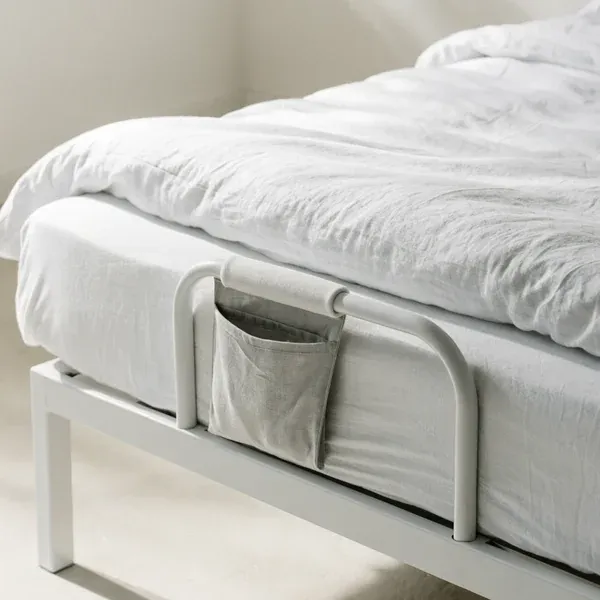 |
 |
| What it is | A short handle that slides under the mattress and stands beside the bed | A longer rail along the side of a home bed, often with a handle | A rail built into a hospital bed |
| What it’s for | Something to hold when sitting up, standing or getting in and out of bed [5] | The same support, plus a barrier along part of the bed [11] | Part of a hospital bed system [3] |
| How it stays put | Its base slides under the mattress, and a safety strap ties it to the bed frame [8] | The same: a base under the mattress and a strap to the frame [11] [12] | Attached to the bed |
| Who oversees it in the US | The FDA if it’s sold for a medical purpose, otherwise the Consumer Product Safety Commission [4] | The FDA if it’s sold for a medical purpose, otherwise the Consumer Product Safety Commission [4] | The FDA, as part of the hospital bed [3] |
The main risk: entrapment
The FDA and the US Consumer Product Safety Commission have received reports of deaths and injuries with adult portable bed rails. The FDA says most of these reports “were for entrapment, asphyxiation (suffocation), and falls” [1]. Entrapment means a person gets caught in a position they can’t move out of. It can happen when the rail isn’t held tight against the mattress and the person slips between the rail and the mattress, between the supports, or within or under the rail [1].
The FDA says adult portable bed rails “are not for everyone, nor every situation.” Even a well-designed rail that fits the bed and is used correctly can be a hazard, especially for people with physical limitations or confusion, such as dementia or delirium [1]. They are meant to help a person move, not to keep them in bed: the FDA says they “should not be used as a restraint” [1].
Handles carry the same risk. In 2021, Drive Medical recalled four models of home bed assist handles. Health Canada said they “may potentially pose a risk for entrapment” and don’t meet the ASTM F3186-17 standard. The recall notice reports deaths in Canada and the United States. In the first two, the safety straps had not been secured as the instructions said [5]. Other bed rails sold online have been recalled for the same reason [6].
Where to buy bed handles and rails
Medical supply stores, pharmacies and online stores sell bed handles and rails in Canada and the US. The table lists products whose makers say they passed the ASTM F3186-17 safety standard for adult portable bed rails and publish their weight limits and the mattress sizes they fit. The figures come from the makers’ pages and instructions, linked in the sources. We haven’t tested the products ourselves.
| Option | Type | Maker's weight limit | Fits, and what else the maker says | Sold in | Where to buy |
|---|---|---|---|---|---|
| Stander BedCane 2041 [8] [9] | Bed handle | 300 lb | Mattresses 6 to 14 in thick, twin to California king. Organizer pouch | Canada and US | See it at Amazon: Stander BedCane 2041 (opens in a new tab) |
| Stander Bed Rail Advantage Traveler 5000 [10] | Bed handle | 400 lb | Mattresses 6 to 16 in thick, twin to California king. Folds in half for storage or travel | Canada and US | See it at Amazon: Stander Bed Rail Advantage Traveler 5000 (opens in a new tab) |
| HealthCraft Assista-Rail [12] | Bed rail | 300 lb | Twin to king. Rail 19¾ in long; height adjusts from 18 to 22 in | Canada and US | See it at Amazon: HealthCraft Assista-Rail (opens in a new tab) |
| Stander Wonder EZ Adjust Bed Rail 8000 [11] | Bed rail | 300 lb | Mattresses 10 to 14 in thick, twin to California king. Extends from 20 to 30 in long | US only | See it at Amazon: Stander Wonder EZ Adjust Bed Rail 8000 (opens in a new tab) |
Weight limits and mattress ranges are the makers' figures. Use a product only with a mattress inside its range, and only as its instructions say. These products are not for adjustable beds.
We don’t link to a general search for bed rails. Search results mix in products that don’t claim to meet the standard, and some sold online have been recalled [6].
Before you use a bed rail or handle
From simpleaging.com. This checklist is general information, not medical advice.
Go through this list before the first night, and again whenever the bed, mattress or rail changes. Most items come from the FDA and from Stander’s instructions [2] [9].
Is it the right choice?
- The person’s care team or an occupational therapist has talked about whether a rail or handle suits them, or whether something else would be safer.
- The person doesn’t have dementia or confusion and isn’t restless, sedated or frail. Stander’s instructions say its product is never to be used by those people [9].
- The product’s maker says it meets ASTM F3186-17 [2].
- It isn’t on a recall list. Check Health Canada’s recalls site in Canada, and the FDA’s and the CPSC’s recall lists in the US [5] [3].
Does it fit this bed?
- The bed is a regular bed, not an adjustable bed [9].
- The mattress is inside the maker’s thickness range. Measure it [9].
- The rail, mattress and bed frame work together. The FDA says to check with the makers, because not all rails, mattresses and frames are interchangeable [2].
- The mattress isn’t very soft, and there’s no air mattress or mattress pad that could leave gaps. The FDA warns about both [2].
Is it set up right?
- It’s set up exactly as the maker’s instructions say [2].
- The safety strap is tied to the bed frame, with no slack [9].
- There’s no gap between the rail and the side of the mattress [9].
- For Stander’s products: at least 12.5 in from the head and the foot of the bed, and the top at least 4 in above the mattress [9].
- There’s only one rail or handle on that side of the bed [9].
Keep checking
Bed handles and bed rails: how they differ
A bed cane or assist handle gives you something firm to hold. The Stander BedCane (opens in a new tab), for example, has a wooden base that slides under the mattress and a handle beside the bed, and it straps to the bed frame [8]. The Advantage Traveler (opens in a new tab) is a padded handle that folds in half [10].
A bed rail is longer. The Stander EZ Adjust Bed Rail (opens in a new tab) extends from 20 to 30 in [11]. The HealthCraft Assista-Rail (opens in a new tab) is a fixed rail. HealthCraft says it’s for people “looking for mild to moderate support for changing positions or moving around in bed” [12].
A longer rail isn’t a safer rail. The FDA says rails should be chosen and placed to discourage climbing over them, which could lead to falls [2].
Other options
The FDA lists alternatives for when a bed rail isn’t right: roll guards, foam bumpers, a bed lowered as close to the floor as possible, a concave mattress that helps stop rolling off the bed, or a bed trapeze to reposition and to get in and out of bed. It also says bed rails “should not be used as a substitute for proper monitoring” [2].
Hospital beds
Rails on hospital beds are a separate thing. Health Canada says entrapment has happened in openings within the rails, between the rails and the mattress, under the rails, between split rails, and between the rails and the headboard or footboard. It says the people most at risk are older patients, “especially those who are frail, confused, restless, or who have uncontrolled body movement,” and that entrapments have happened in hospitals, nursing homes and private homes [7]. If a hospital bed comes home, ask the supplier or the care team how to set it up and check the gaps.
Costs and funding for bed rails and handles
Prices vary by product, store and region, so we don’t list them.
Canada
United States
Questions to ask
The hospital team, a doctor or an occupational therapist
- Would a bed handle, a bed rail or something else help with getting in and out of bed?
- Is a rail safe for this person, given their health and how they sleep?
- Would a lower bed, a floor mat or a trapeze be a better fit?
- Can you check how it’s set up once it’s in place?
The seller or the maker
- Does this product meet ASTM F3186-17?
- Which mattress thicknesses and bed types does it fit?
- What is the weight limit?
- Has this model ever been recalled?
Safety notes and when to talk to a professional
Follow the instructions to the letter. The FDA says to install bed rails using the maker’s instructions, to make sure the safety strap is attached to the bed frame, and to check regularly for gaps and for a rail that has shifted or loosened [2]. Stander’s instructions say never to use its product unless it’s tight against the mattress, with no gap and no slack in the strap [9].
Know who is at higher risk. The FDA lists people with confusion, restlessness or lack of muscle control as being at high risk. So are people who are cognitively impaired by medication or by conditions such as Alzheimer’s disease or other dementia, Parkinson’s disease, multiple sclerosis, balance disorders, stroke or low blood pressure [2].
Report a problem. In the US, report a bed rail problem to the FDA’s MedWatch for medical devices, or call the CPSC hotline at 1-800-638-2772 for consumer products [4]. In Canada, Health Canada asks people to report health or safety incidents with consumer products using its Consumer Product Incident Report Form [5].
When to talk to a professional. If someone has fallen, feels unsteady or worries about falling, talk to a doctor. A doctor can look for causes and may suggest seeing a physiotherapist or occupational therapist. An occupational therapist can watch how a person gets in and out of bed and suggest what would help. Our home safety checklist covers the bedroom, and our guide to preparing a home after a hospital stay covers the first weeks home.