Tub transfer bench vs shower chair: the differences
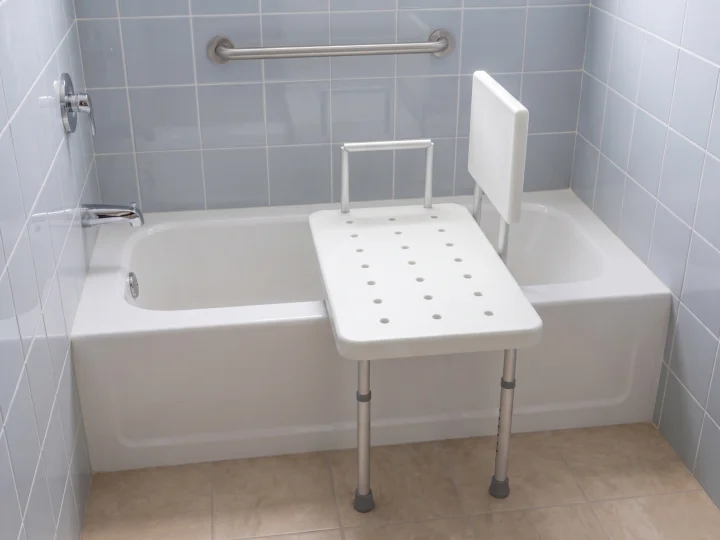
How a tub transfer bench differs from a shower chair, when each fits, what to measure on your tub, and six benches with the makers' weight limits.
This article is general information, not medical advice. For advice about your own situation, talk to a doctor, occupational therapist, physiotherapist or other qualified professional. In an emergency, call 911.
Quick answer
A shower chair stands inside the tub or shower: you step in, then sit. A tub transfer bench is longer and straddles the tub wall, so you sit down outside the tub and slide across without stepping over. Some people choose a bench when lifting a leg over the tub wall is the hard part, and a chair when stepping in is fine but standing to wash isn’t. Either way, it has to fit your tub.
The difference at a glance
| Tub transfer bench | Shower chair or stool | |
|---|---|---|
| Where it sits | Across the tub wall: two legs in the tub, two on the bathroom floor | Inside the tub or shower stall |
| How you get in | Sit on the outside end, lift your legs over the wall one at a time, slide across | Step over the tub wall or into the stall, then sit |
| What it solves | Stepping over the tub wall | Standing to wash |
| Works in a shower stall | Not needed, since there’s no wall to cross | Yes |
| Floor space needed | Room beside the tub for the two outer legs | None outside the tub |
| Shower curtain | Hangs inside the tub between the legs, or a curtain with a slit | Closes as usual |
| Seat width | Long: about 26 to 33 in on the fixed-seat benches below | About 19 to 20 in on the chairs in our guide |
| Makers’ weight limits | 300 to 500 lb on the benches below | 250 to 500 lb on the chairs in our shower chairs guide |
Where to buy tub transfer benches
Pharmacies, home health and medical supply stores, and hardware stores sell transfer benches in Canada and the US. You can also shop online. The table lists benches whose makers publish their specs. The figures come from the makers’ pages, linked in the sources. We haven’t tested the products ourselves. For chairs and stools, see the table in our shower chairs guide.
| Option | Maker's weight limit | Seat height | Seat size | Details | Sold in | Where to buy |
|---|---|---|---|---|---|---|
| Carex Bathtub Transfer Bench FGB15300 [7] | 300 lb | 16 to 20 in | About 31 in long overall | Molded plastic; reversible back; handle | Canada and US | See it at Amazon: Carex Bathtub Transfer Bench FGB15300 (opens in a new tab) |
| Moen Home Care Transfer Bench DN7105 [8] | 400 lb | 16½ to 21 in | 33 by 18 in | Non-slip seat surface | Canada and US | See it at Amazon: Moen Home Care Transfer Bench DN7105 (opens in a new tab) |
| Drive Medical Transfer Tub Bench 12011KD-1 [9] | 400 lb | 17½ to 22½ in | 26 by 18½ to 19½ in | Plastic; reversible back and arm; legs adjust in ½ in steps | Canada and US | See it at Amazon: Drive Medical Transfer Tub Bench 12011KD-1 (opens in a new tab) |
| Carex Universal Transfer Bench FGB170C0 [10] | 400 lb | 17½ to 22½ in | 29¾ by 19 in | All plastic; reversible back; two handles | Canada and US | See it at Amazon: Carex Universal Transfer Bench FGB170C0 (opens in a new tab) |
| Eagle Health Sliding Transfer Bench 77662 [11] | 400 lb | 18¾ to 23 in | 17¾ by 14¾ in, on a 39 to 40 in base | Sliding, swivelling seat that locks every quarter turn; seat belt | Canada and US | See it at Amazon: Eagle Health Sliding Transfer Bench 77662 (opens in a new tab) |
| NOVA Heavy Duty Bariatric Transfer Bench 9075 [12] | 500 lb | 16¾ to 21¾ in | 27 by 16¼ in | Heavy-duty; fixed arms; wide suction feet | US only | See it at Amazon: NOVA Heavy Duty Bariatric Transfer Bench 9075 (opens in a new tab) |
Seat sizes are width by depth. Seat heights are the makers' figures, measured from the floor the legs stand on. Weight limits assume the bench is set up and used as the maker instructs.
More options at Amazon: tub transfer benches (opens in a new tab), shower chairs (opens in a new tab), shower curtains made for transfer benches (opens in a new tab) and handheld shower heads (opens in a new tab).
Will a bench fit your tub?
A bench only works if all four feet sit flat and the seat is level, even though two legs stand on the tub floor and two on the bathroom floor. Measure before you buy.
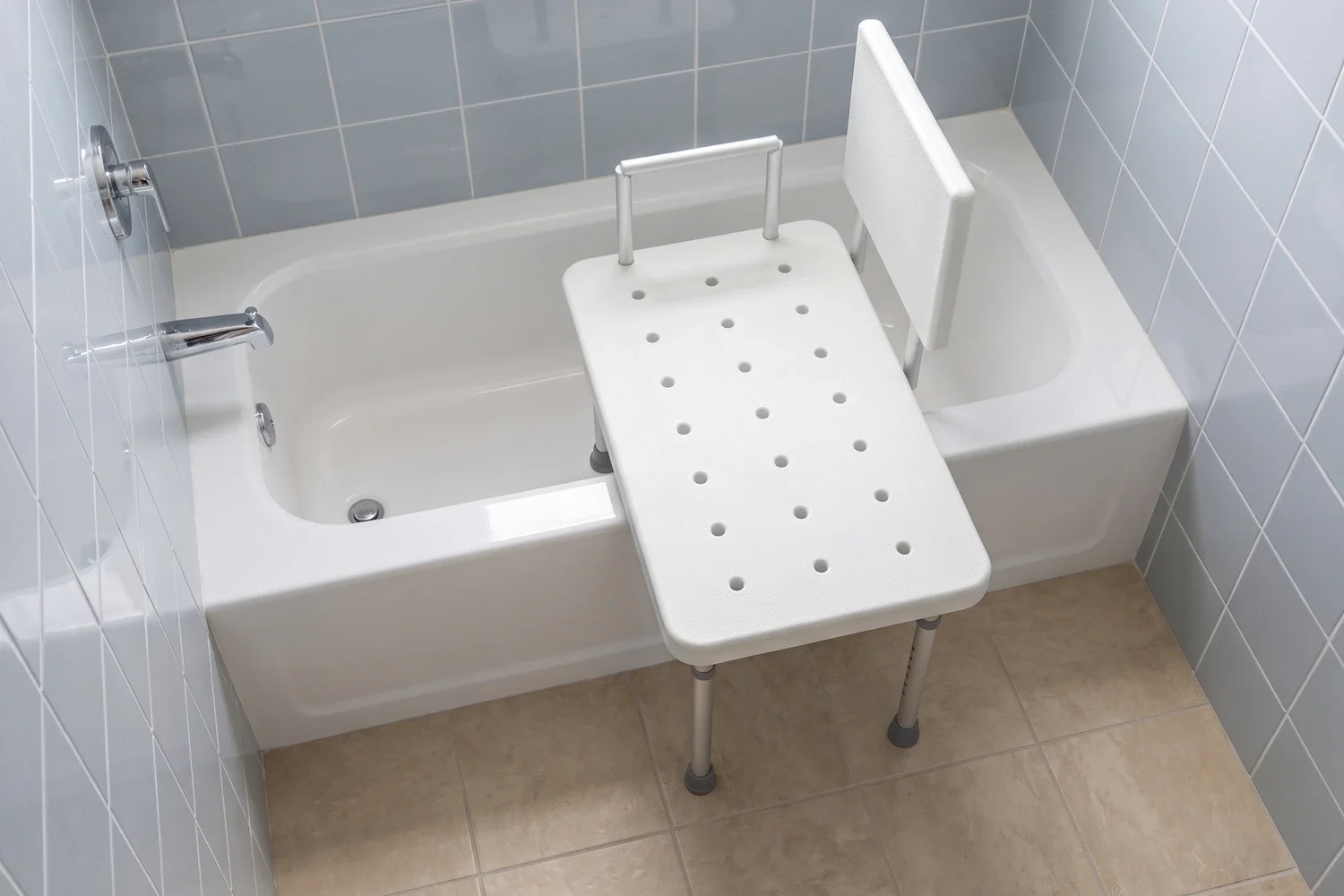
What to measure before you buy
- Floor to the top of the tub wall. The bench seat must clear it with the legs at a height you can still sit on. Compare with the seat height range in the table.
- Width of the tub wall. A wide rim or a tub with a deck needs a longer seat to reach across.
- Inside width of the tub floor, at the bottom, where the two inner legs stand. Curved tubs are narrower at the bottom than at the rim.
- Clear floor beside the tub for the two outer legs, with nothing in the way of the door, toilet or vanity.
- Seat height you need. Sit on a firm chair with feet flat and measure floor to the crease behind the knee. The bench's range should include it, once the legs are set to clear the tub wall.
The shower curtain hangs inside the tub between the inner and outer legs, so it drains into the tub. Some curtains have a slit for this.
Before you buy: measure and compare
From simpleaging.com. This checklist is general information, not medical advice.
Take these measurements with a tape and compare them with the specs in the table.
Measure first
- Floor to the top of the tub wall.
- Width of the tub wall at the top.
- Inside width of the tub floor, at the bottom.
- Clear floor beside the tub for the two outer legs.
- The person’s lower leg: floor to the crease behind the knee, sitting with feet flat.
Features to compare
- Weight limit. The maker’s limit is above the person’s weight, with room to spare for pushing up.
- Seat height range. It includes the leg measurement, with the legs set to clear the tub wall.
- Seat length. Long enough to reach across the wall with room to sit outside the tub.
- Reversible back. The back can go on either end, so the bench suits the side you enter from.
- Handles or arms. Something to hold while you slide and turn.
- Feet. Non-slip rubber tips, or suction cups on the inner legs.
- Drainage. Holes in the seat so water doesn’t pool.
- Assembly. Snaps together without tools, with push-button leg adjustment.
- Extras. A sliding or swivel seat, a seat belt, a cut-out for washing, or a soap dish.
- Curtain plan. You know how the curtain will close: inside the tub between the legs, or a curtain with a slit.
How a transfer bench works
Getting in and out of the tub is where many bathroom injuries happen. The CDC found that injuries linked to getting into and out of the tub or shower “occurred among persons of all ages”, and that about half of all bathroom injuries were precipitated by bathing or showering, slipping, or getting out of the tub or shower [1]. The Public Health Agency of Canada’s home safety guide notes that some bath seats “are specially designed to make it easier to get in and out of the tub” [2]. A transfer bench is one such design.
The move goes like this:
- Sit down on the end of the bench that’s outside the tub, with your back to the tub.
- Hold a handle or a grab bar, lift one leg over the tub wall, then the other.
- Slide across the seat until you’re inside the tub, and turn to face the faucet.
- Wash sitting down, with a handheld shower head. Reverse the steps to get out.
Because you never stand on the tub floor, the wet, slippery part of bathing is done sitting. A grab bar on the wall gives you something fixed to hold during the turn.
When a chair is enough
- You can step over the tub wall comfortably, and the problem is standing under the spray.
- You have a shower stall with a low or no curb. There’s no wall to bridge, so a chair or stool does the job.
- There’s no floor space beside the tub for the bench’s outer legs.
Our shower chairs guide covers the types and how to size one.
Some people choose a bigger change when getting over the tub wall stays hard, such as a walk-in tub. Our walk-in tub cost guide covers prices in Canada.
Costs and funding for transfer benches
There’s nothing to install, so what you pay is the price of the bench. We don’t list prices because they vary by product, store and region.
Canada
United States
Questions to ask
An occupational therapist, physiotherapist or doctor
- Is a bench or a chair the better fit for how I, or my parent, get into the tub?
- Which side should the bench be entered from, given the bathroom layout?
- Would a sliding or swivel seat help, and is a seat belt worth having?
- Is there a safer way to lift my legs over the wall?
A supplier or store
- What is the maker’s weight limit, and what seat height range does the bench have?
- Will the seat clear a tub wall this high, and fit a tub floor this wide? Can I return it if it doesn’t?
- Is the back reversible? Are replacement rubber tips or suction cups available?
- What does the warranty cover?
Safety notes and when to talk to a professional
Level and steady first. The inside legs stand on the tub floor and the outside legs on the bathroom floor, so they’re usually set to different lengths to make the seat level. Adjust, then push down on both ends and rock it. It shouldn’t tip or slide.
Mind the curve. Many tub floors curve up at the sides. Put the inner legs on the flat part.
Water on the floor. If the curtain can’t close inside the tub between the legs, water ends up on the bathroom floor, which is its own slip hazard. Use a curtain with a slit, or one long enough to tuck inside the tub around the legs.
It’s a seat, not a step. Never stand on a transfer bench.
Hot water. Sitting to bathe means more time under the spray. The Public Health Agency of Canada says mixing valves should be set so hot water comes out at no more than 49°C (120°F) [13].
When to talk to a professional. If someone has fallen, feels unsteady or worries about falling, talk to a doctor. A doctor can look for causes and may suggest seeing a physiotherapist or occupational therapist. An occupational therapist can watch how a person gets into the tub and say whether a bench, a chair or a different approach suits them.