Non-slip bathtub and shower options: mats, strips, coatings
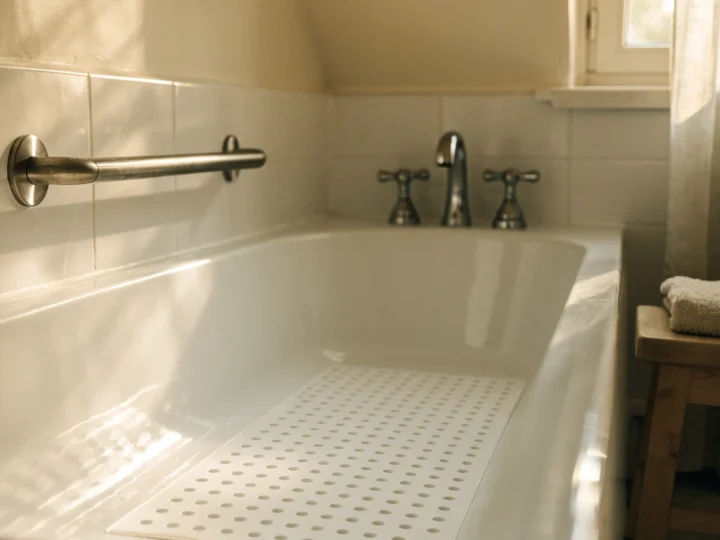
How non-slip bathtub mats, adhesive strips and anti-slip coatings differ, which tub and shower surfaces each one suits, and products sold in Canada and the US.
This article is general information, not medical advice. For advice about your own situation, talk to a doctor, occupational therapist, physiotherapist or other qualified professional. In an emergency, call 911.
Quick answer
There are three common non-slip options for a bathtub or shower floor: a mat, adhesive strips, or a coating or treatment applied to the tub itself. Which one suits depends mostly on the tub’s surface. Suction-cup mats and adhesive strips need a smooth, clean surface, and coatings are made for one kind of tub material and not another. Check the surface first, then read the maker’s instructions [5] [8] [10] [15].
The options at a glance
| Mat | Adhesive strips or treads | Coating or treatment | |
|---|---|---|---|
| What it looks like | 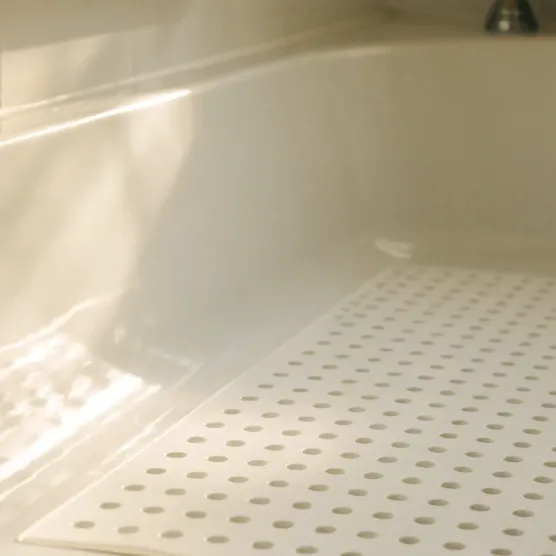 |
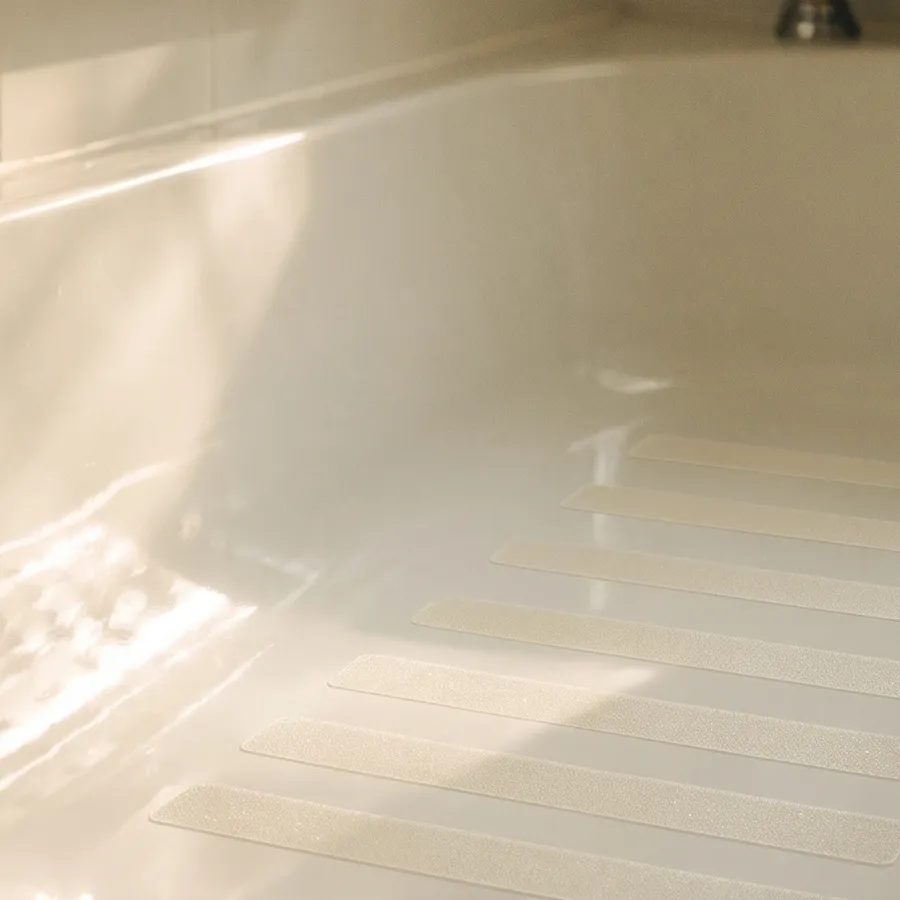 |
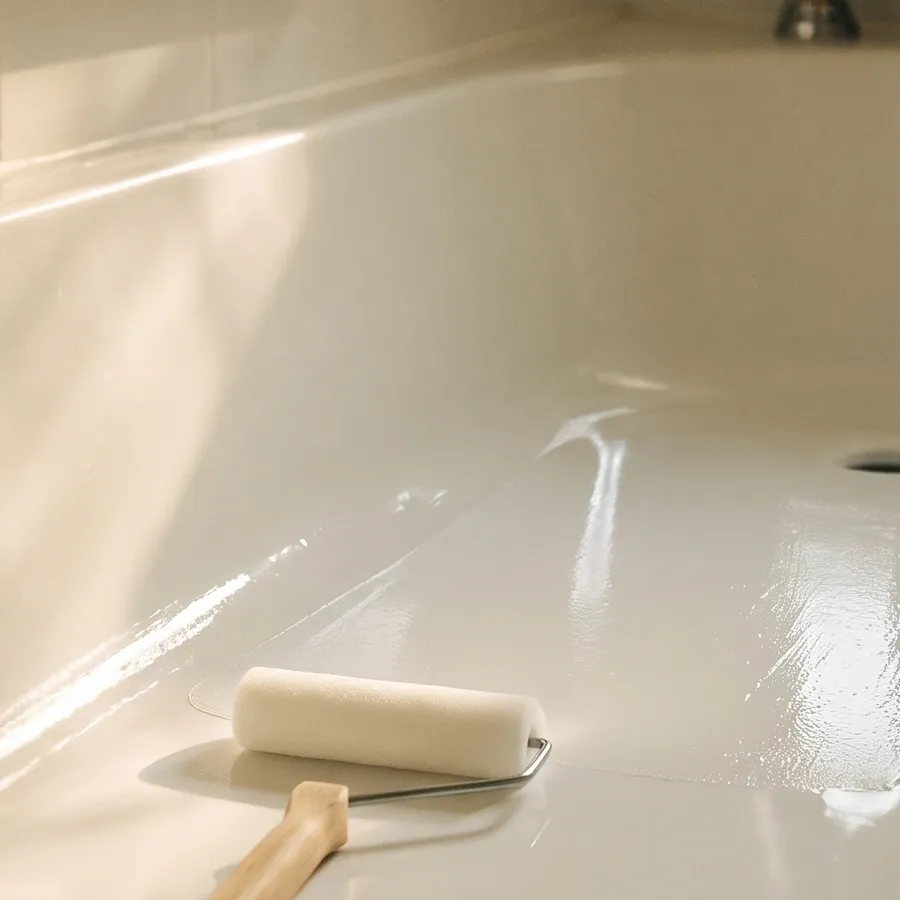 |
| How it grips | Suction cups underneath, or a heavy mat with no suction cups for textured tubs [5] [7] | A textured surface with an adhesive back that sticks to the tub [9] | A clear coating rolled on, or a liquid that etches tiny treads into the surface [11] [15] |
| Surfaces | Suction mats: smooth, non-textured surfaces only [5] [6] | Smooth surfaces; not over grout [8] [10] | Depends on the product: some are for fiberglass and acrylic, others for porcelain, ceramic or enamel but not fiberglass or acrylic [12] [15] |
| Care | Take it out and hang it to dry after use [8] | Stays on the tub until it’s removed. Some bath oils weaken the adhesive [8] | Stays on the tub. Use the cleaners the maker lists [11] [15] |
| Trade-offs | Has to be lifted, cleaned and put back | Removing it takes work, and products used on the leftover adhesive can make the tub slippery [8] | Takes careful preparation. A coating needs 12 to 24 hours to cure. Some products use strong chemicals [11] [13] [16] |
Where to buy non-slip mats, strips and coatings
Hardware stores, pharmacies, home health stores and online stores sell non-slip mats, strips and treatments in Canada and the US. The table lists products whose makers publish which surfaces they’re for and how to care for them. The details come from the makers’ pages and data sheets, linked in the sources. We haven’t tested the products ourselves.
| Option | Type | Surfaces the maker lists | Details | Sold in | Where to buy |
|---|---|---|---|---|---|
| Gorilla Grip Bath Mat, 35 x 16 in [5] | Mat | Smooth, non-textured, non-tiled. Not for newly refinished tubs | Suction cups and drainage holes. Machine washable | Canada and US | See it at Amazon: Gorilla Grip Bath Mat, 35 x 16 in (opens in a new tab) |
| Gorilla Grip Shower Mat, 21 x 21 in [6] | Square shower mat | Smooth, non-textured, non-tiled. Not over grout lines | Sized for stand-up showers. Machine washable | Canada and US | See it at Amazon: Gorilla Grip Shower Mat, 21 x 21 in (opens in a new tab) |
| SlipX Solutions Weighted Bath Mat for Textured Tubs [7] | Weighted mat | Textured tubs and tiled showers, even across grout lines | No suction cups. 3 to 4 times heavier than a standard mat | Canada and US | See it at Amazon: SlipX Solutions Weighted Bath Mat for Textured Tubs (opens in a new tab) |
| 3M Safety-Walk Tub and Shower Tape, clear, 2 in x 15 ft [9] [10] | Strips | Showers and tubs, for wet barefoot areas. Not over grout | A roll you cut to length. Fine-textured vinyl | Canada and US | See it at Amazon: 3M Safety-Walk Tub and Shower Tape, clear, 2 in x 15 ft (opens in a new tab) |
| SlipX Solutions Adhesive Safety Treads [8] | Strips | Smooth surfaces only | Clean with rubbing alcohol first. Wait 12 hours before using the tub | Canada and US | See it at Amazon: SlipX Solutions Adhesive Safety Treads (opens in a new tab) |
| SlipDoctors Tub Grip [11] [12] | Coating | Fiberglass and acrylic tubs and showers | Poured on and spread with a foam roller. Dries glossy. Cures in 12 to 24 hours | Canada and US | See it at Amazon: SlipDoctors Tub Grip (opens in a new tab) |
| SlipDoctors Bathtub and Shower Treatment Kit [14] [15] [16] | Etching treatment | Porcelain, ceramic, enamel, cast iron, steel and stone. Not fiberglass or acrylic | Left on 4 to 8 minutes, then rinsed. Contains acids (see safety notes) | Canada and US | See it at Amazon: SlipDoctors Bathtub and Shower Treatment Kit (opens in a new tab) |
Surfaces and care are the makers' wording. Check your tub's material and texture before you buy.
More options at Amazon: non-slip bath mats (opens in a new tab), bathtub safety treads (opens in a new tab) and anti-slip tub coatings (opens in a new tab).
Before you buy: check the tub or shower
From simpleaging.com. This checklist is general information, not medical advice.
The surface
- You know what the tub or shower floor is made of: fiberglass or acrylic, or porcelain, enamel, cast iron or steel. Coatings and treatments are made for one group and not the other [12] [15]. If you aren’t sure, the tub’s maker or a plumber may know.
- You’ve run your hand over the floor. Suction cups don’t hold as well on textured or uneven surfaces as on smooth ones [8].
- You know whether the tub has been refinished. Some mat makers say not to use their mats on newly refinished tubs [5].
- For a tiled shower, you’ve noted the grout lines. Suction mats and 3M’s treads aren’t meant to go over grout [6] [10].
The person and the routine
- Someone can lift the mat out, hang it to dry and put it back after each bath or shower [8].
- For strips or a coating, there’s a time when the tub can stay unused while it sets: 12 hours for SlipX treads and 12 to 24 hours for Tub Grip [8] [12].
- A grab bar is in place, or planned, for getting in and out [1] [2].
Why the tub floor matters
Injuries in or around the tub or shower had the highest rate in that CDC study [1]. The study’s authors suggest putting non-slip strips in the tub or shower and grab bars inside and outside it [1]. The US National Institute on Aging suggests “nonskid mats, strips, or carpet on all surfaces that may get wet” [2]. The Public Health Agency of Canada’s home safety guide asks, “Do you have non-slip surfaces in the tub or shower?” [3].
A non-slip surface is one part of a safer bathroom. A grab bar gives a hand-hold for stepping in and out, and a shower chair or tub transfer bench takes away the need to stand.
How each one works
Mats
A suction-cup bath mat grips with rows of small suction cups underneath and has drainage holes so water reaches the drain [5]. Gorilla Grip says to install its mats only on smooth, clean, non-textured and non-tiled surfaces [5] [6]. A long mat like the Gorilla Grip 35 x 16 in (opens in a new tab) covers a tub floor [5]. A square mat like the 21 x 21 in model (opens in a new tab) is sized for a stand-up shower [6].
Textured tubs are a problem for suction cups [8]. One answer is a heavy mat with no suction cups. SlipX says its weighted mat (opens in a new tab) is 3 to 4 times heavier than a standard mat and stays put on textured tubs and tiled showers, even across grout lines [7].
Strips and treads
Adhesive strips, also called treads or appliqués, have a gritty or textured top and a sticky back. 3M describes its 200 Series as a fine-textured vinyl for wet, barefoot areas like showers and tubs [9]. The clear roll (opens in a new tab) is cut to length. SlipX’s treads (opens in a new tab) are another option made for smooth tubs [8].
How you put them on matters. SlipX says to clean the tub without a silicone-based cleaner, dry it well, wipe it with rubbing alcohol and wait 12 hours before using the tub [8]. Strips work best on smooth surfaces, and 3M says not to apply its material over grout [8] [10].
Coatings and treatments
The Public Health Agency of Canada notes that there are anti-slip liquids that can be applied directly to the tub to make a non-slip surface [3]. They come in two kinds, made for different tub materials:
- Clear coatings add a layer on top. SlipDoctors’ Tub Grip (opens in a new tab) is a water-based epoxy for acrylic and fiberglass that dries to a glossy finish. The maker says to sand lightly with 220-grit sandpaper first, pour it on, spread it with a foam roller and let it cure 12 to 24 hours [11]. It comes off with lacquer thinner or acetone and a plastic scraper [12].
- Etching treatments react with the surface to make tiny treads in it. SlipDoctors says its Bathtub and Shower Kit (opens in a new tab) is “not a coating that can wear off” and is for porcelain, ceramic, enamel, cast iron, steel and stone, not fiberglass or acrylic [15].
Features to compare
- Surfaces it’s made for. The most important detail. Check smooth or textured, and the tub material, against the maker’s list [5] [7] [15].
- Size and coverage. Measure the flat part of the tub or shower floor. The mats above range from 21 in square to 35 by 16 in [5] [6].
- Care. Whether a mat can go in the washing machine, and which cleaners a strip or coating can take [5] [8] [11].
- Drainage. Holes that let water flow to the drain instead of sitting under the mat [5].
- Removal. How strips or a coating come off later, and what that takes [8] [10] [12].
- Published test results. Few products give them. 3M says its 200 Series is certified “slip-resistant” by the National Floor Safety Institute [10]. SlipDoctors publishes wet friction figures for its treatment kit [15].
Costs and funding for non-slip products
Mats and strips are small purchases. Coatings and treatment kits cost more, and a professional refinishing costs more again. We don’t list prices because they vary by product, store and region.
Canada
United States
Questions to ask
An occupational therapist, physiotherapist or doctor
- Is a non-slip surface enough, or should we also add a grab bar, a seat or a bench?
- Can you watch how the person gets in and out of the tub, and suggest where a grab bar should go?
- Would a walk-in shower or other change help more in the long run?
The store, the maker or a refinisher
- Does this product work on our tub’s material and texture?
- How do I clean it, and which cleaners should I avoid?
- How long before the tub can be used after it’s applied?
- How does it come off, and will removing it damage the finish?
- Is there a safety data sheet? What protection do I need while applying it?
Safety notes and when to talk to a professional
No product prevents every fall. SlipDoctors’ data sheet says its products can’t eliminate all possibility of slip-and-fall accidents [12]. A grab bar and a seat do jobs a non-slip surface can’t [1].
Check the mat before each use. Suction mats need a smooth, clean surface to hold [5]. If a mat slides or curls, don’t use it until it’s fixed or replaced.
Watch what you put in the tub. The Public Health Agency of Canada warns that some tile and bath cleaning products make surfaces more slippery [3]. SlipX says some bath oils weaken the adhesive on treads [8], and SlipDoctors says to avoid cleaners with alcohol or acids on Tub Grip [11].
Clean up well after removing strips. Products used to take off adhesive residue can leave the tub very slippery. SlipX says to clean the tub thoroughly with a cleaner that isn’t silicone-based before anyone uses it [8].
Treat coatings and etching kits as chemicals. The Tub Grip safety data sheet warns it may cause an allergic skin reaction and eye irritation [13]. The safety data sheet for SlipDoctors’ etching formula carries a “DANGER” label and warns it causes serious eye damage [16]. The kit’s data sheet says to use it in a well-ventilated area, lists eye protection, a long-sleeved shirt and the nitrile glove supplied as safety equipment, and says to wash the solution off skin or metal right away [15]. If applying it would be hard for you, ask a family member or a professional refinisher to do it.
Labels aren’t tied to one standard. The US Consumer Product Safety Commission lists the ASTM slip-resistance standard for bathtubs and showers as withdrawn in 2016. It says it aims to work with ASTM to bring it back or develop a new one [4]. So “non-slip” on a package can mean different things. Look for the surfaces the maker lists and any test results they publish.
Outside the tub, too. Bath mats on the floor beside the tub should have a rubberized or non-skid backing [3]. Our home safety checklist covers the rest of the bathroom.
When to talk to a professional. If someone has fallen, feels unsteady or worries about falling, talk to a doctor. An occupational therapist or physiotherapist can look at how they get in and out of the tub and suggest changes, like a grab bar, a seat or a different shower setup.