Grab bars on fiberglass tub-showers and walls without studs
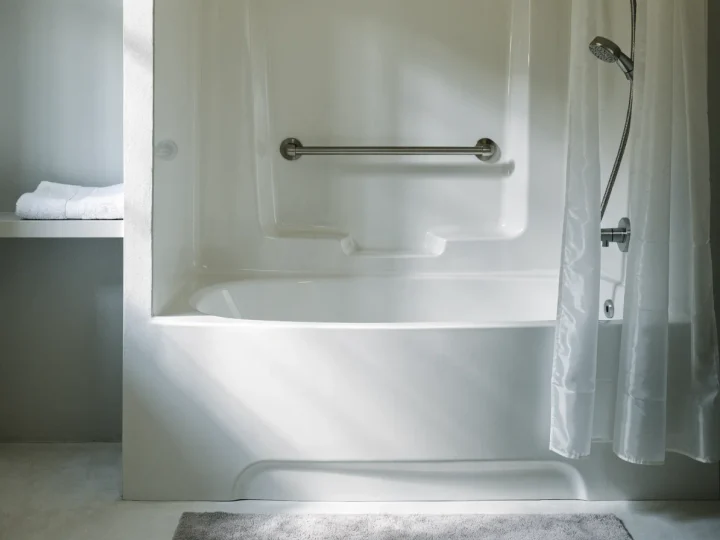
Why a fiberglass or acrylic tub wall can't hold a grab bar alone, and the options: studs, backing, rated anchors, clamp-on rails and floor-to-ceiling poles.
This article is general information, not medical advice. For advice about your own situation, talk to a doctor, occupational therapist, physiotherapist or other qualified professional. In an emergency, call 911.
Quick answer
The walls of a one-piece fiberglass or acrylic tub-shower are a thin shell with a space behind it. The shell alone is too thin to hold a grab bar [1]. A bar can go through the shell into a stud, into wood backing behind the shell, or into anchors rated for fiberglass [1] [3] [4]. A clamp-on tub rail or a floor-to-ceiling pole skips the wall [12]. Ask the tub maker first: Kohler says not to add grab bars to its shower units unless they have “age-in-place backers” [2].
What holds a grab bar on each kind of wall
A grab bar is only as strong as its anchors and the wall it’s mounted on [12]. So the first question is what’s behind the wall.
| Wall | What’s behind it | What can hold a grab bar |
|---|---|---|
| Drywall or tile on wood studs | Studs, usually 16 in apart, with hollow space between them [13] [4] | Screws into the studs. Between studs, an anchor rated for that wall [4], or wood reinforcement added behind it [15] |
| One-piece fiberglass or acrylic tub-shower | A thin shell that touches the stud wall only at the top, with a space behind it [1] | A kit that bridges the gap to a stud [3], solid wood fitted tight to the back of the shell [1], or an anchor rated for that shell [4] [5]. Ask the tub maker first [2] |
| Tub-shower with built-in backers | Backers at set spots, which give the screws solid support [2] | Screws into the backers, at the spots on the maker’s specification sheet [2] [16] |
| The wall just outside the tub or shower | The bathroom wall itself, not the shell | A bar into studs or backing. Canada’s 2025 code puts reinforcement here for prefab tubs and showers [15] |
| No wall you can use | Doesn’t matter | A clamp-on tub rail, or a floor-to-ceiling pole that doesn’t depend on a wall [12] |
Where to buy grab bar anchors and mounting kits
Hardware stores, home health and medical supply stores, and online stores sell these products in Canada and the US. The tables list products whose makers publish their limits and the walls or tubs they fit. The figures come from the makers’ pages and instructions, linked in the sources. We haven’t tested the products ourselves.
| Option | How it holds | Maker's rating | Walls and bars it fits | Sold in | Where to buy |
|---|---|---|---|---|---|
| The Solid Mount grab bar mounting kit (one set per bar) [3] | Into the stud | Tested to more than 300 lb | Fiberglass tubs and showers over wood studs, with the fiberglass face ⅞ to 2⅛ in from the stud. Bars with a 2½ or 3 in flange | Canada and US | See it at Amazon: The Solid Mount grab bar mounting kit (one set per bar) (opens in a new tab) |
| Moen SecureMount Anchor SMA1000CH (pair) [4] | Behind the wall | For people up to 300 lb | ⅛ or ¼ in fiberglass tub surrounds, and drywall. Needs 3½ in of space behind | Canada and US | See it at Amazon: Moen SecureMount Anchor SMA1000CH (pair) (opens in a new tab) |
| HealthCraft Easy Mount Hollow Wall Anchor (one) [5] | Behind the wall | 300 lb | ⅛ to ¼ in fiberglass, and drywall. Needs 3½ in of space behind. HealthCraft bars only | Canada and US | See it at Amazon: HealthCraft Easy Mount Hollow Wall Anchor (one) (opens in a new tab) |
Ratings are the makers' figures, for the walls they list and installed as they instruct.
HealthCraft’s anchor fits only its own grab bars [5], such as the HealthCraft 24 in Easy Mount grab bar (opens in a new tab). HealthCraft rates that bar at 500 lb and the anchor at 300 lb [6] [5]. Moen’s grab bar instructions allow its SecureMount anchors in place of a stud [13].
| Option | Type | Maker's weight limit | Fits, and what the maker says | Sold in | Where to buy |
|---|---|---|---|---|---|
| Carex White Bathtub Rail FGB20400 [7] | Clamp-on tub rail | 200 lb | Flat tub walls 2½ to 5 in wide. Carex calls it ideal for fiberglass tubs | Canada and US | See it at Amazon: Carex White Bathtub Rail FGB20400 (opens in a new tab) |
| Drive Medical Clamp-On Tub Rail 12036 [8] | Clamp-on tub rail | 300 lb | Tub walls 3 to 7 in wide. On fiberglass, don't overtighten: the clamp may crack it | Canada and US | See it at Amazon: Drive Medical Clamp-On Tub Rail 12036 (opens in a new tab) |
| HealthCraft SuperPole SP-S [9] | Floor-to-ceiling pole | 300 lb | Ceilings 93 to 99 in (7 ft 9 in to 8 ft 3 in), with the top plate across a ceiling beam. Not where directly exposed to water | US only | See it at Amazon: HealthCraft SuperPole SP-S (opens in a new tab) |
| Stander Wonder Pole 1100 [10] | Floor-to-ceiling pole | 300 lb | Flat ceilings 7 ft to 9 ft 6 in. Never inside a tub or shower | Canada and US | See it at Amazon: Stander Wonder Pole 1100 (opens in a new tab) |
Weight limits are the makers' figures for a product set up as they instruct.
More options at Amazon: grab bar anchors (opens in a new tab) and stud finders (opens in a new tab).
Before you drill
From simpleaging.com. This checklist is general information, not medical advice.
Go through this list before anyone drills into a tub, shower or wall.
What’s behind the wall
- Studs. Find them with a stud finder. The Solid Mount’s instructions scan the drywall above the tub enclosure and mark each stud [3]. Moen says studs are usually 16 in apart [13].
- Pipes, wires and other things. Moen urges checking for plumbing, electrical lines and other obstructions, like beads of adhesive or ribbing behind some tub surrounds [4].
- Space behind the wall. Moen’s and HealthCraft’s anchors need at least 3½ in [4] [5]. The Solid Mount fits a set range of gaps [3].
- What’s above the ceiling, for a pole. HealthCraft says not to install its pole if you don’t know the structure above the ceiling [9].
Ask the tub or shower maker
- Backers. Does the model have built-in backers for grab bars, and where? Kohler shows backer locations on its specification sheets [2].
- Drilling and the warranty. Is drilling the wall allowed? What does it do to the warranty? MAAX says not following its installation instructions may invalidate the warranty [17].
Choose and install
- A rated product. The anchor or kit is rated for your wall type and thickness, and it fits your bar [4] [5].
- The weight limit. The maker’s limit is above the weight of the person using the bar.
- The maker’s tools. Moen and HealthCraft both call for a 1¼ in hole saw, carbide-tipped for tile [4] [5]. The Solid Mount says not to push hard on the fiberglass while drilling [3].
- Sealed holes. Seal them the way the maker says. The Solid Mount puts silicone around each hole to prevent leaks [3]. HealthCraft puts adhesive tape around the hole on fiberglass [5].
- A pull test. The Solid Mount’s last step is to give the bar a good pull [3].
- Regular checks. Moen says to check the bar from time to time to be sure all screws are secure [4].
Why fiberglass and acrylic walls need care
Many tubs and showers come as one molded piece, walls and all. A design manual from the US Department of Housing and Urban Development (HUD) explains the problem. The wall panels alone are “too thin to support grab bars.” They touch the stud wall only at the top, so there’s a space between the panel and the studs [1].
Drywall is hollow between the studs too [4]. The Public Health Agency of Canada says, “Grab bars must be anchored firmly into the studs in the wall” [11]. Moen’s grab bar instructions say the screws must go into a wood stud, unless you use its SecureMount anchors [13].
Alaska’s Department of Health is stricter about fiberglass. It says tubs with a fiberglass surround have an air gap between the wall and the surround. It says not to install grab bars over these walls, because grab bars must be secured firmly to studs [12].
How strong a grab bar has to be
Building rules set a strength for grab bars, but only in the buildings they cover.
- United States. The 2010 ADA Standards say a grab bar must take a force of 250 pounds (1,112 N), pushing down or sideways at any point. That covers the bar, its fasteners, its mounting and the structure that supports it. The standards apply to new and altered businesses, other public places, and state and local government buildings [14].
- Canada. The 2025 National Building Code says grab bars must resist 1.3 kN (about 290 pounds of force), pushing down or sideways. It sets this for grab bars in larger buildings, and for grab bars installed in houses. Each province and territory decides whether to adopt the code, with or without changes [15].
These rules don’t test the bar in your bathroom. They show what a grab bar installation is expected to take. Some makers rate their anchors against them. Moen says its anchors meet or exceed the ADA and the CSA standards it lists [4], and HealthCraft lists the ADA strength rule on its anchor’s data sheet [5].
Your options, from most to least wall-dependent
1. Into a stud, through the shell
Grab bars can go level, upright or at an angle, so both ends land on studs [12]. On a fiberglass shell, a screw into a stud also has to cross the gap behind the shell [1]. The Solid Mount (opens in a new tab) uses spacers that bridge the gap between the fiberglass and the stud. Its maker says this moves the bar’s load into the wall framing, not the fiberglass [3].
Its instructions drill through the fiberglass with a hole saw, slowly, without pushing hard. Each hole gets a bead of silicone to prevent leaks [3].
2. Solid backing behind the shell
Wood behind the shell gives the screws something solid. HUD’s manual says the blocking must be cut to fit snugly between the studs and the panel. It must touch the panel over the whole reinforced area [1]. Canada’s 2025 code says the same for houses: no gaps are allowed between the reinforcement and the wall material in front of it [15].
In the houses it covers, the 2025 code requires stud walls around toilets, tubs and showers to be reinforced for grab bars, now or later. With a prefab tub or shower enclosure, the code moves that area off the enclosure, to the wall beside its entrance. A note explains that these enclosures “are often not compatible with grab bars that are not fabricated as part of the enclosure” [15]. Provinces and territories decide whether and when to adopt it [15].
3. Anchors made for hollow walls and fiberglass
Some anchors go through a hole in the wall and open up behind it. HealthCraft says its anchor spreads the load onto the wall [5]. Moen (opens in a new tab) and HealthCraft (opens in a new tab) each make one that the maker says can go in fiberglass [4] [5]. The table above shows the walls, space and bars each one needs.
Moen says not to install its anchors in walls or thicknesses it hasn’t approved, in walls that are weakened or damaged, or on a curved surface [4]. Moen and HealthCraft both allow one end of a bar in a stud and the other in an anchor [4] [5].
Not everyone agrees anchors belong in fiberglass. The Solid Mount’s maker says hollow-wall anchors rely on the fiberglass panel itself [3], and Alaska’s guide (above) is against grab bars on these walls at all [12].
4. What tub and shower makers say
Check your tub maker’s instructions before anyone drills.
- Kohler and Sterling. Kohler says grab bars may be added to a shower unit “only if it has age-in-place backers.” Without them, “the wall alone will not be able to provide adequate support” [2]. Sterling sells some bath/showers “with Aging in Place backerboards.” The spec sheet for one says: “Attach grab bars at the specified backerboard locations only.” [16]
- MAAX. A MAAX installation guide says that if you add a grab bar, “additional framing or backing may be needed for support.” It also says that not following its instructions may invalidate the warranty [17].
For other brands, ask the maker whether your model has backers, and whether drilling affects the warranty.
5. Options that don’t use the wall
Clamp-on tub rails grip the side wall of the tub. Alaska’s guide says they can help when stepping in and out of a tub, and when getting up from a toilet next to it [12]. Makers don’t agree about fiberglass tubs:
- Carex calls its bathtub rail (opens in a new tab) “ideal for use on fiberglass tubs” [7].
- Drive Medical says to use extreme care with its clamp-on rail (opens in a new tab) on a fiberglass tub, and not to overtighten, because the clamp may crack the fiberglass [8].
- HealthCraft says its own clamp-on tub rail can’t be installed on fiberglass tubs [18].
So check what the maker says about your kind of tub. Clamp-on rails can also loosen. Alaska’s guide says to check the tightening nut and rubber pads often [12].
Floor-to-ceiling poles stand between the floor and the ceiling. The Public Health Agency of Canada says these poles, “securely installed,” can help steady you getting out of bed or dressing [11]. The HealthCraft SuperPole (opens in a new tab) and the Stander Wonder Pole (opens in a new tab) are held by pressure against the ceiling, with no drilling. Both can also be screwed into the ceiling joists [9] [10]. Alaska’s guide prefers poles fixed at the floor and ceiling, because friction alone is often not enough [12].
Stander says never to put its pole inside a tub or shower [10]. HealthCraft says not to put its pole where it’s directly exposed to water, and places it beside a bathtub with the base against the tub [9]. Both makers say not to install these poles on an angled ceiling [9] [10]. Neither pole is meant to carry a person’s full weight. HealthCraft says its pole isn’t, and Stander says its pole gives “minimal to moderate weight support” [9] [10].
Suction-cup bars
Suction-cup bars hold on by suction. Alaska’s Department of Health says to avoid them: they can let go at random, which makes them a fall danger. Makers may say they’re only for steadying, but a person who slips grabs whatever is there [12]. That’s why they’re not in our tables.
Costs and funding for grab bar installation
What you pay depends on the product and the work it needs. Prices vary by product, store and region, so we don’t list them. Ask for a written quote that includes installation.
Canada
United States
Questions to ask
A contractor or installer
- What’s behind this wall: studs, backers, a gap, pipes or wires?
- Can the bar go into studs through the shell? Or on the regular wall just outside the tub?
- Can solid wood backing be added behind the shell? Would that mean opening a wall?
- If you use anchors, are they rated for this wall and this thickness? What do the makers say the finished bar can hold?
- Will you follow the tub, anchor and grab bar makers’ instructions, seal the holes and test the bar?
- Is labour in the written quote?
The tub or shower maker
- Does my model have backers for grab bars? Where are they?
- Can I drill through the wall? Does that affect the warranty?
- Do you sell grab bars or kits made for this model?
An occupational therapist or physiotherapist
- Where would a grab bar help most: at the tub entrance, on the back wall or outside the tub?
- Would a clamp-on rail, a pole, a transfer bench or a shower chair help, instead or as well?
- What height suits the person? Our grab bar height guide shows the code heights.
Safety notes and when to talk to a professional
Check what’s in the wall first. Moen says to consult a professional if the area to be drilled has electrical, plumbing or other obstructions [4].
Stay inside each maker’s limits. Use only the walls and thicknesses the maker lists [4]. When a bar and its anchors have different ratings, the lower one is the limit. Moen’s grab bar instructions mention a 500 lb weight pull capacity [13], but its anchor instructions limit use to people weighing no more than 300 lb [4].
Keep checking. Check now and then that bars aren’t loosening [12]. Drive says its tub rail often needs retightening, so check it before use [8]. HealthCraft says to inspect its pole monthly, and Stander says to check its pole daily [9] [10].
Towel bars and soap dishes aren’t grab bars. The Public Health Agency of Canada says, “Towel racks or soap dishes should never be used for support!” [11]
Avoid suction-cup bars. Alaska’s Department of Health advises against them, and says grab bars need to be securely attached into studs, or to a piece of wood that is securely attached to the studs [12].
Get help if you need it. HealthCraft suggests a qualified contractor for its pole if you’re not equipped to do the work [9].
When to talk to a professional. If someone has fallen, feels unsteady or worries about falling, talk to a doctor. A doctor can look for causes and may suggest seeing a physiotherapist or occupational therapist. An occupational therapist can watch how a person gets in and out of the tub and suggest where a grab bar, rail or pole would help.