Rollator size chart: seat height, handle height and weight limits
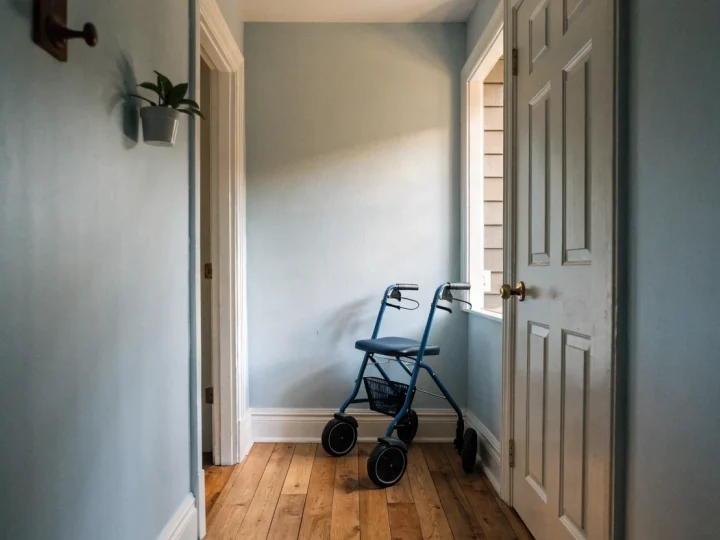
How to measure for a rollator, and a size chart built from makers' specs: seat heights from low to tall, handle height ranges and weight limits.
This article is general information, not medical advice. For advice about your own situation, talk to a doctor, occupational therapist, physiotherapist or other qualified professional. In an emergency, call 911.
Quick answer
Two measurements decide whether a rollator fits. The handles should be level with the crease of your wrist when you stand up straight with your arms relaxed [2] [3]. The seat should let you sit with your feet on the floor [3] [4]. Many rollators come in more than one height, and the chart below compares the makers’ seat heights, handle heights and weight limits.
Have the fit checked
A rollator suits some people and not others. A review in American Family Physician says it isn’t appropriate for people with significant balance problems or problems with memory and thinking [2]. Another review in the same journal calls it the least stable type of walker. It can slide out from under a person when the brakes aren’t on [1]. A physiotherapist or occupational therapist can say whether a rollator suits the person, set the handles to the right height and show how to sit and stand safely. Our guide to rollators, walkers and canes explains the differences between the types.
How to measure for a rollator
Wear the shoes you usually walk in. A helper and a tape measure make this easier.
- Handle height. Stand up straight with your shoulders relaxed and your arms hanging at your sides. Measure from the floor to the crease of your wrist. That’s the handle height to look for [2] [3].
- Seat height. Find a firm chair you can sit on with your back against the backrest, your feet flat on the floor and your knees bent at about a right angle. That’s how NOVA’s instructions describe a rollator seat that fits [4]. Measure the chair’s seat height from the floor, and look for a rollator seat close to that height.
- Weight. Note the user’s weight, to compare with each maker’s weight limit.
- Doorways. Measure the narrowest doorway or hallway the rollator must pass through, to compare with its open width.
Some rollators have a seat that can’t be raised or lowered. The Canadian Red Cross’s instructions say that if the seat is too high or too low, a different size of walker may be more appropriate. You should be able to sit “with the balls of your feet touching the ground” [3].
Rollator size chart and where to buy
Pharmacies, home health stores and online stores sell rollators in Canada and the US. In Ontario, the Assistive Devices Program pays part of the cost only for a rollator bought through a registered business after you apply, so read Costs and funding before you buy [6].
The chart lists rollators whose makers publish the seat height, handle height and weight limit. It’s sorted by seat height, lowest first. The figures come from the makers’ pages, linked in the sources. We haven’t tested these products. Some rollators are sold in more than one height under the same name, so check the model number before you order.
| Option | Seat height | Handle height | Maker's weight limit | Details | Sold in | Where to buy |
|---|---|---|---|---|---|---|
| Stander Wonder Rollator, Short 4330 [8] | 17 in | 27 to 30 in | 250 lb | Weighs 13.5 lb. 25 in wide. 6 in wheels. Stander says it fits most users 4 ft 9 in to 5 ft 3 in tall | Canada and US | See it at Amazon: Stander Wonder Rollator, Short 4330 (opens in a new tab) |
| Drive Medical Nitro Sprint Rollator, Hemi 102662BL-H [9] | 18 in | 29 to 33 in | 350 lb | Weighs 19 lb. 18 in wide seat. 10 in front wheels | Canada and US | See it at Amazon: Drive Medical Nitro Sprint Rollator, Hemi 102662BL-H (opens in a new tab) |
| Drive Medical Nitro DLX Rollator RTL10266 [10] | 20 in | 33.5 to 38.5 in | 300 lb | Weighs 22 lb. 18 in wide seat. 10 in front wheels | Canada and US | See it at Amazon: Drive Medical Nitro DLX Rollator RTL10266 (opens in a new tab) |
| Vive Health Lightweight Rollator MOB1079 [11] | 21 in | 31 to 36 in | 300 lb | Weighs 14 lb. 24 in wide. 14 in wide seat. 6 in wheels | US only | See it at Amazon: Vive Health Lightweight Rollator MOB1079 (opens in a new tab) |
| Stander Wonder Rollator, Standard 4350 [8] | 22 in | 33 to 36 in | 250 lb | Weighs 14.5 lb. 26.5 in wide. 6 in wheels. Stander says it fits most users 5 ft 4 in to 6 ft 3 in tall | Canada and US | See it at Amazon: Stander Wonder Rollator, Standard 4350 (opens in a new tab) |
| Medline Heavy-Duty Bariatric Rollator MDS86800XW [12] | 22 in | 31.5 to 37.5 in (overall height) | 400 lb | Weighs 19 lb. 29 in wide, with 23.5 in inside the frame. 8 in wheels | Canada and US | See it at Amazon: Medline Heavy-Duty Bariatric Rollator MDS86800XW (opens in a new tab) |
| Drive Medical Nitro Sprint Rollator, Tall 102662BL-T [9] | 23 in | 32 to 39.4 in | 350 lb | Weighs 19.5 lb. 18 in wide seat. 10 in front wheels | Canada and US | See it at Amazon: Drive Medical Nitro Sprint Rollator, Tall 102662BL-T (opens in a new tab) |
Seat heights, handle heights and weight limits are the makers' figures. Medline lists an overall height range for its rollator, which changes with its height-adjustable arms.
More options at Amazon: rollators with a seat (opens in a new tab).
Some makers sell one rollator in several heights. Drive’s Nitro Sprint comes as a Hemi with an 18 in seat, a Standard with a 21 in seat and a Tall with a 23 in seat [9]. Stander’s Wonder Rollator comes in a Short size with a 17 in seat and a Standard size with a 22 in seat, and Stander says which user heights each size fits [8].
What height should a rollator be?
The handles should be at the height of your wrist crease when you stand up straight with your arms relaxed at your sides [2] [3]. Holding the handles at that height, your elbows bend a little. The 2011 American Family Physician review gives 15 to 30 degrees [2], and NOVA’s instructions say 20 to 30 degrees [4].
NOVA’s instructions say how to check the setting. Stand upright behind the rollator, with your arms at your sides and your feet in line with the back wheels. Then adjust the height until the handles are even with your wrists [4].
The rollators in the chart adjust their handles over a range, so check that your wrist height falls inside it. If it doesn’t, look for a short or tall version of the model.
How high should a rollator seat be?
NOVA describes a seat height that lets you sit safely and comfortably with your back resting on the backrest, your feet flat on the ground and your legs at a 90 degree angle [4]. The Canadian Red Cross says you should be able to sit with the balls of your feet touching the ground [3].
Compare the seat height you measured at home with the chart. If no seat in a model’s range is close, look at the same maker’s low or tall version.
Weight limits and other sizes to compare
- Weight limit. Use the maker’s figure for the exact model number. Limits in the chart run from 250 lb to 400 lb. The Medline model is a heavy-duty (bariatric) rollator, with a 400 lb limit and 23.5 in of space inside the frame [12].
- Basket and bag. NOVA’s instructions give a 10 lb limit for the basket on its rollator [4]. The Canadian Red Cross warns not to overload the basket or use it to store heavy items such as oxygen tanks [3].
- Seat width. Vive lists a 14 in wide seat, and Drive an 18 in wide seat on its Nitro models [11] [9] [10].
- Open width. Compare it with your narrowest doorway. The rollators in the chart whose makers list it are 24 to 29 in wide [11] [12].
- Rollator weight and folded size. These matter if someone has to lift it into a car. The chart runs from 13.5 lb to 22 lb [8] [10]. Stander lists a folded size of 11 by 10 in for its Wonder Rollator [8].
- Wheel size. The chart runs from 6 in wheels to 10 in front wheels [8] [9]. Ask the supplier which size suits the ground the person walks on, indoors and out.
Rollator fit checklist
From simpleaging.com. This checklist is general information, not medical advice.
Take this list to the store, or use it when the rollator arrives.
Before you buy
- A doctor, physiotherapist or occupational therapist has talked about whether a rollator suits the person. American Family Physician advises that clinicians check a device’s fit and use [1].
- You’ve measured the wrist crease height [2] [3], wearing everyday shoes, and it falls inside the model’s handle range.
- The seat height is close to the height of a chair where the person sits with feet flat and knees at about a right angle [4].
- The maker’s weight limit is above the person’s weight.
- The open width fits through the doorways at home.
- You’ve checked whether a program will pay part of the cost, and whether it needs an assessment first [6] [5].
When it arrives
- Both handles are set to wrist height at the same setting, and their buttons and knobs are secure [4].
- With both brakes locked, the person sits with their back on the backrest and their feet on the floor [4] [3].
- The brakes slow the rollator and lock for parking. NOVA’s instructions say not to use the rollator if the brakes aren’t working correctly [4].
Costs and funding for rollators
Prices vary by model, store and region, so we don’t list them. Some programs pay part of the cost.
Canada
United States
Questions to ask
A physiotherapist, occupational therapist or doctor
- Is a rollator the right type of walker for this person?
- What handle height and seat height should we look for?
- Can you check the fit, and show us how to sit down and stand up with it?
- Will the person’s needs change as they recover?
The store or supplier
- What are the exact seat height and handle range for this model number? Is there a short or tall version?
- What is the maker’s weight limit, and what does the rollator weigh?
- How wide is it when open, and how small does it fold?
- Can we try it in the store, and are brake parts and wheels available later?
- In Ontario: are you registered with the Assistive Devices Program? [6] In the US: are you enrolled in Medicare, and will you accept assignment? [5]
Safety notes and when to talk to a professional
Lock the brakes before sitting or standing. The Canadian Red Cross and NOVA both say to lock the brakes before using the seat [3] [4]. American Family Physician adds that the rollator should be against a wall or other solid object before the person sits [2].
It’s not a wheelchair. Don’t move the rollator, or let anyone push it, while someone is sitting on it [3] [4]. NOVA’s instructions also say not to sit on the rollator on a slope [4].
It isn’t built to take your weight. American Family Physician says a rollator shouldn’t be used for weight-bearing, and that it suits people who don’t need the walker to support their weight [1]. When sitting down, NOVA says not to put your full body weight on the handles [4].
Stay off stairs and escalators. Both the Canadian Red Cross and NOVA say not to use a rollator on stairs or escalators [3] [4]. Our guide to making stairs safer covers railings and lighting.
Clear the way at home. Our home safety checklist goes room by room, and our guide to preparing a home after a hospital stay covers the first weeks home.
When to talk to a professional. If someone has fallen, feels unsteady or worries about falling, talk to a doctor. A physiotherapist or occupational therapist can watch how a person walks, check whether a rollator suits them and set it to the right height.