How high should a handheld shower be? A guide for showering seated
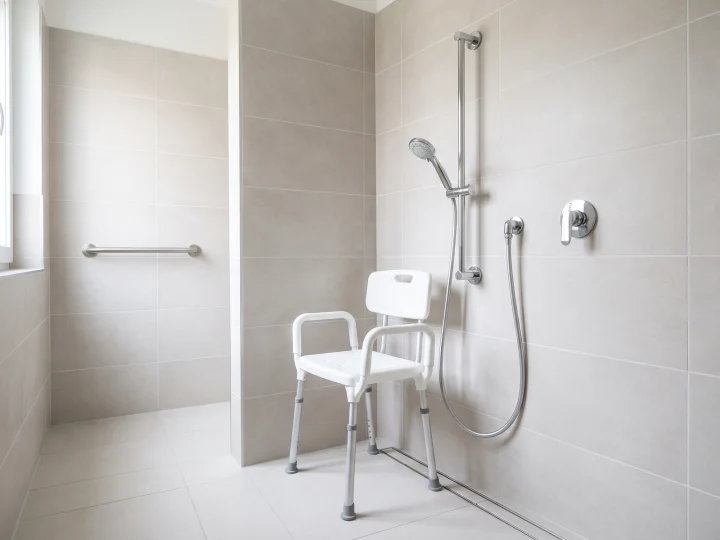
Where to put a handheld shower or slide bar so it reaches from a shower chair, the hose length building codes ask for, on/off buttons, and models compared.
This article is general information, not medical advice. For advice about your own situation, talk to a doctor, occupational therapist, physiotherapist or other qualified professional. In an emergency, call 911.
Quick answer
For showering seated, the handheld shower should rest in its holder where the person can reach it from the shower seat. Canada’s National Building Code asks for a hand-held shower in accessible showers that can be reached from a seated position and used in a fixed position at 1,200 mm (about 47 in) and at 2,030 mm (about 80 in) [1]. The US 2010 ADA Standards put the shower spray unit 38 to 48 in (965 to 1,220 mm) above the floor in a transfer shower [2]. A slide bar lets one holder move between a seated height and a standing height.
Code heights are a guide, not a rule for your home
These code numbers were written for accessible showers in public and larger buildings. Canada’s National Building Code says its accessible shower rules don’t apply to houses, including duplexes, townhouses and row houses, or to showers inside apartments. It’s also a model code: each province and territory decides whether to adopt it, with or without changes [1]. The ADA Standards set the minimum for public places, businesses and government buildings [2]. We use their numbers as a starting point because they say where a handheld shower should go for someone who showers seated. An occupational therapist can watch the person in their own bathroom and say where the holder, the controls and the seat should go.
Types of handheld showers at a glance
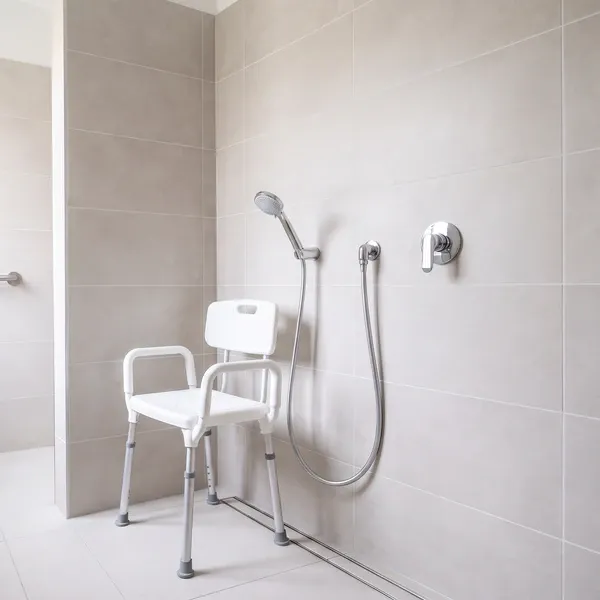
A handheld shower is a shower head on a long hose. You can hold it in your hand or rest it in a holder. The Public Health Agency of Canada says hand-held shower heads “can make showering easier, especially if you’re using a bath seat” [3]. The main difference between types is where the holder goes.
| On the shower arm | On a wall holder | On a slide bar | |
|---|---|---|---|
| What it looks like | 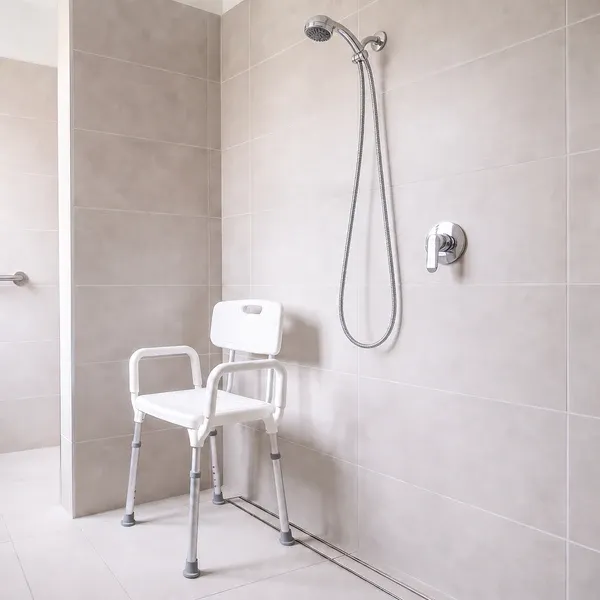 |
 |
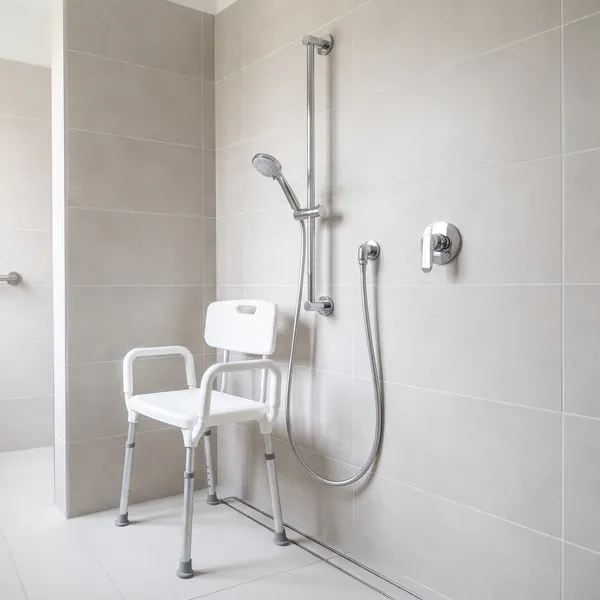 |
| How it’s fitted | The holder screws onto the shower arm in place of the fixed shower head [21]. Some come with a diverter instead, so you can keep the fixed head too [23] | A holder screwed into the wall at the height you choose | A bar screwed into the wall at both ends. The holder slides up and down the bar [14] |
| Where the holder sits | High on the wall, where the shower head was | Where it’s installed, for example within reach of the seat | Anywhere along the bar |
| Showering seated | The holder may be out of reach from the seat, so the handheld is taken down first | Can be placed within reach of the seat | Slide the holder down to reach it from the seat, and up for standing |
| Installing | Usually by hand, with no drilling [15] [22] | Drilling into the wall | Drilling into the wall, with screws into a stud or anchors in a hollow wall [14] |
| Example | Moen DN8001CA (opens in a new tab) | Ask the store for a wall holder that fits the handheld | Moen 3667EP (opens in a new tab) |
Holders and slide bars that stick on with suction cups or adhesive aren’t in this guide. Whatever the type, hold a grab bar, not the handheld, its holder or its hose, when you sit down or stand up (see Safety notes).
Where to buy a handheld shower
Hardware stores, plumbing suppliers, home health stores and online stores sell handheld showers in Canada and the US. If you have a Medicare Advantage plan, check its extra benefits before you buy (see Costs and funding).
The table lists handheld showers whose makers publish the hose length and how the shower mounts. It’s sorted by hose length, shortest first. The figures come from the makers’ pages and spec sheets, linked in the sources. We haven’t tested these products. None of them mounts with suction cups.
| Option | Hose length | On/off control | How it mounts | Details | Sold in | Where to buy |
|---|---|---|---|---|---|---|
| Moen 3868EP handheld with slide bar [8] [9] | 59 in | None | Slide bar screwed into the wall. Needs a wall outlet | 24 in bar. 1 spray setting. 1.75 gpm | Canada and US | See it at Amazon: Moen 3868EP handheld with slide bar (opens in a new tab) |
| Moen 3667EP handheld with slide bar [10] [11] | 69 in | None | Slide bar screwed into the wall. Needs a wall outlet | 30 in bar. 4 spray settings. 1.75 gpm | Canada and US | See it at Amazon: Moen 3667EP handheld with slide bar (opens in a new tab) |
| Moen 3671EP handheld with slide bar [12] [13] | 69 in | Pause (slows to a trickle) | Slide bar screwed into the wall. Needs a wall outlet | 30 in bar with a height lever. 5 spray settings. 1.75 gpm | Canada only | See it at Amazon: Moen 3671EP handheld with slide bar (opens in a new tab) |
| Drive Medical AquaSense 770-980 [16] [17] | 80 in | On/off switch | Holder on the shower arm, in Drive's photo. No tools | 3 spray settings, set with a dial | Canada and US | See it at Amazon: Drive Medical AquaSense 770-980 (opens in a new tab) |
| Moen Home Care DN8001CA [20] [21] | 84 in | Pause | Holder screws onto the shower arm | 4 functions. 1.75 gpm. White | Canada and US | See it at Amazon: Moen Home Care DN8001CA (opens in a new tab) |
Hose lengths, spray settings and flow rates are the makers' figures. Moen's slide bar kits connect the hose to a separate wall outlet, which Moen calls a drop ell and sells separately. Flow rates are maximums, in US gallons per minute (gpm). Moen says the 3671EP's pause slows the water to a trickle. It doesn't say what the DN8001CA's pause does.
Of the slide bar kits in the table, only Moen’s 3671EP has a pause button.
How high should a handheld shower be?
It depends on who uses the shower and whether they sit or stand.
- For someone who sits to shower, the holder should be where they can reach it from the seat without standing, leaning far or twisting. Canada’s code asks for a hand-held shower that “can be reached from a seated position” and can be used in a fixed position at 1,200 mm (about 47 in) [1]. The ADA Standards cover a transfer shower, a 36 by 36 in (915 by 915 mm) shower with a seat. There, the shower spray unit goes on the wall facing the seat, 38 to 48 in (965 to 1,220 mm) above the floor [2].
- For someone who stands, the same handheld also has to work as an overhead shower. Canada’s code asks that it can be used in a fixed position at 2,030 mm (about 80 in) as well [1].
- For a household with both, a slide bar or a second holder lets the handheld sit at either height. The Public Health Agency of Canada says a hand-held shower head can be installed with two or three mounting positions, “allowing it to be used by standing or seated bathers” [3].
The controls matter too. If the person can’t reach the tap from the seat, they have to stand to turn the water on or off. Canada’s code puts the shower controls no higher than 1,200 mm (about 47 in) above the floor and within reach of the seat [1].
What is the standard height of a hand shower?
There isn’t one for homes. The closest thing is the building code figures for accessible showers, shown side by side in this height chart. Canada’s figures are from the National Building Code 2025 [1], and the US figures are from the 2010 ADA Standards [2]. Inches and millimeters in brackets are our conversions, except where the code gives both.
| What | Canada: National Building Code 2025 | US: 2010 ADA Standards |
|---|---|---|
| Hose length | At least 1,800 mm (about 71 in) of flexible hose | At least 59 in (1,500 mm) |
| Handheld, for a seated person | Can be reached from a seated position, and can be used in a fixed position at 1,200 mm (about 47 in) | In a transfer shower: on the wall facing the seat, 38 to 48 in (965 to 1,220 mm) above the floor. In a roll-in shower: above the grab bar, and no higher than 48 in (1,220 mm) |
| Handheld, as an overhead shower | Can be used in a fixed position at 2,030 mm (about 80 in) | Can be used as a fixed shower head as well as a hand-held one |
| Shower controls | No higher than 1,200 mm (about 47 in), within reach of the seat. Usable with one hand in a closed fist, without tight grasping, pinching or twisting the wrist | Same height as the spray unit. Usable with one hand, without tight grasping, pinching or twisting the wrist |
| On/off control on the handheld | Not stated | Required, with a “non-positive shut-off”. Makers use the term for a pause that slows the water to a trickle [7] (see the on/off button) |
| Slide bar | The handheld must not get in the way of the grab bars | A bar for an adjustable-height shower head must not get in the way of the grab bars |
| Shower seat height | 460 to 480 mm (about 18 to 19 in) | 17 to 19 in (430 to 485 mm) |
| Hot water | No temperature in the shower rules, which ask for a pressure-equalizing or thermostatic mixing valve. The Public Health Agency of Canada suggests mixing valves set to 49°C (120°F) [4] | 120°F (49°C) at most from the spray unit |
| Bathtub with a shower | At least 1,800 mm of hose, usable in a fixed position at 1,200 mm and 2,030 mm | At least 59 in of hose, with an on/off control. A slide bar must not get in the way of the grab bars |
Working it out for one slide bar. The two heights in Canada’s code are 830 mm (about 33 in) apart: 2,030 mm minus 1,200 mm. So if one slide bar is to hold the handheld at both heights, its holder has to slide at least that far. The slide bars in the table are 24 in and 30 in (610 and 760 mm) long [9] [11], so neither covers both heights. Set the bar where the low end can be reached from the seat, and it will reach as high as its length allows. Another way is a second holder. The Public Health Agency of Canada mentions shower heads installed with two or three mounting positions [3].
Measure from the seat
From simpleaging.com. This checklist is general information, not medical advice.
Do this with the shower chair or bench in place and the water off. A helper and a tape measure make it easier.
Sitting on the shower seat
- Set the seat to the height it will be used at. For comparison, the ADA Standards put shower seats 17 to 19 in (430 to 485 mm) above the floor [2], and Canada’s code 460 to 480 mm (about 18 to 19 in) [1].
- Sit as you would to wash. Reach toward the wall where the holder will go, without leaning or twisting. Have the helper mark the highest point you can reach comfortably, and measure it from the floor. A holder at or below that mark is one you can reach from the seat.
- Reach for the shower tap. If you can’t reach it from the seat, ask a plumber about moving the controls or adding a second outlet. Canada’s code puts the controls within reach of the seat [1].
- Measure from where the hose will connect, on the shower arm or a wall outlet, to the floor in front of the seat. Check that a hose that long would reach your feet and your back while you sit. Compare with the hose lengths in the table.
On the wall
- Mark where the grab bars are, or where they will go. Both codes say the handheld or its slide bar must not get in the way of the grab bars [1] [2].
- Find out what the wall is made of, and where the studs are. Slide bars and wall holders screw into the wall: into a stud, or with anchors in a hollow wall [14].
- Check the tap: can the person turn it with one hand, without a tight grip or twisting the wrist? That’s what both codes ask of shower controls [1] [2].
The water
- Check the hot water temperature at the tap. The Public Health Agency of Canada says mixing valves on showers and tubs should be set to allow hot water of 49°C (120°F) [4].
How long should a handheld shower hose be?
Canada’s code asks for at least 1,800 mm (about 71 in) of hose in accessible showers and bathtubs [1]. The ADA Standards ask for at least 59 in (1,500 mm) [2]. The handhelds in the table have hoses from 59 to 84 in. The 59 in and 69 in hoses meet the US figure but are shorter than the Canadian one.
Where the hose connects makes a difference. A handheld that hangs from the shower arm starts high on the wall, so the hose has to reach all the way down to the feet of someone sitting. On Moen’s slide bar kits in the table, the hose connects to a separate wall outlet instead of the shower arm. Moen calls it a drop ell and sells it separately [12]. To check, measure from the connection point to the floor in front of the seat, as in the checklist.
Do you need an on/off button on a handheld shower?
An on/off or pause button on the handle lets someone stop the spray without reaching for the tap, for example while soaping up or while getting on or off the seat. The ADA Standards ask for an on/off control on the spray unit with a “non-positive shut-off” [2]. The standards don’t explain the term. American Standard describes its pause button as a “non-positive shut-off button on handle” that “reduces flow to a trickle” [7].
So a pause button usually slows the water rather than stopping it. Vive says its pause function doesn’t completely stop the water. It slows it to a trickle and keeps the water temperature setting, and Vive suggests using it while getting in or out so you can turn the water off at the tap safely [15]. When you’re done, turn the water off at the tap.
Check how the button works before you buy. Ask whether it slides, presses or turns, and whether the person can work it with wet, soapy hands.
Can you add a handheld shower to the shower you already have?
Often, yes. The Public Health Agency of Canada calls hand-held shower heads “relatively easy to install” [3]. There are two common ways.
- On the shower arm. Many handhelds replace the fixed shower head. Moen’s and Vive’s instructions say to unscrew the old head, wrap the threads of the shower arm with thread seal tape, and screw the holder onto the arm [22] [21] [15]. Some come with a diverter instead, a valve that lets you switch between the fixed shower head and the handheld [23].
- On a slide bar or wall holder. These screw into the wall. Moen’s slide bar instructions give two ways. Where there’s a stud, wood screws go into it. Where there isn’t, a toggle anchor goes through a 5/8 in hole into a hollow wall 1/2 to 1 1/2 in thick [14]. Our guide to grab bars on walls without studs explains studs, tile and fiberglass walls.
Moen’s instructions for its home care handheld also say to install it with a certified backflow preventer at the shower hose inlet, “as required by the local plumbing code”, and to ask a plumbing professional what that code requires [22]. A backflow preventer stops shower water from flowing back into the water pipes.
Can a slide bar be used as a grab bar?
No, unless the maker says it is one. Moen lists its slide bars as “not to be used as a grab bar” [12], and Delta’s spec sheet for its slide bar hand shower says the same [24]. The Public Health Agency of Canada says grab bars must be anchored firmly into the studs [3], and both codes say the shower’s handheld or slide bar must not get in the way of the grab bars [1] [2]. Holders and bars that stick on with suction cups or adhesive aren’t in our table. Our guide to grab bar heights shows where shower grab bars go.
Features to compare
- Hose length. Canada’s code asks for at least 1,800 mm (about 71 in) and the ADA Standards for at least 59 in [1] [2]. Measure from where the hose will connect.
- Where it mounts. On the shower arm, a wall holder or a slide bar. Some slide bar kits need a separate wall outlet for the hose [10].
- Slide bar length. The bars in the table are 24 in and 30 in long [9] [11]. A longer bar leaves more room between the seated and standing heights.
- On/off or pause control. Ask what it does and whether the person can work it with one hand [7] [15].
- Holder angle. Moen’s spec sheets say its slide bar holders rotate to change the angle of the handheld, and Vive says its bracket’s angle adjusts for hands-free showering [11] [15].
- Backflow protection. Moen and Delta list check valves in the handheld [11] [19]. Check valves keep water from flowing back into the pipes.
- Spray settings. From 1 to 5 in the table, and some add a pause. Drive’s are changed with a dial [16], and some other handhelds use push buttons [18]. Check that the person can change the setting with one hand.
Costs and funding for handheld showers
Prices vary by model, store and region, so we don’t list them. A handheld that screws onto the shower arm needs no wall work. A slide bar or wall holder means drilling, and a plumber costs extra if the controls or the water outlet have to move.
Canada
United States
Questions to ask
An occupational therapist, physiotherapist or doctor
- Should this person shower sitting down, and on what kind of seat?
- Where should the holder and the controls go so they can be reached from the seat?
- Can the person grip the handheld and press its on/off button?
- Is the hot water a risk, for example because of numbness in the feet or hands?
The store, installer or plumber
- How long is the hose, and how does the handheld or slide bar mount: on the shower arm, or screwed into the wall?
- Will the slide bar or holder go into studs, or does the wall need anchors? Will it be clear of the grab bars?
- Can the shower controls be reached from the seat, or do they need to move?
- What does the on/off button do: stop the water fully, or slow it to a trickle?
- Can the water temperature be limited with a mixing valve? [4]
Safety notes and when to talk to a professional
Don’t hold on to the handheld, its holder or a slide bar. The Public Health Agency of Canada warns that towel racks and soap dishes should never be used for support, and says grab bars must be anchored firmly into the studs [3]. Moen and Delta both say their slide bars are not to be used as grab bars [12] [24]. Our guide to grab bar heights shows where shower grab bars go.
Check the temperature before you sit under the spray. The Public Health Agency of Canada suggests setting the water heater to 60°C (140°F) to stop bacteria such as Legionella from growing, and installing mixing valves on showers and tubs set to allow hot water of 49°C (120°F) [4]. Its home safety checklist asks whether you test the water temperature before you get into the tub or shower [3].
Sit on a seat made for the shower. The Public Health Agency of Canada says a hand-held shower head is easier to use with a bath seat [3]. Our guides to shower chairs and tub transfer benches explain the types, and our bathroom safety guide covers non-slip floors, grab bars and lighting.
When to talk to a professional. If someone feels unsteady in the shower, has fallen, or is coming home from hospital, ask their doctor about an occupational therapy assessment. An occupational therapist can watch how the person washes, say whether to sit, and set the seat, the holder and the controls where they can reach them.