Medical alert systems in the US: costs, types and Medicare
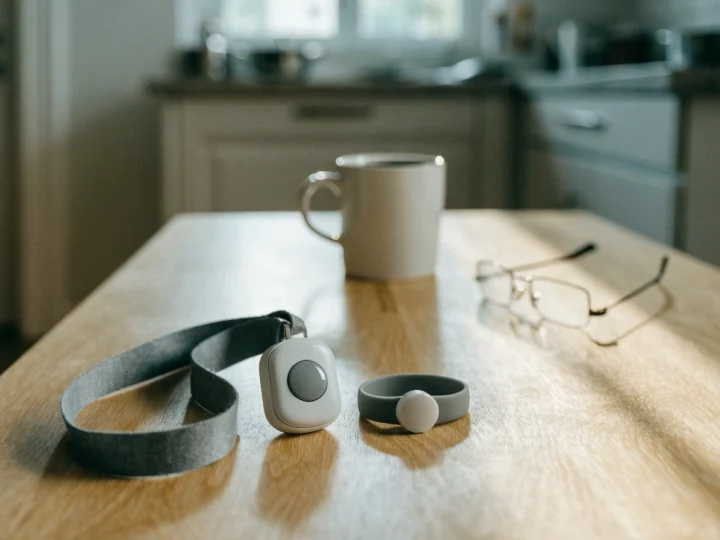
How medical alert systems work in the US, monthly fees from six companies' published plans, what fall detection can't do, and what Medicare covers.
This article is general information, not medical advice. For advice about your own situation, talk to a doctor, occupational therapist, physiotherapist or other qualified professional. In an emergency, call 911.
Quick answer
A medical alert system, also called a personal emergency response system (PERS), lets you call for help by pressing a button you wear. With a monitored plan, the call goes to a 24/7 monitoring center that can reach your family or 911. The plans in our table cost US$27.95 to US$44.99 a month, before extras such as fall detection. Original Medicare doesn’t pay for them [1], but some Medicare Advantage plans, Medicaid programs and the VA may. Fall detection can call for help on its own, but no company in our table says it catches every fall.
In Canada? Our guide to medical alert systems in Canada covers the providers and programs there.
The types at a glance
| In-home system | Mobile system with GPS | Smartwatch | Call buttons with a pager | |
|---|---|---|---|---|
| What it looks like | 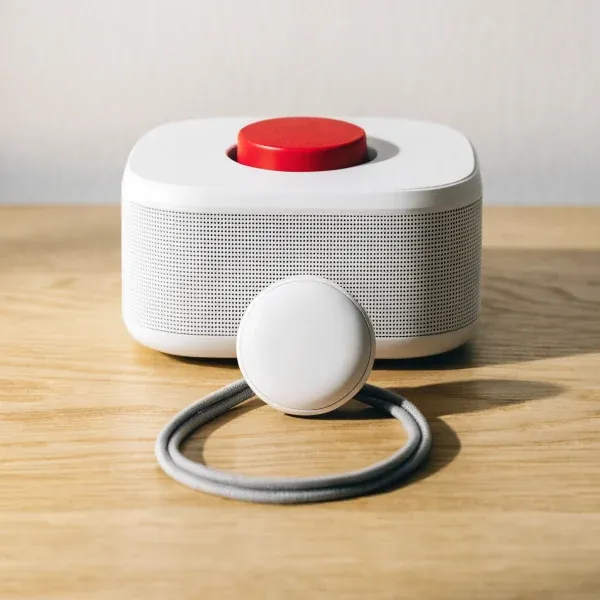 |
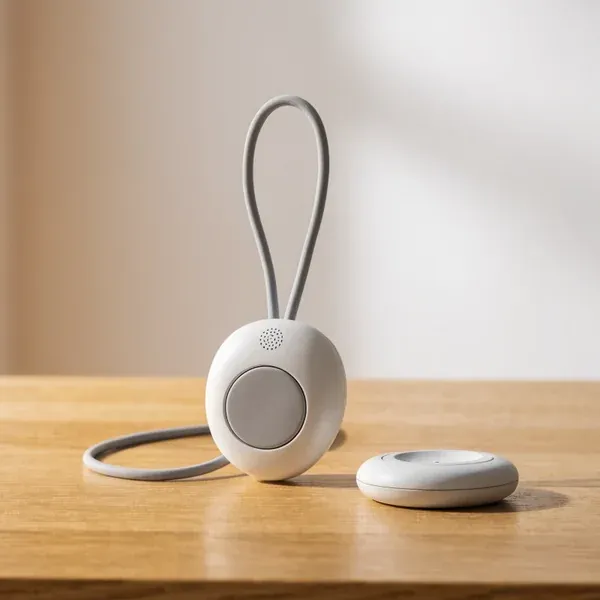 |
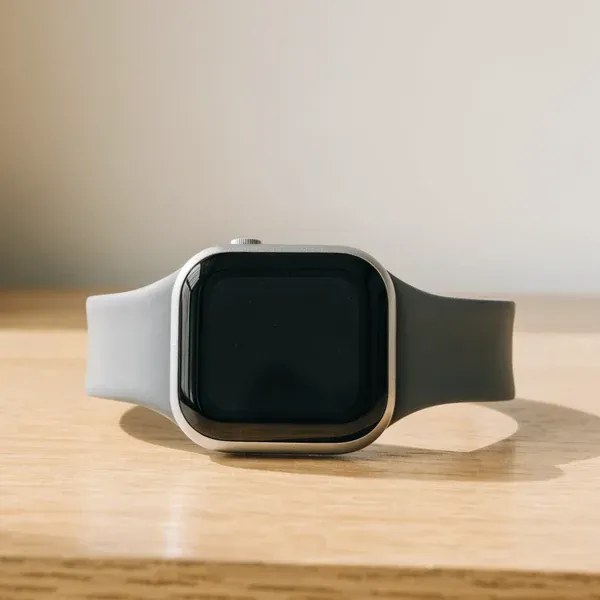 |
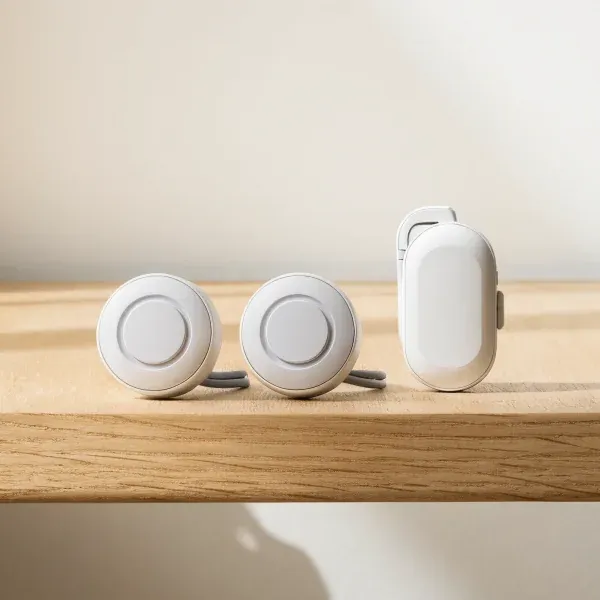 |
| Where it works | At home, near a base unit. The companies below list ranges from 200 to 1,400 ft [2] [3] | Where there’s cellular service [4] | Through your paired phone. Some cellular models work on their own, with a plan [5] | In the home, within range. Up to 300 ft for the one below [6] |
| Who gets the call | A monitoring center, 24/7 | A monitoring center, 24/7 | 911, your contacts or both, depending on the watch [7] [8] | The person carrying the pager |
| How it connects | A base unit on a landline or the cellular network | Cellular, with GPS for your location | Your phone, or the watch’s own cellular plan | A radio signal from the button to the pager |
| Fall detection | Extra on five of the six plans below: US$5 to US$10 a month | Included on one plan below. Extra on four: US$5 to US$10 a month | On some Apple and Samsung watches [7] [8] | No |
| Monthly cost | US$27.95 to US$39.99 on the plans below | US$34.95 to US$44.99 on the plans below | No monitoring fee. A cellular plan for the watch costs extra | None |
| Charging | The base plugs in. Some buttons last years without charging [9] | Makers list from daily charging to up to 10 days a charge [10] [11] | Apple lists up to 18 hours for its SE 3 [5] | Batteries |
Where to buy a medical alert system
You can sign up online or by phone. The table lists six companies that serve the whole US, post their month-to-month and one-time fees online, and say what fall detection costs or whether it’s included. For each, it shows the lowest-priced in-home plan and the lowest-priced mobile plan with GPS. The figures come from each company’s own plan and order pages, linked in the sources. We read them on October 23, 2026. Prices and offers change often, so check before you sign up. We haven’t tested these services.
| Option | In-home plan, a month | Mobile plan with GPS, a month | Fall detection | One-time fees and contract | Sold in | Where to buy |
|---|---|---|---|---|---|---|
| Bay Alarm Medical: SOS Home and SOS All-In-One 2 [12] [13] [14] [15] | US$27.95 with a landline, US$34.95 cellular | US$34.95, plus US$149 for the device (US$89.40 on sale) | US$10 a month extra. The in-home fall button has a US$30 device fee | No activation fee. Shipping is US$15 unless an offer covers it. Its agreement asks for 30 days' written notice to cancel | US only | See plans at Bay Alarm Medical: Bay Alarm Medical: SOS Home and SOS All-In-One 2 (opens in a new tab) |
| One Call Alert: Classic and Elite [16] [17] [18] [19] | US$29.95, landline or cellular | US$41.95 | US$10 a month extra | No equipment or activation fee. US$12.50 shipping on monthly plans. 3-month minimum | US only | See plans at One Call Alert: One Call Alert: Classic and Elite (opens in a new tab) |
| MobileHelp: Classic Home and Elite [20] [21] [22] [23] | US$29.95, landline or cellular | US$37.95 | US$10 a month on the home system. Not priced online for the Elite | Free activation and shipping. 3-month minimum | US only | See plans at MobileHelp: MobileHelp: Classic Home and Elite (opens in a new tab) |
| Alert1: EZ Care and LifeBeacon [24] [25] [11] [26] | US$29.99 with a landline, US$39.99 cellular (EZ Care Plus) | US$44.99 | US$5 a month extra | No equipment or activation fee. Free shipping. Cancel any time by returning the equipment | US only | See plans at Alert1: Alert1: EZ Care and LifeBeacon (opens in a new tab) |
| Medical Guardian: MGHome and Guardian Flex [27] [28] [29] [30] [31] [32] | US$31.95 with a landline, US$38.95 cellular | US$44.95 | US$10 a month extra | US$149.95 equipment for MGHome. The Guardian Flex device was shown free with a promo code. US$12.50 shipping. 3-month minimum | US only | See plans at Medical Guardian: Medical Guardian: MGHome and Guardian Flex (opens in a new tab) |
| Aloe Care Health: Essentials and Mobile Companion 2 [33] [34] | US$39.99, cellular | US$44.99 | Included with Mobile Companion 2. Not part of Essentials | US$199.99 (Essentials) or US$149.99 (Mobile Companion 2) for the hardware. No contract. 30-day money-back guarantee | US only | See plans at Aloe Care Health: Aloe Care Health: Essentials and Mobile Companion 2 (opens in a new tab) |
Month-to-month fees as each company listed them on October 23, 2026, before tax and add-ons. Several companies charge less a month if you pay for a year ahead. Where a company's pages disagreed, we used its order page.
Life Alert. Many people say “Life Alert” for any medical alert. Life Alert is one company, and its website doesn’t list prices. Its cost page says the price “varies based on your specific needs” and asks you to call for a quote [35].
Smartwatches and the equipment below are bought once, with no monitoring fee. Each is sold on Amazon in the US and Canada. None of them connects to a monitoring center.
| Option | Phone it works with | Fall detection | Battery, maker's figure | Sold in | Where to buy |
|---|---|---|---|---|---|
| Apple Watch SE 3 (GPS, 40 mm) [5] [7] | iPhone 11 or later | Turns on by itself for people 55 and over who entered their age. Calls emergency services, then messages your contacts | Up to 18 hours | Canada and US | See it at Amazon: Apple Watch SE 3 (GPS, 40 mm) (opens in a new tab) |
| Samsung Galaxy Watch9 (Bluetooth, 40 mm) [36] [37] [8] | Android phones | Off until you turn it on in the Galaxy Wearable app. Sends SOS messages to your contacts | Up to 40 hours, or 30 with the always-on display | Canada and US | See it at Amazon: Samsung Galaxy Watch9 (Bluetooth, 40 mm) (opens in a new tab) |
Specs are the makers'. These are the versions without their own cellular service: they reach help through the paired phone or Wi-Fi. Versions with cellular service need their own wireless plan.
| Option | Type | How it helps | Details | Sold in | Where to buy |
|---|---|---|---|---|---|
| Smart Caregiver Call Buttons with Standalone Pager TL-5102TP [6] | Call buttons with a pager | Rings a pager that someone at home carries. Doesn't call 911 or a monitoring center | Two call buttons. Up to 300 ft range | Canada and US | See it at Amazon: Smart Caregiver Call Buttons with Standalone Pager TL-5102TP (opens in a new tab) |
| Master Lock 5400D Portable Lock Box [38] | Key lock box for a door knob | Holds a house key for responders | Set-your-own 4-digit code. 6¼ × 3¼ × 1½ in | Canada and US | See it at Amazon: Master Lock 5400D Portable Lock Box (opens in a new tab) |
| Master Lock 5401D Wall Mount Lock Box [39] | Key lock box for a wall | Holds a house key for responders | Set-your-own 4-digit code. Inside: 3¼ × 2¼ × 1 in | Canada and US | See it at Amazon: Master Lock 5401D Wall Mount Lock Box (opens in a new tab) |
Specs are the makers'.
More options at Amazon: smartwatches with fall detection (opens in a new tab), caregiver pagers (opens in a new tab) and key lock boxes (opens in a new tab).
Questions to ask a medical alert company
From simpleaging.com. This checklist is general information, not medical advice.
Print this list and keep it by the phone when you call.
The service
- Where is your monitoring center? Who answers when I press the button, and how fast?
- Who do you call: my family, 911 or both? Can I choose the order?
- What happens if I can’t speak?
- Do you offer other languages?
- Does the mobile device work everywhere I go, including when I travel in other states?
The equipment
- Does it need a landline, or does it use the cellular network? Which network, and is the signal good where I live?
- How far from the base unit does the button work? Can we test it in every room and the yard?
- How long does the battery last, and how will I know it’s low?
- Can I wear it in the shower?
- Is fall detection included, or extra? How do I need to wear it?
- Is there a lock box, or a way to give responders a key?
- Is there an app for family, and what does it cost?
Costs and contract
- What is the monthly fee? What will it be after a sale or the first months end?
- Are there equipment, activation or shipping fees? Is tax extra?
- Is there a contract? How do I cancel, and do I get a refund for months I’ve paid ahead?
- Do I rent the equipment or own it? What if it’s lost or damaged?
- Is there a trial period?
- Does my Medicare Advantage plan, Medicaid waiver or VA benefit work with your company?
Testing
- How often should we test it, and how?
How a medical alert system works
CMS describes a personal emergency response system as “an electronic device that enables waiver participants to secure help in an emergency,” with a button you can wear. It’s set to signal a response center staffed by trained professionals when you press the button [40].
Alert1 describes the steps for its systems this way [24] [11]:
- You press the button.
- A trained agent answers, and you talk through the base unit’s speaker. Alert1 lists an average of 28 seconds to reach live help.
- The agent calls the people you chose, emergency services or both.
- The agent stays on the line until help arrives.
If you can’t talk, Alert1 says it will still send help [11].
In-home systems
A base unit sits in your home and plugs into the wall. You wear a button around your neck or on your wrist. When you press it, the base calls the monitoring center, and you talk through its speaker.
The button only works near the base. The companies in our table list ranges from up to 200 ft (Aloe Care) to up to 1,400 ft (Medical Guardian and MobileHelp) [2] [3] [20]. Test it in every room and in the yard.
Some base units use a landline, like Alert1’s EZ Care [24]. Others use the cellular network, like Bay Alarm’s SOS Home Cellular [12]. Our guide to medical alerts without a landline explains the cellular options and what to check about coverage. It was written for Canada, but the checks are the same.
Mobile systems with GPS
A mobile system puts everything in one small device you wear, with its own speaker. It uses the cellular network, so it works away from home too. MobileHelp lists AT&T coverage for its Elite [22], and Medical Guardian lists Verizon for its Guardian Flex [31]. Ask which network a device uses, and check the signal where the person lives and goes.
Smartwatches
Some smartwatches can call for help with no monitoring plan. They call 911 or send a message to your contacts. No monitoring center is involved.
- Apple Watch. After a hard fall, if you don’t move for about a minute, it calls emergency services. Then it sends a message with your location to your emergency contacts. Fall detection turns on by itself for people 55 and over who entered their age [7]. The Apple Watch SE 3 (opens in a new tab) needs an iPhone 11 or later [5].
- Samsung Galaxy Watch. Fall detection is off until you turn it on. If you don’t respond for 60 seconds, it sends an SOS message to the contacts you chose [8]. Samsung says the Galaxy Watch9 (opens in a new tab) needs a network connection to notify your contact [36].
Away from your phone, a watch may need its own cellular service. Apple says its fall detection needs a cellular connection or Wi-Fi calling from the watch or a nearby iPhone [7].
Some monitoring companies also sell a watch with their monitoring. Bay Alarm lists its SOS Smartwatch at US$39.95 a month, plus US$199 for the watch (US$159.20 on sale) [12]. Medical Guardian lists its MGMove at US$49.95 a month [41].
Call buttons with a pager
This is the simplest type. Press a call button, and a pager that someone in the home carries goes off. It doesn’t call anyone outside the home. Smart Caregiver lists a range of up to 300 ft for its system, and says it “is not a substitute for direct visual monitoring by caregiver” [6].
Automatic fall detection and its limits
Some devices can call for help on their own after a fall. Alert1 says its fall detection measures “speed, impact, and lack of movement” [11]. It usually costs extra: US$5 to US$10 a month on the plans in our table.
No company in our table says it catches every fall. In their own words:
- Bay Alarm Medical: “It should only be used as a backup plan and should not be relied on 100%” [15].
- Medical Guardian: “Fall Detection does not detect 100% of falls” [3].
- MobileHelp: “It may not detect every fall and may sometimes send a false alert” [42].
- One Call Alert: its fall button “does not detect 100% of falls” [4].
- Aloe Care Health: “not guaranteed to detect all falls” [33].
- Apple: “Apple Watch cannot detect all falls” [7].
- Samsung: “A Galaxy Watch cannot detect all falls” [8].
The companies also give these tips:
- Press the button anyway. One Call Alert says that if you’re able, always push the help button when you need help [4].
- Wear it the way the company says. Medical Guardian says to wear its fall detection only around the neck [3], and Bay Alarm says its All-In-One 2 detects falls best worn around the neck [43]. MobileHelp says fall detection works best worn outside your clothes [42].
- Expect some false alarms. Apple says high-impact activity can set off its fall detection. If the watch calls emergency services by mistake, Apple says not to hang up. Wait for a responder and explain that you don’t need help [7].
Features to compare
- Range from the base unit. Listed ranges run from up to 200 ft to up to 1,400 ft [2] [3]. A company’s pages may not agree, so test the button where you’ll use it.
- Battery and charging. Mobile devices need regular charging: Aloe Care suggests daily, Bay Alarm lists up to 72 hours for its All-In-One 2, and Alert1 up to 10 days for its LifeBeacon [10] [43] [11]. Some in-home buttons last years: Bay Alarm lists 5 years and MobileHelp over 5 years [9] [42]. In a power cut, base units run on a backup battery: up to 32 hours at Bay Alarm and Medical Guardian, about 30 at MobileHelp and 4 to 6 at Aloe Care [9] [3] [42] [44].
- Water. Many buttons can be worn in the shower, but base units usually can’t get wet. MobileHelp says its base stations and wall buttons aren’t waterproof, and Medical Guardian says its base station isn’t water-resistant [42] [3].
- The monitoring center. Bay Alarm says its centers are in Utah and Idaho [12]. MobileHelp says its monitoring is done by a partner, Affiliated Monitoring [45]. Ask where calls are answered and what languages are offered: Bay Alarm lists 180 languages [46].
- Contract and canceling. Medical Guardian, MobileHelp and One Call Alert have a 3-month minimum [32] [23] [19]. Bay Alarm’s agreement asks for 30 days’ written notice [13]. Alert1 says you can cancel any time by returning the equipment, but it doesn’t refund prepaid annual plans, with some exceptions [26]. Aloe Care says it has no contracts [34].
- Renting or buying the equipment. Some plans lend you the equipment, and you send it back when you cancel. Bay Alarm’s SOS Home base is leased free [12], and One Call Alert’s equipment is included while you subscribe [4]. Other plans charge for the device, like Aloe Care’s hardware and Bay Alarm’s mobile device [33] [14].
- A way in for responders. Bay Alarm sells a lock box for US$30, Medical Guardian rents one for US$2.99 a month, and MobileHelp includes one with an annual plan [47] [27] [20]. You can also buy one, like the two in the table above.
- An app for family. Bay Alarm includes its caregiver app with its mobile devices [48]. Ask what the app shows and what it costs.
What medical alerts cost
The plans in our table cost US$27.95 to US$39.99 a month for an in-home system, and US$34.95 to US$44.99 for a mobile system with GPS. Fall detection usually adds US$5 to US$10 a month. Some plans add a one-time fee for the device or shipping, and some add monthly fees for extras such as a lock box or a second button.
Paying for a year ahead often lowers the monthly price. Medical Guardian, for example, lists its MGHome Landline at US$31.95 month to month and US$27.95 a month on an annual plan [27]. Check the refund rules first: Alert1 doesn’t refund annual plans if you cancel early, with some exceptions [26].
Does Medicare cover medical alert systems?
Original Medicare doesn’t. Some other programs may pay for one, usually only when a care plan or a clinician says it’s needed.
| Program | Does it pay for a medical alert? | Where to ask |
|---|---|---|
| Original Medicare (Parts A and B) | No. Medicare’s equipment list denies “Telephone Alert Systems” [1] | Not covered, so there’s nothing to claim |
| Medicare Advantage (Part C) | Some plans do, as an extra benefit [49] | Your plan’s member services, or Medicare’s Plan Finder [50] |
| Medicaid home and community-based waivers | In states that offer it, for people who’d otherwise need a nursing home’s level of care [51] [40] | Your state Medicaid office or Area Agency on Aging |
| The VA | Case by case, when a VA clinician finds it’s part of your treatment [52] | Your VA health care team |
| Area Agency on Aging | May have home safety funds for people 60 or older [53] | The Eldercare Locator, 1-800-677-1116 [53] |
| IRS medical expense deduction | Medical alerts aren’t named in the IRS guide [54] | A tax professional |
Questions to ask
For the company, use the checklist above.
A doctor, occupational therapist or physical therapist
- Would a medical alert help me, and which type fits my day?
- Is fall detection worth adding for me?
- Can you show me how to get up from the floor? Researchers who followed people over 90 said people need training in ways to get up from the floor [57].
- If a program needs it, can you put in writing why I need a medical alert?
Your Medicare plan, Medicaid office or VA
- Does my plan or program cover a medical alert? Which company and device does it use?
- Is there a copay or a monthly fee I pay myself?
- What do you need from my doctor, if anything?
Family and the people on the call list
- Who will be on the list, and will they answer at night?
- Who has a key, or should we use a lock box?
- Does the person who will wear it agree to it?
If the family is also thinking about a camera, our guide to cameras in a parent’s home covers consent and privacy.
Safety notes and when to talk to a professional
Wear it, and use it. A study in the UK followed 110 people over 90 for a year. Most of those who fell could not get up on their own at least once. Call alarms were widely available, but they weren’t used in most of the falls that led to a long time on the floor [57].
Test it. Test it after setup and as often as the company says. Bay Alarm and MobileHelp suggest once a month [58] [42]. Tell the operator it’s a test.
Keep it charged. A mobile device only works when it has power. Make charging part of your routine, and learn how your device shows a low battery.
Check the water rating. Wear it in the shower only if the company says you can, and keep the base unit dry.
Mind the cord. Lifeline warns that “any cord worn around the neck can pose a strangulation risk” [59]. Use the cord or band that came with the device, and ask the company about a wrist button if that’s a worry.
Keep your details up to date. Tell the company when phone numbers, door codes or health details change.
When to talk to a professional. If someone has fallen, feels unsteady or worries about falling, talk to a doctor. A doctor can look for causes and may suggest seeing a physical therapist or occupational therapist. An occupational therapist can see how a person manages at home and suggest changes, equipment or a call system that suits them. Our home safety checklist goes room by room, and our guide to preparing a home after a hospital stay covers the first weeks home.